▶ VIDEO — youtube.com/embed/RZ_tT2xIsbA?feature=oembed
▶ VIDEO — youtu.be/RZ_tT2xIsbA
How I Completely Transformed My Street Photography (12 Years Later)
What’s poppin’, people? It’s Dante, currently going for a beautiful walk here in Philadelphia.
Check it out. City Hall, standing tall.
And yeah, today I’m thinking about my journey as a photographer and how I’ve completely transformed over a decade of photography.
How I Started Photography
In the beginning of my journey, I photographed here in my hometown, Philadelphia, of course, learning classically on film.
My first camera was actually a Nikon FM and a 50mm lens. I picked it up from a mom-and-pop shop here in Chestnut Hill.
And yeah, from there I would walk the streets, go in the woods, and take pictures of things.
I think naturally, because I live in the city, I’ve always gravitated towards street photography.
It was never something I learned through some sort of YouTube video or whatever.
I genuinely just kind of hit the streets and made pictures of things and people originally.
Eventually, I dove deeper into what street photography is, learning about the history and things like this.
And I learned that my great-uncle Bill owned a Leica M3.
He passed that down to me, and so I started to hit the streets and learn.
Eventually, I went on YouTube, social media, and websites, trying to discover different techniques or cameras to use.
And I learned about the Ricoh GR from the Eric Kim blog.
I remember picking up the Ricoh GR II in 2015.
And honestly, ever since I picked up that camera and hit the streets in Baltimore, where I studied in school, I pretty much started to dial in my photography.
It completely transformed everything for me.
How the Ricoh GR Changed Everything
The technical aspect of choosing your camera and finding the gear that works for you is a pretty significant detail.
I think what happened is, shooting with film was just a burden.
It was something that slowed me down because I produce ruthlessly.
And then once I had a compact camera that I could slip in my pocket and just photograph endlessly, it opened up this ability for me to advance much more rapidly.
One of the things specific about using the Ricoh that completely transformed my workflow was walking the streets of West Baltimore.
Specifically, in these neighborhood communities where there are no photographers, there are no tourists.
It actually helped me a lot because I could present myself as a human being firstly, and then I could take out my camera and be a photographer secondarily.
This approach of roaming these neighborhoods, interacting with people, and then practicing my photography really taught me the game.
You know, the game of engaging with the world in my own unique way.
Beyond Sidewalk Strolling
I learned how to make pictures here in Philly, kind of just roaming the streets.
I call it sidewalk strolling.
You know, like what I’m doing now.
Think of the classic Garry Winogrand, just strolling the sidewalk, photographing the people in perfect stride, walking towards you.
I mean, this kind of shit is just level one.
You kind of just walk and take pictures of people.
But then when you really get into the weeds of shit and start going to places where there are no photographers, where there maybe aren’t that many people, and there are what I call scenes, that’s when the game really elevates.
You find more scenes.
You find people just hanging out on their front porch.
That’s when you really have to step it up and actually learn how to engage with the medium in a nuanced way.
I stopped running and gunning.
I started spending a lot more time engaging with people and photographing.
And through that act of learning how to engage with people and gaining trust from others with my camera, I started to really enhance my photography.
I just exponentially grew.
I think it’s because I had the ultimate challenge of photographing in a community like West Baltimore, in Sandtown-Winchester.
I mean, it’s probably one of the most difficult places to practice street photography in the world, honestly.
So it taught me.
And it’s wild to learn that way because it really does throw you into the chaos.
Photography as Adventure and Exploration
From there, I traveled to Israel and studied abroad in Jerusalem.
I photographed the front lines of conflict in Palestine.
I basically traveled to every major Palestinian city, all throughout Israel, Palestine, and the West Bank.
I spent a lot of time there for around six months.
I came back, finished school, and decided to volunteer on a kibbutz in Haifa, where I was milking cows and tending the land.
After a month of doing that, I thought, okay, I can continue my work in Israel.
I can make something here.
But realistically, the kibbutz was extremely boring.
There wasn’t anything going on.
And so I packed up my bags and traveled the road to Jerusalem, from Jerusalem to Jericho, all the way down to the Dead Sea.
I knocked on the door of a Palestinian family that I had known previously.
They allowed me to stay and volunteer and essentially integrate myself with this family.
I spent my time in this community for a few months.
I slept on the floors of mosques.
Every morning, I would wake up and meet my friend Mohammed.
He would do his morning routine.
We’d have breakfast together.
I’d go over to his friend Hassan’s house, we’d water his garden, and I’d make photos.
And I really just threw myself out there into the world very early on in these different places.
This is what I always saw as adventure.
Exploration.
Exploring the unknown.
Engaging with the world.
It had less to do with photography and more about my own curiosity about what’s out there in the world.
Almost treating the life I live like an open-world video game.
And I’m just the hero on the journey, going out there to explore.
That’s why I love photography. It really gives you that excuse to go out there.
Living in Zambia With the Peace Corps
From there, I decided to volunteer with the Peace Corps.
I was a fish farmer in Zambia, Africa.
For over a year, I learned the local language, lived off the grid in a mud hut, with no running water and no electricity.
I essentially integrated myself deeply into this rural community.
I documented funerals and baptisms.
I spent time under thatched roofs, eating with my hands and learning about this culture.
And I really found that this was one of my peak experiences in life.
It taught me so much about my perspective on life and the world in general.
From there, I returned home, traveled to Mumbai, Hanoi, Vietnam, and Mexico City, and continued to practice my photography.
Hitting a Wall in Street Photography
But it was when I was in Hanoi that I realized I was essentially repeating myself photographically.
I could be in a crazy scene in Palestine, or…
Look at this beautiful light.
I’m just enamored.
This is all I need.
I don’t need a crazy scene.
I just need this beautiful light casting.
Look at this.
And yeah, I was repeating the same kind of imagery over and over again.
I think it’s because I hit this point where I’m seven years in.
I’ve made a lot of photos that are strong.
And it’s like, you can only do so much.
You can only photograph so many different ways when you’re engaging with the medium this way.
I think when you have the approach dialed in, where you can pretty much go anywhere in the world and make the same kind of picture, it’s like, all right, shit, I’m bored.
It’s time to make new pictures.
I guess you hit this kind of peak or wall that you have to bust through.
Destroying My Old Photography Process
And so I basically came home, sold all my camera equipment, and picked up the Ricoh GR III and Ricoh GR IIIx.
I set my camera to high contrast mode, shot black and white, only small JPEGs.
And we’re basically on the four-year mark right now.
Yeah, this is exactly the four-year mark of me doing this.
I guess technically I’ve been shooting for like 12 years.
It was around 2014 that I started shooting on the street, 2015 when I was learning on film.
But it took at least two years to actually figure it out.
And now I’d say it’s the four-year mark of my new process.
It’s pretty significant to jump from shooting color, traveling, and making pictures this way, to using black and white and now shooting everything.
I don’t just shoot photos of people.
I make photos of all sorts of shit.
I’m looking at the details around me.
The architecture above me.
The light itself.
My philosophy around photography has completely transformed.
Photography Is the Art of Discovery
I think the mindset shift of detaching from all these preconceived ideas of what makes a good or bad photo is the most important thing I can share now.
My inner curiosity with photography lies in the unpredictability of the medium.
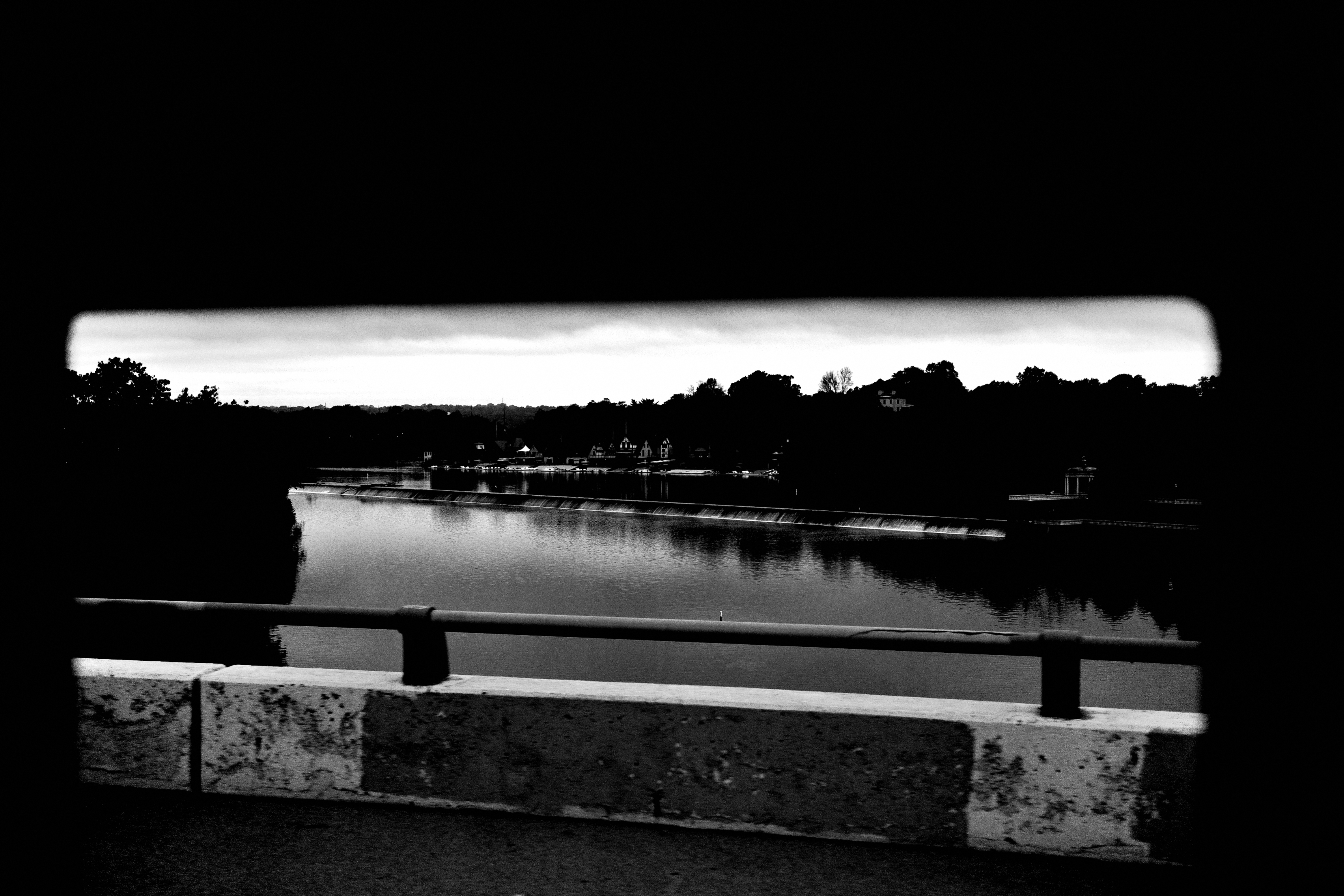
And what that means is, when I boost my contrast to the max, when I’m shooting black and white, when there are no gray tones, and I’m pushing the medium and stripping it down to this sort of drawing of light, essentially, I’m creating this natural abstraction of reality.
Because of that, what I’m starting to realize is that while I’m looking at life with my two eyes and photographing this wall here, what I’m actually amazed by every single day is what this medium does.
What I see right now in reality, you could say it’s what you get.
But really…
What I get back in the photograph is what I didn’t see.
It’s what the camera is interpreting of reality.
It’s the way that light is essentially emanating through my lens, touching the camera sensor, and rendering the image that keeps me surprised.
That keeps me curious about everything.
For instance, right now you can see the photo I just made.
Crushing the shadows.
Exposing for the highlights.
Creating abstract shapes of the buildings.
It’s that act of discovery.
Essentially wondering, what is the camera going to see?
How is the camera going to interpret the world?
That’s what I’m curious about now.
I’m more curious about that act as opposed to the act of me telling some grand story or making some impactful photo.
And that’s what’s keeping me out here photographing.
The Power of Creative Constraints
It’s this infinite, endless, unrepeatable practice that I finally tapped into through giving myself an ultimate creative constraint.
By staying within this box of limitations, I now have this ability to endlessly photograph.
And it’s just the most transformative, incredible thing that I’ve ever done.
It’s making me a much more joyous human, let alone a more achieved photographer in terms of what I’m trying to achieve.
I believe the images I’m making now are much more interesting, or at least more fulfilling for me personally.
And it required me to let go of any idea of what a good photo is, essentially.
Photography as Life Affirmation
What’s really profound is that when I’m photographing now, it’s less about the outcome of the image and making a great next frame.
But kind of just affirming that my next frame is going to be my best frame.
And essentially just saying yes to life with the click of the shutter.
It’s an act of life affirmation.
It’s almost an existential practice for me at this point.
It’s almost just a reminder that I am alive.
That I am here.
And I use the camera and photography as a way for me to exist outside the passage of time.
What I mean by that is we have a past, we have a future, but those things aren’t of my concern.
I’m in the present moment.
Engaging the sights, the sounds, the smells of the street.
Moving my feet.
Observing the patterns of nature and human behavior.
Observing everything.
This kind of practice becomes meditative.
It becomes a spiritual practice for me where I’m using the medium in a way that goes beyond the image.
It goes beyond the act of conquering the frame, making a composition, sharing it with somebody, and making them shocked or amazed.
Being radically detached from the outcome is putting me in this place where everything is beautiful.
Everything is meaningful.
Everything has potential in front of me.
Finding Beauty in the Mundane
I now look at the way that the paint on the ceiling and the light, the way that it’s glimmering and casting upon something, can create something otherworldly within this ordinary moment.
And so when I walk through this mundane mall that’s empty, with shops that have been standing for the past five years and haven’t been changing, I actually remind myself that I am changing.
The external world around me, these shops here in the Fashion District mall, they might not be changing entirely.
The Burlington Coat Factory has had that same advertisement for the past five or six years.
But I’ve been coming back to this same advertisement for the past five years as a different human every day.
My cells are replenishing every morning.
Every day, I wake up with vitality.
Every day, I’m changing.
Every day, I have a different idea or a different thought about life generally.
And I never want to stay stagnant.
I never want to stay in this place where I feel like I’ve mastered photography or know everything.
Because I think at the end of the day, as humans, we actually don’t know much.
We’re just kind of floating around on this big rock, orbiting around a ball of fire, floating out into the void of space.
And we think we know everything because we have AI in our front right pocket.
But in reality, we don’t know how the world operates.
We don’t know anything.
Become a Child Again
I think that’s the most humbling thing.
To remember that you are a big child.
We’re all children.
And I think that reminder I give myself in the morning, that I am just this child, it’s almost like I’m born again each day.
And then from that blank slate, think of a child.
They’re just eager for the day.
Their goal is just to wake up and catch the sunrise, to go to the playground.
And so now with this new process, it feels that way for me.
It feels as if I’m just going to the playground each day for the first time.
And the most mundane situations and things give me a smile.
And then I take a picture.
The Infinite Potential of Photography
It’s this flywheel of waking up each morning, eager and curious for the day.
Clicking the shutter.
Saying thank you and yes to the day.
Coming home.
Going through the photos.
Reliving those memories.
Discovering something.
And endlessly returning to photography.
Because I now see the infinite potential of life generally and what lies within the mundane as a photographer.
The way the light is always in flux.
The way the light casts upon surfaces, people, places, and things is always moving and changing.
And it’s out of my control.
The subjects on the street, the people, the humanity, they’re all moving.
They’re all changing.
They’re all out of my control.
I can’t put order to the world around me.
But I can put four corners around something, click the shutter, and that can live on forever.
That’s the thing.
What’s most powerful for me as a photographer is recognizing what’s out of my control and thriving in that unknown.
Thriving in the fact that the seasons are changing.
Thriving in the fact that I, too, am changing.
And the people around me are growing older.
Life is moving on.
And I’m just going to continue moving my body along and photograph it all.
To Change Is Happiness
I just find power in this idea of change.
And I realize that this is happiness.
To change is happiness.
To evolve.
To transform.
To stay stagnant, to stay the same, this is where I believe you go insane.
But essentially, by changing and evolving, this is where you find joy.
And I think in order to change, you actually have to destroy.
You have to destroy to create.
You have to destroy all preconceived thoughts you’ve had in the past.
You have to basically destroy everything and return to that blank slate every single day.
And so I treat each night like a miniature death.
And each morning like a miniature birth.
And then through the click of the shutter, it’s almost like a reminder that I can’t live forever.
But at least I can make a photograph.
Photography Is My Purpose
I just continuously push myself each day to practice photography because it’s my purpose.
It’s what gives my life meaning.
And essentially allows me to cultivate this indestructible spirit where I’m just waking up with this enthusiasm for life.
And that’s what I seek.
Enthusiasm, honestly.
Just look at the word.
It means to be possessed by God.
And so I want to wake up possessed by God.
I’m the first street photographer who’s possessed by God.
How about that?
I’m the only street photographer with a demon.
I’m the first street photographer who is a daimon, who’s possessed by God.
All right?
Peace.
DANTE SISOFO · · dantesisofo.com/how-i-completely-transformed-my-street-photography-12-years-later/