June 5, 2024 – Philadelphia


The Garden of Epicurus, also known simply as “The Garden,” was the philosophical school founded by the ancient Greek philosopher Epicurus around 306 BCE in Athens. This garden was not just a physical space but also a symbol of Epicurean philosophy, which emphasized the pursuit of happiness and tranquility through simple pleasures, friendship, and intellectual contemplation.
Key Aspects of the Garden of Epicurus:
- Philosophical Haven: The garden served as a retreat from the hustle and bustle of Athenian life, providing a serene environment conducive to philosophical discussion and reflection.
- Inclusivity: Unlike other philosophical schools of the time, which often excluded women and slaves, the Garden of Epicurus welcomed individuals from all backgrounds. This inclusivity reflected Epicurus’ belief that the pursuit of happiness and wisdom was a universal right.
- Focus on Simple Pleasures: Epicurus taught that true happiness comes from simple, everyday pleasures rather than extravagant indulgences. The garden, with its natural beauty and tranquility, embodied this ideal.
- Friendship: Epicurus placed great importance on friendship, considering it one of the highest forms of pleasure and a key component of a happy life. The garden provided a space for friends to gather, converse, and support each other.
- Philosophical Teachings: Epicurus’ teachings in the garden covered a range of topics, including the nature of the gods (whom he saw as indifferent to human affairs), the importance of overcoming irrational fears (such as fear of death), and the pursuit of ataraxia (peace of mind) and aponia (absence of pain).
- Material Simplicity: The physical layout and maintenance of the garden were simple, reflecting the Epicurean ideal of living modestly and focusing on the essential aspects of life.
The Garden of Epicurus was more than just a physical location; it was a community dedicated to living out the principles of Epicurean philosophy. Its legacy has endured as a symbol of the pursuit of a rational, joyful, and serene life.
Friedrich Nietzsche’s statement, “One should never measure an artist by the standard of his works,” reflects his belief that the value and significance of an artist extend beyond their individual creations. Here are a few key points to consider in understanding this idea:
- Separation of Life and Art: Nietzsche suggests that the artist’s life, intentions, and personal experiences should not be conflated with their works. The creative process is influenced by many factors, and an artist’s work might not fully capture or represent their personal beliefs or character.
- Complexity of the Individual: The statement implies that an artist is a complex individual who cannot be wholly understood or judged based on their artistic output alone. Their creativity, thoughts, and emotions are multi-dimensional and may not always be directly reflected in their works.
- Creative Freedom: By emphasizing not measuring artists solely by their works, Nietzsche acknowledges the freedom of artists to explore various themes, styles, and subjects without being confined to a singular interpretation of their persona. It supports the idea that artists can experiment and evolve without being pigeonholed by their previous creations.
- Intrinsic Value of Art: The works of art should be appreciated and critiqued on their own merits, independent of the artist’s personal life or moral character. This separation allows for a more objective and focused evaluation of the artwork itself.
In summary, Nietzsche’s statement encourages a broader and more nuanced understanding of artists, recognizing that their worth and significance extend beyond the scope of their creations. It advocates for an appreciation of art that acknowledges the complexity and individuality of the artist.
We off the grid, grid, grid, grid, grid. Thanks to William Penn, he laid the city of Philadelphia out on a grid. While this has its advantages, I believe that the grid itself is something that we must go beyond.
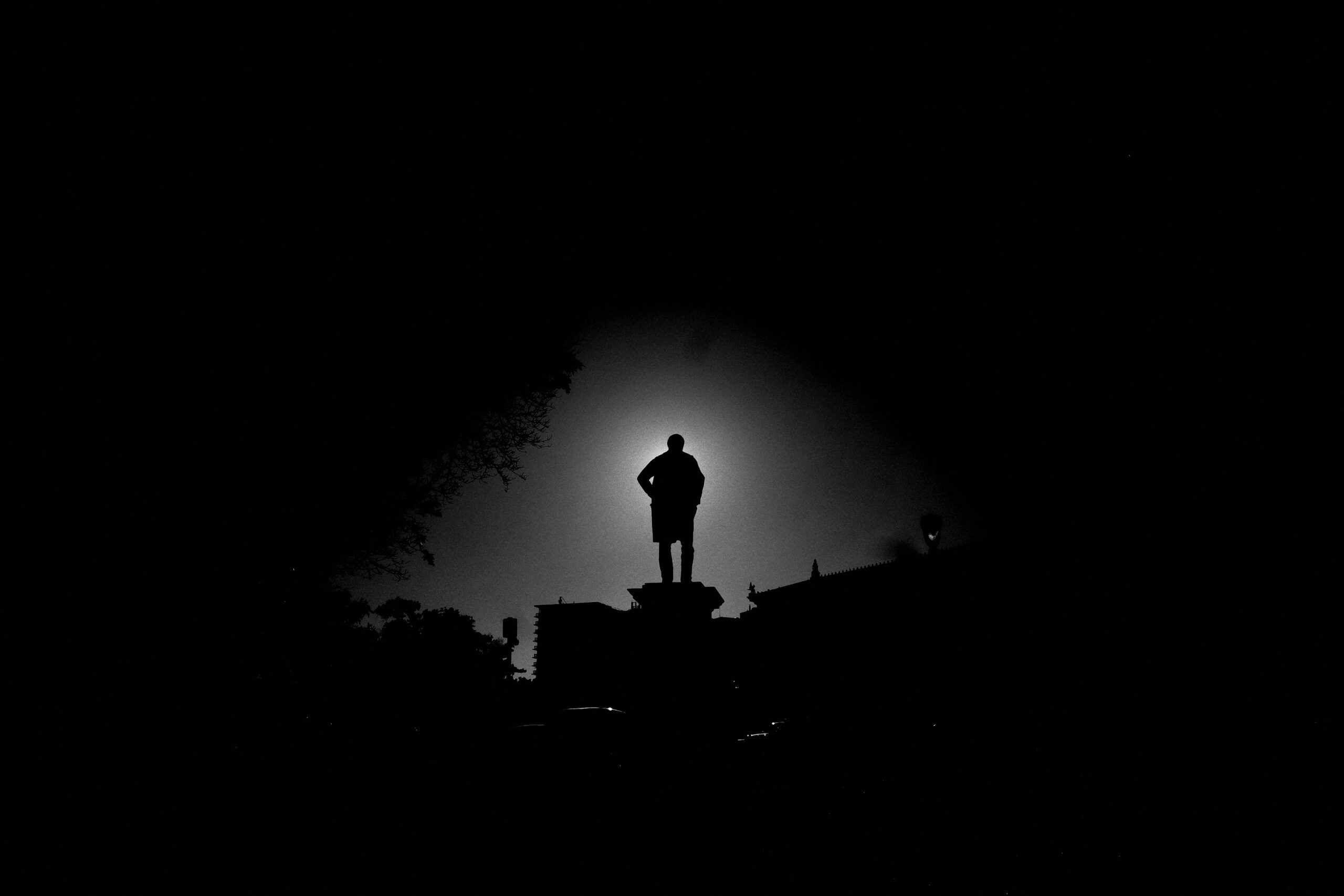
A sculpture of William Penn sits atop the City Hall building in Center City, the largest municipal building in the country, crafted by the Scottish Freemasons. This is one of the most incredible structures I’ve ever witnessed in my life, and I have the privilege of walking through its tunnels every day. The sculptures, columns, and intricate details throughout the building provide an endless sea of wonder to gaze upon.
One of my favorite things about William Penn is his relationship to green spaces and his commitment to creating a green town within the city of Philadelphia, laying the grid out with various parks throughout the streets. We also have beautiful Fairmount Park, which is larger than Central Park in New York City. There’s something about nature that is vital to my daily life; I feel called to return to it each day and go off the grid.
Perhaps we should go off the grid both physically and mentally, creating our own grid, our own universe, our own world. We hold the power to create a new world in a fraction of a second through the medium of photography.
What could/should the world be?
Another thought I have about the city of Philadelphia, in relation to William Penn, is his peaceful interaction with the Lenape tribe, making an agreement to create the city. The native tribes never really believed that anybody owned the land itself. They believed that God held supreme ownership and the tribes merely dwelled there.
As a Peace Corps volunteer in Zambia, Africa, I spent one year in a remote village, Mpanta, of the Samfya District, in Luapula Province, as a member of the Bemba Tribe. I spoke the local language, prayed under the Seventh-day Adventist Church, worked as a fish farmer, and integrated myself within this community. The thing that struck me the most was the hierarchy that exists within the society between God, tribe, and land. Also, within the family unit, where mothers come home with firewood on their heads, babies on their backs, the men are building churches and homes, the boys are making bricks with sand and mud, and the girls are sweeping the floors and preparing food for the day. Everybody has a role to play within the village, the tribe, the family.
The church is the center of the community, with an altar, a place for sacrifice. Everyone within the community makes their daily sacrifice for the greater good of the community. Whether farming, teaching, or working in transportation along the lakes with boats, everyone provides goods and services to nearby villages. I believe that the church itself, and the beliefs and teachings within it, keep the community thriving, and the people within the village become harmonious.
However, I witnessed firsthand what happens when someone acts out of place and causes chaos amongst the tribe. One young man pushed an older lady to the ground, who was suffering from old age, and wound up killing her. The community took matters into their own hands, beating this man to a bloody pulp and forcing him out of the tribe and the village, as there are no police, laws, or bureaucracy to keep the village together.
If someone dies, especially children, for uncertain reasons, and there is presumably a witch within the village, they visit the witch’s home with the coffin and throw stones at the witch or destroy their house.
I remember during my trip to Central America, in Belize, I was on a tour by boat, a small canoe, going downstream through a cave system. The tour guide described how the Mayans would perform rituals, kill and sacrifice babies, and leave the skulls behind. As I went downstream, looking at the walls of the cave, I remember seeing these skeletons firsthand.
Athens is the birthplace of democracy in the world. Philadelphia is the birthplace of democracy in the United States of America.
Perhaps we should treat Philadelphia similar to Athens, or even ancient Rome. Let’s consider that the Western world, Western civilization, the United States of America, is essentially the Roman Empire 2.0. Has Rome really fallen?
Look around you—at the roads, architecture, churches, and beautiful sculptures. Surround yourself with these beautiful spaces, such as the Philadelphia Museum of Art, and remind yourself of how great this country really is. Similar to Athens or Rome, two of the leading forces in the world, we can create our own paradise here in Philadelphia.
One thought I have is that we can create paradise on earth, right here. Or, you can create hell for yourself, right now, on earth. How? Quite simply, honestly.
Maybe hell is war. When the United States went to the Middle East, did we ever find the weapons of mass destruction that we were looking for? No. What we made are weapons of mass distraction, sitting in your front right pocket, the iPhone.
I believe that we create hell through endless distractions from media consumption, whether television shows, movies, social media, YouTube, podcasts, etc. Most especially, the news. When you surround yourself with beautiful things and live in the present moment, you create paradise.
When you indulge in digital distractions, your mind becomes clouded, distracted, and slowly but surely, you create hell for yourself.
Paradise is simple to create by surrounding yourself with beautiful things, beautiful thoughts, and elevating your body, both physically and metaphorically, to new heights. My personal suggestion is to start your day along the river, any body of water, with an elevated view so that you can see the horizon. When I see the horizon and watch water flowing, I’m reminded that this world is open and endless, with so much to see and do.
Perhaps one of the greatest things that modern Western civilization offers is comfort and pleasure. Are these things so bad after all?
When I think of war, battle, and conquest, I think of people like Alexander the Great, on horseback, leading an army to conquer parts of the world. It feels like there was more to conquer, and glory to be had on the battlefield during these ancient times. Nowadays, war feels like slaughter, with the advent of technology, nuclear weapons, drones, robots, and artificial intelligence. War, to me, feels like the product of cowardice, not courage. An 18-year-old kid sitting behind a computer screen, operating a drone using an Xbox controller, like they’re playing a video game, but the consequences are real, and people are being slaughtered. Real war was hand-to-hand combat; these new war games are akin to playing Call of Duty.
My thought is, since there is no more glory to be had on the battlefield, where can man seek to conquer? Perhaps the realm of art and photography is fair game to dominate, as there is endless terrain, off the grid, to conquer.
I know that I am wise because I know nothing.
One funny story about Alexander the Great is when he went to visit Athens and greeted Diogenes, an ancient and prominent philosopher known for his ascetic lifestyle, critical of social conventions, and lived a life of extreme simplicity.
Everybody in Athens went to see Alexander the Great, but Diogenes stayed put, in his clay pot that he used as a home, living practically homeless, enjoying the sunlight. Because Diogenes was the only person that did not go to greet Alexander, he went to seek Diogenes himself, as he was intrigued by his reputation.
When greeting Diogenes, Alexander told him, “I am Alexander the Great.”
Diogenes responded, “And I am Diogenes the Cynic.”
Alexander asked if there was anything he could do for him.
Diogenes famously responded, “Yes, stand out of my sunlight.”
This to me highlights the basic and founding principle of stoicism, where the simple pleasures in life, such as being outside, enjoying the fresh air, and the rays of the sun, is all man really needs. Diogenes, presumably unimpressed by this world conqueror, did not care for his fame whatsoever.
The story goes, when Alexander walked away from the scene, he joked to his comrades that,
“If I were not Alexander, I would wish to be Diogenes.”
While Alexander’s greatness was external, based on conquest and power, Diogenes’ greatness was internal, based on wisdom and self-sufficiency. This highlights that true wisdom and contentment do not depend on external circumstances, such as material wealth and social status, a lesson that even a powerful king such as Alexander could appreciate.
We too, should seek wisdom by studying the ancient philosophers of ancient Greece, and treat Philadelphia as a new Athens.
A good thought to consider when it comes to photography. Forget about the “real world.” Create your own!
Since eliminating breakfast and lunch from my routine, I feast like a king every night. It’s much more fulfilling to have a full meal and enjoy it thoroughly than waste time during the day nibbling like a squirrel.

I need a higher vantage point—somewhere to go to look out, see the horizon, and find my place in this world. When I start my day off in the city, walking through a grid, surrounded by tall, looming buildings, following traffic signals, and using crosswalks, I feel like a mouse stuck in a cage.
John B. Calhoun conducted a mouse utopia experiment in the 1960s and 70s. The goal was to study the effect of population density on behavior. The mice were given everything they needed in this cage, where they lived in abundance. At first, the population began to grow at a very fast rate. Once the population grew, they began to run out of space, the mice became stressed, and the population stagnated. At this point, the mice became aggressive, they began to eat each other, there was a breakdown of maternal care, social withdrawal, and many stopped mating.
Despite the abundance of resources that these mice had within their cage and their utopia, the social structures broke down, causing the population to collapse. Maybe we are currently living within mouse utopia on a larger scale, with real human beings. It’s quite evident to me that the chaos within society has reached a breaking point where we are living in an age of abundance—with everything at our fingertips—yet we face imminent threats of artificial intelligence, automation, weapons, war, nukes, false news, lack of communities, and a decline in our population.
It seems like we are raising more dogs than human beings these days.
I see people walking around with dogs that have shoes on, tucked away in baby carriages, and hear stories of people who actually feed their dogs real food and cook for them over a stovetop. We have the choice to live our lives however we deem fit, but I am reminded of the human being and our natural biological goal of reproduction. If we replace this primal goal with the creation of artificial intelligence, the operation of technology, and the pursuit of pleasure, perhaps there will be a reset in the world, where the strong will inherit the earth.
I often hear people who work in offices complain about this notion of the hamster wheel—how they feel like they can’t leave, but constantly need to go back, on a loop, completing the same tasks over and over again. You also see people who love to run on treadmills indoors, after a long night of drinking or binge eating. Humans are funny and often find themselves stuck on a wheel, in a loop, doing the same thing over and over again, expecting something new or different. Think of the movie Wall-E. The problem with this is that we may never reach the peak, the goal, the end in itself. If we’re all hamsters stuck on a wheel, maybe it’s best that we find joy in the process itself—find ways to play this game while maintaining our sanity, clarity, and strength upon the wheel itself.
What is the city but merely cars and computers?
Sure, we have people in the street, walking upon the sidewalk, but to me, this space becomes a no man’s land. When I walk around the city, it feels like the movie The Matrix, where the agents are all wearing sunglasses. Have you ever noticed the abundance of people wearing sunglasses these days? It always bugs me as a street photographer who wants to photograph the soul of the street.
People with sunglasses lack soul.
While we have the choice to wear whatever we please, it certainly does concern me. Why? I believe that wearing sunglasses is not only bad for your health, but it seems antisocial and makes you a bit less human. I cannot see your eyes, and something doesn’t feel right. You don’t feel human to me, especially with the advent of technology, and the combination of someone on their phone, wearing AirPods, and wearing sunglasses. This seems to be the trifecta that I see so frequently in the city. I understand that the street is merely a place for people to walk, bike, or simply pass through, but something still does not feel right. I find it difficult to make eye contact with people, even when holding the door open for others, where people are afraid, shy, bashful, and gaze the other way.
How are we to overcome this antisocial world that we live in?
What are the repercussions and outcomes that could arise through this behavior pattern?
My fear is that the more antisocial we are, the more aggressive, violent, and depressed we become.
During a long journey from the capital of Zambia, Lusaka, toward my village in Samfya district, as a Peace Corps volunteer, I hitchhiked on the back of a truck, had a bus break down on me, and even took a taxi with a drunk driver. As this driver began to drink, he didn’t really think that anything bad could happen, as the road was open, and there was no real threat that could turn him off course. However, his oblivious and drunken state caused problems during this ride, where he popped his tire and drove down the road with sparks flying from the wheel, like a scene out of the video game Grand Theft Auto. As the sparks flew, I smelled the burning asphalt, plastic, and the stench that the car was making. He was eventually pulled over by police, arrested, and I found another truck or bus to hitchhike on.
Maybe a lot of people in this modern world are souped up on a plethora of medications, drugs, and alcohol on a day-to-day basis.
It’s funny how roads control the systems, cities, and communities all across the world. During my time spent in Hanoi, Vietnam, or Mumbai, India, I recognized how controlled the chaos is on a street corner. While people typically do not follow the law or abide by traffic signals, there is still safety, where every driver and pedestrian is hyper-aware of their surroundings, following intuition, and somehow managing to leave the scene with no accidents. I genuinely never saw an accident or problem with the way people drive in cities such as these, but here in Philadelphia, you constantly hear about hit-and-runs, and I often see car crashes throughout my daily commute during the week. Also, the street life in these cities is bustling, alive, and full of soul.
It feels like we enslave ourselves to technology quite easily.
You hear the phone ring, you pick it up right away. That’s not a way that I could ever see myself living life. Do people seriously have the urgency to pick up a phone when they get a notification? Are you excited to speak with a robot?
I see the traffic signals—the red, green, and yellow colors, the countdown numbers, the flashing red hand, or the white walking man—as a system within a giant computer, or the city, that controls our behavior.
When I am in isolation, alone, I thrive. While I maintain my friendships from childhood and have a healthy social circle, I can find joy in the mundane, entertain myself, and experience life this way. I find joy in nature, surrounded by birds, the trees, and that crisp, cool breeze. There’s nothing that surprises me more than a person who cannot just be.
There is so much endless opportunity for you to find joy within yourself and the external world. However, we turn to simulated universes, through the power of our phones, entering digital spaces, and engaging with society this way.
In the wake of artificial intelligence, I believe it is critical to become skeptical of these spaces.
Just assume that all people on the internet are bots, and only trust physical flesh. I understand that we are still early with AI and technology, but I believe that it is best for us to recognize the power of it now. I enjoy using ChatGPT to study the etymology of words, summarize texts that I am reading, and draw from this well, an endless sea of knowledge, to enhance my learning and everyday life. One of the fun things I’ve been doing with it recently is making a photograph of a sculpture and asking ChatGPT what is the title of it, who the artist is, the history of it, and what it means. I can also photograph trees and plants, find the species names in Latin, and understand things more deeply. There are certain advantages that we can draw from using this technology, and I’m not entirely against it. Perhaps we must be aware of who has the power and why they choose to use it.
When you consider the term depression, depressed, I believe in this notion of it meaning you are physically lower than. You are being pushed down by gravity itself, where your body cannot move. Think of a depressed person—are they typically outside? Are they on a walk? Moving their physical bodies? No, they are typically bedridden, sitting down, or lying in bed, unable to move.
I believe that we currently have a lot of disease in our country, world, and cities. This disease does not necessarily manifest as physical ailments, but there is a lot of anxiety, mental illness, and crazy people out there. To be diseased is to be uneasy, unwell, and anxious.
You often see in the newspapers or on commercials the promotion of pharmaceutical drugs to cure depression, anxiety, and even schizophrenia. You see a lot of drugs that are being used on a day-to-day basis, especially among the youth, that alter your hormones, brain, physiology, and even these new, strange drugs like Ritalin that are given to people with ADHD. Ritalin increases the dopamine in your brain. Maybe we have too much stimulation through technology—thinking of the iPhone and the media that it produces, video games, etc. Perhaps this increase in dopamine fries your brain. In order to reset this, you must return to nature.
What does this even mean? ADHD… maybe these drugs are used to administer to children so the parents can go back to their hamster wheel and not deal with a child that has an abundance of energy.
If somebody cannot pay attention, maybe the teacher is just boring, uninteresting, and not engaging with the student. I question the validity of such conditions, and especially the use of these drugs, such as antidepressants, to cure patients.
If you are a man, do not go to therapy. Therapy is bad. Speaking about your problems puts you on a hamster wheel, an endless loop, a spiral to insanity. Men should seek to conquer themselves—whether in the gym, reading books, or creating art.
In the movie A Bug’s Life, Flik uses a dandelion to fly across a canyon. He left the ant colony in search of warrior bugs to bring back and fight against the grasshoppers who held power and control over their community. Flik was the first ant within the colony that decided to hop off the hamster wheel and play the game his own way. While the rest of the ants toiled around, carrying grains on their backs, providing the grasshoppers with food, Flik liked to make things, tinker, and create inventions that would speed up the process of harvesting food.
According to the Bible, the cities of Sodom and Gomorrah were destroyed by fire. Perhaps this is the inevitable outcome of a colony or a city that is in decline. However, it is not God who holds the power—it is the human.
When I was a young boy, I remember looking at ants and the different ant hills in my backyard. Sometimes I would take a magnifying glass, face it towards the sun, and create a beam of fire, burning the entire colony down, and watching as the ants scurried away, running from the omnipotent power I held over them.
I would also craft boats using sticks from my popsicles that I would eat and throw them down a stream after the grass was freshly cut, the plants were watered, and the hose created a waterfall going downhill for me to play with.
Maybe we need to find that dandelion, that popsicle stick, avoid wielding the magnifying glass, and find ways to use technology to thrive in this age of abundance.

The word “courage” comes from the Latin word “cor,” which means “heart.” It passed into Old French as “corage,” which meant “heart, innermost feelings, or temper.” By the late 14th century, “courage” in English had come to mean “bravery” or “valor,” reflecting the idea of facing challenges with one’s heart. This evolution underscores the connection between emotional fortitude and the metaphorical heart.