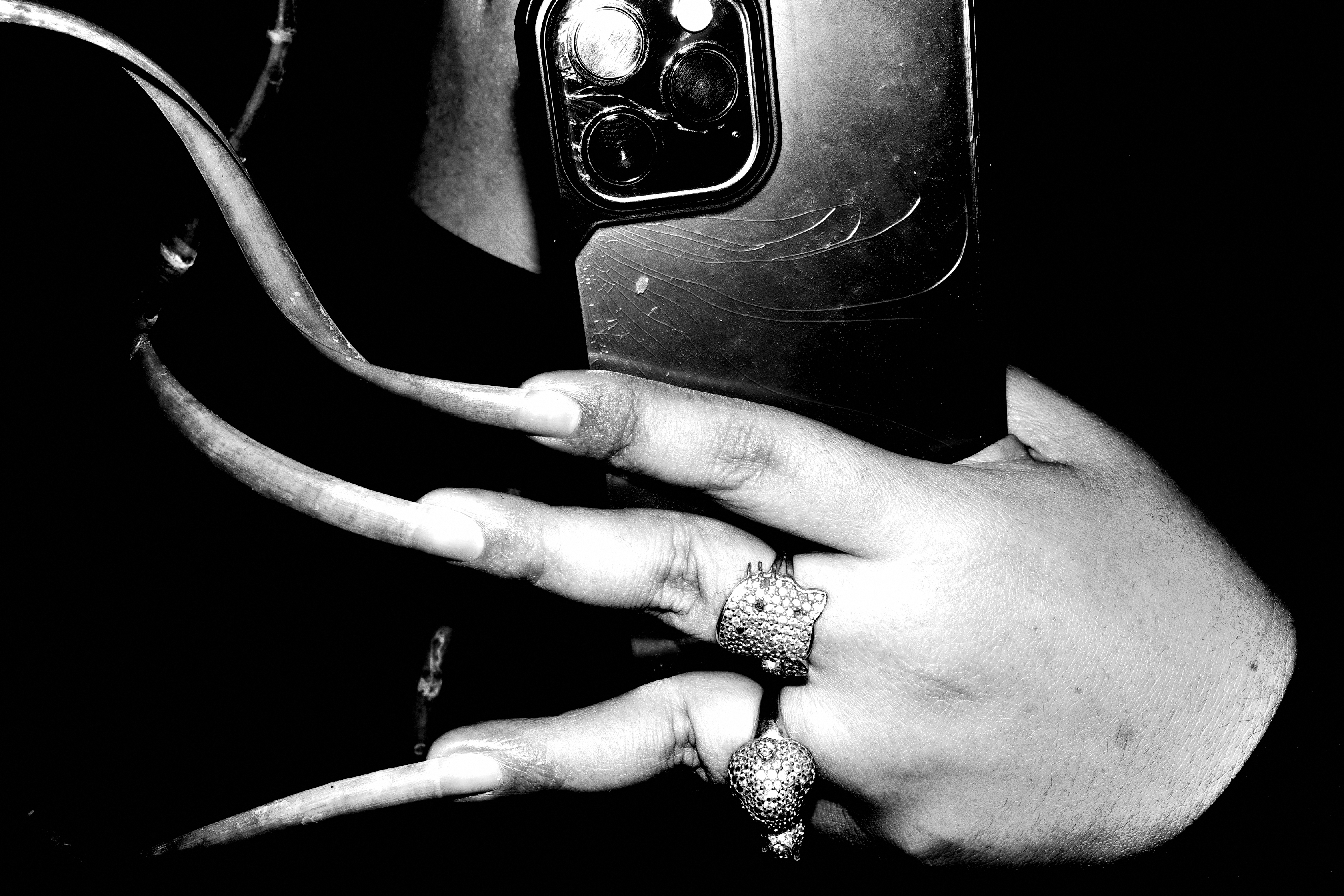
What’s poppin’, people? It’s Dante. This morning we’re looking at photographs I’ve made throughout my three-year journey shooting black and white, including new work from Tokyo. We’re using these frames to explore layering — a technique I’ve used for over a decade, in color and in black and white, all around the world.
Layering is simple once you understand the game. In this post, I’m giving you a rapid-fire breakdown of seven photographs and the seven core ideas behind how to make layered images.
The Purpose of Layering
Street photography happens in chaos: Shibuya Crossing, Coney Island, Rome, Paris — places where people flow endlessly in and out of the frame.
The photographer’s role is to:
Explore the unknown → Articulate it → Put order to chaos inside the frame.
Photography is:
A physical pleasure (moving through space)
A visual game (solving compositional puzzles)
Layering arranges foreground, middle ground, and background so the viewer’s eye moves through the frame with clarity and intention.
The Fundamental Sentence of Layering
The photographer is responsible only for where they position their physical body in relation to the subject, the background, and when they click the shutter.
Memorize that. It will carry you in any city in the world.
1. Tokyo — Shibuya Crossing
Fishing, Patience, and the Clean Background
At Shibuya Crossing — one of the busiest places on Earth — I began with a simple problem:
How do I isolate a subject inside absolute chaos?
Solution:
Find the background → A clean white wall.
Find the stationary subject → A woman leaning against the wall.
Position myself directly across from her.
Fish → Wait for moving figures to drift into the frame.
Click more than less → Respond to instinct as alignments formed.
This is layering at its simplest: Background → Subject → Moving figures completing the frame.
Patience + intuition = everything.
2. Coney Island — Fourth of July
Drop Low to Separate Subjects From the Sky
When we climbed onto the rocks at sunset, a group of boys emerged from nowhere. Lit by golden light, they felt like mythic heroes.
If I shot from eye level, they’d blend into the ocean.
Solution:
Drop low so their silhouettes separated cleanly from the sky.
Use the rocks as the stage.
Wait for the decisive gesture → the boy turning his head, elevating the moment.
Color, black and white — the principles carry across all mediums.
Final Thoughts
I wake up at 3:30–4:30 AM to make these videos before catching the 6:30 AM bus to work. There’s no time for complicated scripts, but I care about giving you the best information I can.
Layering is simple. Master it once, and it stays with you forever.
What’s poppin’, people? It’s Dante. This morning I’m out here hiking through the woods with my Ricoh GR III, the Ricoh GF-2 flash mounted on top, shooting in manual mode, experimenting with flash and macro, and just letting curiosity guide me.
I’m looking at the trees, the frost, the dew drops catching the morning light — and I’m asking myself the same question I ask every single day:
What will reality manifest to be in a photograph today?
That question is what keeps me returning to photography with childlike curiosity. Because when I put four corners around life and click the shutter, I’m not documenting a fact — I’m exploring what life could become through the abstraction of reality.
The Surprise of the Frame
People assume that shooting high-contrast JPEGs straight out of camera means what you see is what you get.
But in my workflow, it’s the opposite.
What you get is what you didn’t see.
By boosting contrast to the maximum, using grit, grain, shadows, highlight-weighted metering — the camera reveals something my eyes never consciously registered. I love that surprise. I love when the photograph becomes more extraordinary than the moment itself.
Photography becomes a way of looking beyond the veil of the everyday.
Light as the Language of the Medium
What I’m really interested in is light — the way it casts across surfaces, people, places, things. Light is always moving, always changing. And because of that:
You cannot make the same photograph twice.
Not only does the light change — you change. So as photographers, we should aim to become like the light:
Always in movement
Always transforming
Always embracing spontaneity
That’s where the real magic lives.
Photographing Like Action Painting
The way I shoot these days reminds me of how action painters work.
It’s not about rational thought. It’s about responding to:
the subconscious
the gut
the instinct to press the shutter
Photography becomes a discovery. A chance to surprise yourself.
That fine line between order and chaos is where the interesting pictures live.
Flash, Macro, and Creating New Worlds
Experimenting with the Ricoh GF-2 flash in macro mode opens up a whole new dimension.
A simple leaf, a vine, a frost crystal — suddenly becomes its own world.
When the flash carves the subject out of darkness, the background collapses into black, and the photograph becomes ambiguous, otherworldly, mysterious.
Even without the flash, using macro with natural light reveals veins, textures, and tiny surfaces that the naked eye barely perceives.
It’s wild how easy it is to take something from the world and place it into a new world inside the frame.
Transcending the Material Plane
Through this workflow, I’m not just trying to record nature. I’m trying to:
reveal the essence of life
evoke emotion
transcend the material plane
create worlds that didn’t exist before the shutter clicked
The sublime — that overwhelming feeling — is what guides my instinct to shoot. It’s not rational. It’s a bodily sensation, something flowing through me.
That’s what keeps me in a flow state for hours.
Instinct Over Vision
Often it’s not your eyes or your brain making the photograph.
It’s something deeper:
the subconscious
the instinct
the irrational pull toward a moment
And through that instinct, the camera gives you something that reality alone could never offer.
The photograph becomes a natural abstraction of reality.
That’s the part I love.
The Morning Light
Right now, the frost on the leaves is shimmering. You can barely see it with the naked eye, you can’t see it on the GoPro, but the Ricoh — with its micro-textures and contrast — will reveal it.
Everything feels animated this morning.
And so the very simple question returns, the question that keeps me clicking:
What will reality manifest to be in a photograph today?
In 1960, Japan reached a boiling point. Millions took to the streets in what became one of the most decisive political uprisings of the postwar era: the Anpo Protests, a nationwide movement opposing the renewal of the U.S.–Japan Security Treaty. These protests were not symbolic. They were visceral. Bodies pressed against police shields, voices collided in the air, and for a brief moment it felt as if the entire fate of Japan’s democracy hung in the balance.
Out of this turmoil emerged the photobook The Anger of the Sovereign People (主権者の怒り ― 安保斗争の記録), published on August 15, 1960 by the Japan Journalists Conference (日本ジャーナリスト会議). It stands as one of the most important collective photographic documents of protest in Japanese history.
A Collective Vision of Resistance
Unlike most photobooks of the period, this work was intentionally created without a single authorial voice. It was built through collaboration — a merging of perspectives from photographers who embedded themselves directly inside the demonstrations.
The contributing photographers include:
Hiroshi Hamaya (濱谷浩)
Shomei Tomatsu (東松照明)
Ihei Kimura (木村伊兵衛)
Shigeichi Nagano (長野重一)
Yukichi Watanabe (渡辺雄吉)
Hiroshi Kawashima (川島浩)
Takeshi Takahara (高原猛)
Kōichi Uchida (内田康一)
Hisaya Konishi (小西久弥)
Shōzō Satō (佐藤省三)
Haruyasu Hiratsuka (平塚晴康)
and several others
This lineup reads like a cross-section of Japan’s most important photographers — from documentary pioneers like Hamaya and Kimura to later Provoke-era giants like Tomatsu. But in this book, none of them stand above the others. The authorship dissolves into the movement itself.
This is the power of the book: the collective eye of a people demanding to be seen.
Inside the Photobook
The pages present a kinetic portrait of the uprising:
Students scaling the iron gates of the National Diet
Police phalanxes pressing against waves of demonstrators
Workers raising handmade signs
Women shouting with unrestrained defiance
The funeral march for Kanba Michiko, the student killed during a clash on June 15, 1960
The images are not neat. They are not calm. They pulse with anger, fear, solidarity, and hope.
There is a sense that the photographers were not observing history — they were inside the bloodstream of it, pushed and pulled by the same current that moved the crowds.
This rawness anticipates the visual rupture that would define the late 1960s in Japan, especially the birth of the Provoke movement. You can see the seeds here:
Grainy tones
Blurred edges
Harsh contrast
A rejection of stillness and neutrality
The book is not “documentary” in the journalistic sense. It is documentary in the existential sense.
A Record of Sovereignty
The title — The Anger of the Sovereign People — is not poetic exaggeration. It is a statement of political philosophy.
In 1960, Japanese citizens confronted a question central to any democracy:
Who holds sovereignty — the state, or the people?
The protests, and this photobook, argued forcefully for the latter.
In these images, the people assert themselves not as passive subjects but as active agents shaping their country’s future. That is why this book transcends its moment. It is not merely about the Anpo treaty; it is about the recurring struggle between authority and citizenry — a struggle present in every society, in every era.
Why This Book Still Matters
More than sixty years later, the book remains:
A historical document
A visual manifesto
A collective cry for agency
A prelude to the radical aesthetics of 1960s Japanese photography
It teaches us that photography can do more than record. It can bear witness, provoke, mobilize, and preserve the emotional truth of a moment.
In a world still wrestling with protests, state power, and civic responsibility, this book feels as alive as ever.
Final Reflection
The Anger of the Sovereign People is not just a photobook. It is a testament to what happens when ordinary people realize their power — and when photographers choose to stand with them, not apart from them.
It is a rare collective artifact in which image-making becomes inseparable from political courage.
To flip through it is to return to the very heartbeat of 1960: a moment when the streets became a parliament, and the camera became a witness to sovereignty itself.
For the first time in my life, I feel like I experienced a true creative breakthrough on the streets. It happened in Tokyo, Japan—completely by accident, completely instinct-driven, and completely rooted in the flow of light, chaos, and movement. I want to break down the process, the technique, and the exact settings I used so you can understand how these photographs came into being and how you can adapt this approach in your own work.
Following the Instinct
Everything began at Shinjuku Station. It’s one of the most chaotic places in the world—waves of people moving in every direction, nonstop. I wasn’t overthinking anything. I wasn’t trying to “make” a great photograph. I was simply responding to the energy in front of me.
And then it happened.
I accidentally hit the crop mode button on the Ricoh GR IIIx, looked at the screen, and realized I could use 71mm crop mode intentionally. It felt like a door cracking open. I followed the obsession. I followed the instinct. And that instinct carried me through the rest of my trip.
The Technique I Discovered
What I found most interesting was how light and shadow carve shape into the faces of the people I photographed. By placing myself in golden light—sun to my back, or slightly to the side—I could isolate faces against deep shadow and eliminate the chaos of the street.
Everything became about:
Faces emerging from shadow
Slivers of light revealing eyes, noses, mouths
Negative space crushing into black
Simple gestures elevated by light alone
Ambiguity—photographs that could be made anywhere
The street no longer had a location. It became pure form, pure shape, pure energy.
Exact Settings
Here is everything baked into the camera:
Ricoh GR IIIx
71mm crop mode (double-tap the side “video” button)
Snap focus at 1 meter
Manual mode
1/2000s, f/16
Auto ISO
Highlight-weighted metering
High-contrast black and white JPEGs (cranked to the max)
These settings gave me:
Speed
Precision
Deep shadows
High-contrast etched shapes
A way to freeze people as they walked into the light
Every frame came straight out of camera.
Positioning the Body in Chaos
When photographing in places like Shibuya Crossing, the environment is overwhelming. Thousands of people moving in unpredictable ways. But that’s exactly why this technique worked.
You’re only in control of two things:
Where you place your body
When you press the shutter
Everything else—the light, the chaos, the movement—is out of your control. And that’s the beauty of it.
By positioning myself at the edge of the crossing, with golden light ripping through the environment, I could watch faces enter the beam of light. The moment their face appeared, I lifted the camera, got close, and shot.
The foreground. The background. The overlap. The compression.
All of it came together in ways my naked eye couldn’t fully see. That’s the magic—the camera reveals what you didn’t consciously notice.
Ambiguity Over Documentation
For years I focused on traditional documentary-style street photography. But this technique pulled me into a different world. A more abstract world. A world where:
The place doesn’t matter
The background doesn’t matter
Even the “scene” doesn’t matter
All that matters is light, shadow, and human gesture.
Some of these photos have no location. They’re just faces floating in darkness. Anonymous. Ambiguous. Mundane elevated into something more.
That ambiguity is powerful.
Why It Worked
I didn’t intellectualize any of this. There was no theory. No plan. No expectation.
What happened was simple:
I was obsessed with the crowd.
I was obsessed with the light.
My body kept pulling me back to Shibuya and Shinjuku.
I kept following that instinct.
I shot every day, with intensity, without caring about the outcome.
That instinctual repetition is what created the breakthrough.
One frame in particular—an eye revealed in the background, a mouth revealed in the foreground, light forming shapes through the overlap—became the photograph I had been chasing without even knowing it.
Dual-Wielding the GR System
For this trip I wore both cameras at once:
Ricoh GR IIIx on my neck (71mm crop mode)
Ricoh GR III on my wrist (28mm traditional documentary)
When I wanted to switch from abstract compression to wide documentary, I just swapped cameras instantly. No lens changes. No fumbling. Pure flow.
This was the first time in my life I found true value in using two cameras simultaneously. It opened up a new way of working.
Bringing It Home
The most beautiful part of this technique is that it doesn’t require Tokyo. It doesn’t require Shibuya. It doesn’t require chaos.
All you need is:
Light
Shadow
Curiosity
A willingness to get close
This approach is coming back with me to Philadelphia. I want to keep pushing it, keep experimenting, keep finding new ways to see.
The Lesson
Follow the obsession. Follow the instinct. Follow the thing that increases your curiosity by 1% each day.
This technique wasn’t planned. It wasn’t conceptual. It wasn’t rational.
It was discovered through mistake, movement, repetition, and curiosity.
And that’s the whole point of photography.
If you want my exact camera setup, philosophy, JPEG recipe, and workflow, you can download my Ultimate Ricoh GR Street Photography Guide on my website:
The world is a beautiful place, and I’m no longer afraid to die.
What Is Beauty?
Beauty is indescribable.
Yes, I can confirm to you right now—as I’m walking through the park, looking at the trees, feeling the sun on my skin, watching the way the leaves fall, and the squirrels scurry throughout the grounds—that this is beautiful.
But to go beyond beauty, to the sublime, to the eternal Form of Beauty itself, to absolute perfection—the Absolute Good, the Beautiful, God—is where my mind gravitates when I contemplate beauty.
The things within the material plane are imperfect. I’m not perfect, you’re not perfect, and nobody on this earth is perfect or absolutely beautiful. We all have inherent flaws; we all cut, we all bleed, we are all built of flesh.
Flesh is impermanent. The trees are impermanent. The leaves will fall. The plants will decay. And when you die and your body decomposes into the ground, you become decomposing organic matter.
And so within this world, we merely experience imperfect reflections of the eternal Form of Beauty—which is God, the One, the Good, the Absolute.
The Sublime
Sometimes when I walk through the Fashion District mall on Market Street, I get goosebumps on my body and experience some deep emotional response to the most mundane situations.
For instance, when I pass through the mall and watch people rushing home after work to catch a train, I genuinely still can’t believe that we have achieved the ability to form a transportation system that allows this to occur with ease—without even thinking about it.
Like seriously— How is the city even functioning right now? How is all of this occurring? How is the earth located at the particular place in space, with the particular tilt of its axis, and the perfect distance from the sun, that allows life to exist at all?
And so when I pass GameStop and look at the list of imaginative worlds we’ve created through video games—simulations of reality—I think about the infinite possibility not only within this world that we embody and walk through each day, but the different worlds that we can create through beauty, through art.
The Goal of the Artist
The goal of the artist is to transcend the material world through the act of creation.
As an artist working in embodied reality—physically, with a camera in hand, walking through the streets, recognizing patterns and people and things to photograph—I’m not only trying to uplift humanity by creating something beautiful.
The goal is this:
Through the experience and act of creating beautiful things, the artist strives to have a dialogue with the Divine.
The beautiful things we create are reflections—imperfect reflections—of the eternal Form of Beauty, God, who created you.
Created in the Image of God
And so when you consider that you are created in the image of God—the eternal Form of Beauty itself—the things you create are direct reflections, imperfect representations of Beauty.
As imperfect beings, we create imperfect representations of Beauty itself.
But that imperfection is perfection, because we are created from the eternal source of Beauty.
When you pass through City Hall in Philadelphia and look up at the grand architecture—the sculptures, the columns, the intricate detail worked within the laws of physics, striving upward despite being bound by gravity—you witness our desire to transcend.
We place sculptures on the tops of towers and build incredible structures because we seek to transcend the material world of space and time through leaving something behind that honors the Divine.
When you step foot in a cathedral—surrounded by this sacred space with an impossibly tall ceiling—you feel as though you can touch the sky.
There’s a reason why the Pantheon in Rome opened the dome, allowing the light to shine down upon the ground:
We once sought communion with God.
Summon Your Daemon
Mix up Achilles and Jesus in a cup. Be a savage wolf, but also a pup.
We flesh and bone—but we demigod. Disobey like Prometheus and steal the lightning rod.
Yeah, yeah, be meek, be humble— But when the money lenders come, you know I’m ready to rumble.
The ultimate adventure: take the arrow to the knee. Until death do us part—strive for beauty.
When you create anything—music, art, poetry, photography—you are a creator. You are not just a consumer, not just a cognate machine.
You are divine. You tap into the inner spiritedness that carries you to create.
When you wake up in the morning, do you really think the strength in your physical body merely comes from flesh and bones—from muscles and atoms that bind you together?
Do you truly believe that deep sleep alone gives you that feeling of power and strength?
While the physiological effect and cultivation of a strong physical foundation is critical, you can still lack spirit.
And when you lack spirit—even with a strong body—you are merely a puppet with no guiding hand.
The Guiding Hand
So let’s say you’re a puppet on a stage, as a fun and autistic thought experiment.
Well, if that’s the case, there’s obviously someone guiding you—giving you the ability to move, to do, to create, to speak. Giving you life. Animation itself.
Shōmei Tomatsu’s 『朱もどろの華―沖縄日記』 (Flowers of Vermilion Seaweed – Okinawa Diary) is one of the key photobooks from his long, immersive engagement with Okinawa. Published in 1976 by Sanseidō, the book combines photographs, diary fragments, personal notes, and reflective essays created during the early to mid-1970s, when Tomatsu was living between various islands in the Ryukyu archipelago. It stands today as one of his most intimate records of Okinawa.
Publication Details
Title: 朱もどろの華―沖縄日記
English title:Flowers of Vermilion Seaweed – Okinawa Diary
Photographer / Author: Shomei Tomatsu (東松照明)
Publisher: Sanseidō (三省堂)
Year: 1976
Format: Hardback, approx. 153 × 200 mm
Length: ~238–240 pages
Contents: 50+ black-and-white photographs accompanied by extensive written text
The book blends Tomatsu’s characteristic visual language—high contrast, texture, dramatic light—with his deeply personal writing. It reads as both a photobook and a journal.
Tomatsu and His Okinawa Years
Tomatsu first visited Okinawa in 1969 while the islands were still under U.S. occupation. What began as an assignment evolved into a lifelong relationship with the region. He returned repeatedly, documenting everything from military presence to daily life, rituals, landscapes, and the quiet intensity of island weather.
After the 1972 reversion of Okinawa to Japan, Tomatsu spent long stretches living on the islands, including Naha, Miyako, and Hateruma. This period produced some of his most poetic and contemplative work. Photobooks like The Pencil of the Sun (1975) and Flowers of Vermilion Seaweed (1976) mark a shift in his style—from direct postwar critique toward a slower, more lyrical approach to seeing.
About Flowers of Vermilion Seaweed
This book focuses on one of Okinawa’s symbolic natural elements: akamo-doro, a reddish seaweed that appears in Tomatsu’s writing as a metaphor for endurance, memory, and the regenerative power of nature. The seaweed becomes an emotional thread running through the book, linking the physical coastline with the lived experiences of the people who inhabit it.
The images range from quiet coastal scenes to portraits of local residents, from weathered surfaces to delicate gestures. Tomatsu’s sense of place is unmistakable—humid air, corroded metal, saltwater glare, shadows on limestone, and the calm after storms. Every photograph feels rooted in long observation.
The diary texts add another dimension. They include reflections on seasons, travel between islands, the passage of time, and subtle details of everyday life. The writing is spare but evocative, mirroring the rhythm of the photographs.
Why the Book Matters
Flowers of Vermilion Seaweed holds a special place in Tomatsu’s body of work because:
It reveals a personal, lived-in Okinawa, not a detached documentary view.
It unites image and text in a way few photobooks of the era attempted.
It marks a turning point in Tomatsu’s style—toward introspection, softness, and patient seeing.
It helps complete the arc of his Okinawa trilogy:
Okinawa, Okinawa, Okinawa (1969)
The Pencil of the Sun (1975)
Flowers of Vermilion Seaweed (1976)
Together, these books form one of the most important photographic meditations on place, memory, and history in postwar Japanese photography.
Full Photobook Flip-Through
Below is the complete flip-through of Shomei Tomatsu – Flowers of Vermilion Seaweed (Okinawa Diary). The goal is simple: to let the book speak for itself.
Closing Thoughts
Photobooks often become vessels for the spirit of a place. In Flowers of Vermilion Seaweed, Tomatsu captures Okinawa with a kind of reverence—neither romanticized nor critical, but deeply attentive. The seaweed of the title becomes a symbol of what endures: color, memory, resilience, and the slow movement of time.
For anyone interested in Japanese photography, Okinawan history, or the evolution of Tomatsu’s vision, this book remains essential.
Photography and the Thought of Language Michiei Amano / Takahiko Okada / Yutaka Takanashi / Koji Taki / Takuma Nakahira / Daido Moriyama
Table of Contents
Predict 1 What Is Possible in Photography — Koji Taki …… 5
Predict 2 Living the Present: Notes on Language and the Body — Takahiko Okada …… 47
Predict 3 Dialogue: Abolish the Word “Photography” — Takuma Nakahira / Daido Moriyama …… 139
Predict 4 The Eye and That Which Is Not the Eye — Koji Taki …… 175
Predict 5 “Fact” and “Image” — Michiei Amano …… 253
Predict 6 The Restoration of Reality — Takuma Nakahira …… 325
Provoke 1 — Takuma Nakahira …… 13
Provoke 2 — Daido Moriyama …… 103
Provoke 3 — Yutaka Takanashi …… 153
Provoke 4 — Koji Taki / Daido Moriyama …… 217
Provoke 5 — Koji Taki …… 307
Afterword …… 339
What Is Possible in Photography — Instead of a Preface
Koji Taki Predict 1
Whether it is “language” or “photography,” every act of expression is, in the end, an effort made by one’s own body to pass through the membrane of uncertain phenomena and, in doing so, to search for what true reality might be. Pushed further, it is connected to the attempt to discover a new structure that goes beyond the structures with which we are presently in everyday contact.
This is the activity of our whole existence, and at the same time, we constantly feel that whatever we attempt to discover is always already being surpassed by reality itself. The operation called “expression” is nothing other than the ceaseless substitution of this invisible reality with something visible.
However, to put it another way, it may be that this function merely allows us to weather away the world, to fictionalize it, and to send it far off into the beyond. From the world of things visible — the things that compose the everyday, that appear to us as “reality,” that form a world which seems so very certain — expression shifts us toward a world in which our bodies have not yet even found a way to adapt themselves.
The act of expression is such a transition. No matter how “new” something may sound, as long as it does not negate the comfort of dwelling within this seemingly certain world, neither “language” nor “photography” can bring about even the erosion of that already existing world — a world that has hardened into a shell.
Let me make it clear: we are not arguing for “subjectivity.” Indeed, what is “subjective” is not the main issue for us at the present moment. Nor are we placing excessive expectations upon “photography” itself.
Even if this book stages the two signs “language” and “photography,” it is also a fact that the world as a whole cannot disclose its image except through a variety of approaches, up to and including matter itself. Yet is it really our task to choose such an “overall” approach from the outset?
At any rate, let us begin from “photography.” If, as a result, we end up deviating from it, that too is something unavoidable. Our pursuit is by no means sufficient, yet the question “What is possible in photography?” keeps arising within us.
In a sense, what drives us is the question of method that is born together with this question. Intertwined with this is an impulse toward the reality of the world. From this entanglement, something vague and uneasy takes form — something we ambiguously call “expression.”
There is quite a distance between the question “What is photography?” and the question “What is possible in photography?” Usually, the former (“What is X?”) is teleological and historicist, while the latter (“What is possible?”) is regarded as exploratory, carrying within it denial and rupture in relation to the past. This difference in questions is often thought to represent the difference between the modern and the contemporary.
However, more than a matter of era or situation, it is a difference in the primitive attitude that we almost unconsciously take toward them.
When I pose to myself the question, “What is possible in photography?”, what arises is not so much an answer as a kind of almost physical, bodily reaction, which appears in two forms.
One is a kind of helplessness, the feeling that “photography can do nothing” in the face of the world with which I am now living and in opposition to which I stand in various forms.
Yet immediately beneath that reaction, there surges up into consciousness the many meanings of the world that I have nonetheless been able to grasp through photography, and from thinking about them there arises the recognition that “there is indeed something that is possible in photography.”
In reality, our everyday lives consist of the repetition of this question and these two kinds of answers; it is never just one or the other. This situation is not at all limited to photography. It can be said of all the arts of expression.
For example, when we think of what photography can do in the face of the intense movement of the world in which we live today, the sharp ideas of revolution that have emerged from that movement, and the ebb and flow of their suppression, we cannot help but fall into helplessness.
This is not because we are trying to unify politics and art, but because both politics and art are inseparably involved in the very fact that we are alive. From within such helplessness, what can come of proclaiming that “photography can do nothing”?
Even that helplessness, at the very least, crushes various established consciousnesses that cling to photography, and is effective in relocating ourselves into an unknown world. That is to say, it strips away, one by one, the constraints under which photography has been smothered — realism being among them — and it allows a descent of thought down to the roots, to the point where our own consciousness and body stand exposed. Unless we descend to this point, no kind of clear, spiritual realism can ever emerge.
Yet the occasions when photography strikes us with shock clearly still exist even now. Let me mention just one example that many people will remember.
We know many things about the Vietnam War in the form of knowledge. However, nothing made us understand the meaning of Vietnam as much as that photograph titled “Execution in Saigon” taken by a certain AP news photographer.
It consists of two photographs capturing the scene in which a man named Loan, the police chief of South Vietnam, shoots a captured Liberation Army soldier on the street.
In one shot, one man aims a pistol at another man; in the next moment the soldier’s body lies sprawled on the ground like a squashed caterpillar. There is something sickening in these two images. So to speak, they strip reality of its coverings, revealing a naked world in which there is neither beauty nor sorrow.
The presence of this world before us is full of suggestions. Its ugliness strikes a deep part of our existence that is no longer a matter of words or consciousness.
Moreover, the photographer did not take this picture out of any particular intention to denounce the war. The photograph has gone beyond his thoughts, his consciousness, his so-called subjectivity; it has become something else.
To say that photography is “record” points exactly to this structural characteristic of the photograph when it appears in such an extreme form. At that moment, the photograph also attains a true anonymity.
If we broaden this issue a little, as long as we are speaking about a single photograph, it does not matter who took it. Perhaps the person was simply there by chance; perhaps it was taken for some entirely different purpose.
If we look back at the mass of photographs that have been taken and left behind in the hundred-odd years since photography’s birth, it appears that the countless contingencies of countless people have together formed a vast testimony that supplements the reality of human history as a whole.
To think in this way is to be led back to re-asking the meaning of photography and photographer. Are photographers unnecessary? Or are they professionals who build the graphs of journalism?
If we consider subjective consciousness, photography is an inconvenient medium. The conventional idea that one has an inner thought and then “expresses” it in a photograph will always be betrayed by the photograph.
On the other hand, no matter how much writers like Robbe-Grillet or Butor aim to describe the external world, their work is nothing but consciousness in motion through time. By contrast, photography presents the world before our eyes without mediation.
Photography and language belong to heterogeneous systems. Their direct methods of grasping the world differ. The claim that our civilization has shifted from a culture of writing to a culture of images captures a certain truth.
The notion that “seeing is easier to understand than reading,” or that images are more persuasive, only skims one side of this presence and directness.
Perhaps the photographer is the most unfree among all who express. Even if one tries to depict the world within one’s heart, what appears in the image are the external objects. Yet this very involvement with the world is, in fact, what fascinates me.
The photographer may be the first kind of person to have discovered with overwhelming clarity that the world transcends the self. The world is not identical with the human being; nor is it something constructed by human consciousness. The world exists, and humans exist as well. The world lies in the totality woven together by a structure that is anti-human, or super-human, and the raw concreteness called “human being.”
Yet in truth, what “reality” is for us is always “reality as seen.” Therefore, as long as the act of seeing borrows other people’s ways of seeing, as long as it follows modes of seeing that are already known, the world will never reveal itself.
It is enough to recall how standardized our everyday perceptions are. We think we are seeing, but in fact we often “see nothing.”
And unlike Weston, who could gaze only into things themselves, when we try to look at a fragment of the flowing, amorphous world, we acutely feel how hard it is for our focus to settle. We so often see according to patterns taken from other people’s eyes.
That is the world saturated with certainty.
However, during the Prague Spring, for example, there was that photograph of a burning tank taken by a mere traveler. Such photographs taken by non-photographers can convey an unexpected degree of truth with shocking force because, in those moments, the structure of photography functioned precisely, leaving no room for the habitual ways of seeing that cover over reality.
As is often said, photography shook the existing arts not only by its power of reproduction. More than that, photography, by its ability to grasp a reality so external that it cannot be controlled by any individual consciousness, was a forerunner of the collapse of the old consciousness that believed it could construct a total image centered on the individual.
If we recall, for instance, the agitation that photography caused in Baudelaire, it may have been human “ideas” that photography was threatening to destroy.
If what painting once tried desperately to regain was the reality of the external world, photography acquired that reality in a single stroke through a machine indifferent to personal “qualities” or interiority.
In other words, because photography is born from the hybrid system of machine and human, so long as the machine exists on one side, it possesses the ability to capture reality on an operational level beyond consciousness — indeed, irrespective of it.
On the one hand, this makes it easier to possess external reality; on the other hand, by the same route, it buries the subject in anonymity.
Here begins, for the photographer, that eternal theme: the dialectic of anonymity and expression. And we must clarify, through the meaning of expression, that these two are one and the same.
That is, the two sources of photography — that it is based on the subject’s consciousness and that it is at the same time anonymous — must be structured in such a way that neither is denied. Only then will the meaning of the photographer’s act of “seeing together with the machine” be made clear.
A photographer is someone who, on one side, ceaselessly maintains the pure clarity of seeing in this way, and on the other, seeks to discover worlds not yet revealed by such seeing.
This is akin to how a poet digs out words of a different quality from those that ride the circuits of mass communication.
Thus, like the protagonist of Resnais’ Hiroshima mon amour, asking over and over, “Did I see it? Did I not see it?”, the photographer is one who approaches ever more closely a reality that has not yet been seen.
As will be discussed in a later chapter, seeing is not simple. It is a matter of re-grasping oneself and the world in which one lives in a new relationship. This is why the question is not “What is photography?” but “What is possible in photography?” — a question that always seems to be directed toward the unknown.
The world with which the photographer is involved — the world he or she can grasp — is, for the time being, limited to what can be seen, and so it may give the impression of being nothing more than fragments of the external world.
Yet while accepting the fact that one can only see fragments, only pieces, the photographer carries out an action full of contradiction: questioning the meaning of the world as a whole.
If we speak of “invisible realms” or “unseen phantasms,” we risk being misunderstood. Some photographers may call that realm “reality” and think of seeing as the act of seizing a reality that had gone unnoticed.
Photography may be something capable of destroying the mediation of existing concepts and recovering a direct connection between humans and the world. It may again become something that calls forth fresh thoughts and green leaves.
Now that photography’s information function has, in a sense, shifted to other media, we can say that photography has begun to acquire a new philosophical meaning.
Of course, just as art in a certain sense is said to be born from art history, as long as method is in question, photography is born from the history of photography.
No matter how much one attempts to rupture with it, photography cannot be separated from the structures formed by its own history and from the ways in which it has formed communication within the social context.
Yet this does not mean falling into a historical determinism, nor does it mean completely dissolving oneself into the world. To the same degree that history is a cause of everything, the unconscious gestures of a single human being toward the future are the very cause that grant photography its expression.
To borrow the words of T. S. Eliot, the photographs we consider to belong only to the “present” are made up of past and future time.
At the same time, to rescue the present from both the past and the predicted future and to make it appear before us as that “naked world” — this is what we hope someday to reach through the endless repetition of photographic acts.
Provoke 1 — Living the Present
Takahiko Okada Notes on Language and the Body Predict 2
Every honest man is a Prophet; he utters his opinion both of private & public matters. Thus: If you go on So, the result is So. He never says such a thing shall happen let you do what you will. A Prophet is a Seer, not an Arbitary Dictator. — William Blake
Without Coherence
First of all, I would like to sweep the leg of the dull part of you.
If, seeing the title, you imagine that I am simply dividing “language” and “body” into two, then proceed to line them up in parallel as logos and pathos, spirit and flesh, and finally conclude that I am yearning for their reconciliation — that would be, as will become clear below, utterly foolish.
My concern, of all things, gathers around this: that the contradiction whereby my present self is the embodiment of language is itself what I am, and is itself reality.
I am on the inside, and yet with the functions and organs of this “inside,” I grasp the outside, and at the same time I throw myself outward. I sustain that present with language.
Because that language depends greatly on what is given, there are times when the present and I fall into estrangement. For that reason, I must rely on language, and at the same time I cannot help but distort it.
The thought that is now about to pass away is like this. My power of description is poor, so it may turn into something like drawing horses on a wall,* but I suspect that even someone as richly gifted with intuition as Pascal clung so tenaciously to the forms of language precisely because he knew thoroughly how the unfolding of intuition is unintentionally obstructed.
To press upon that present, he disciplined himself severely and calmly immersed himself in the ritual of language.
So that we might not dismiss Pascal’s suffering as mere exaggeration, let us confirm that the present as contradiction, as estrangement, is precisely the present that is alive.
“Interpenetration each other” — to borrow that expression is almost presumptuous, for it (this) is the true body itself, moving on a horizon far removed from any neat division such as parole and langue.
To paraphrase Lenin, if things could proceed in straight lines, then better that they die quickly. It is precisely the question of whether we advance in spirals or not that my gaze is directed toward.
When we include the music playing in the brain — (“What did you just say?”) — right now you are voicing this universe, and at the same time you are grasping living reality as signs.
Therefore, with the body that I want to touch, we both are living in the reality of voice and gaze.
That said, things are far from peaceful under heaven. As long as there is something that overflows, something that erupts as a scream, various problems necessarily arise.
And so, feeling that I must again deliver a sweeping kick to an invisible leg, I take up this heavy pen. I must, little by little, knock some sense into things.
I repeat: even if I, for example, recall how Antonin Artaud cried out with extreme poignancy over the estrangement of body and thought, or even if I, looking back further, invoke Plotinus and introduce the absolute separation of soul and speaking language, I would not want you to misunderstand.
Let us think of the reality of the times.
For me, who has been listening to Artaud’s cry since my student days, it immediately concentrates upon organe (the organs), and in that case it must surely be an issue of today, and therefore my issue as well.
But in the case of Plotinus, if we ignore the reality of his time, it might seem as if he were grasping language and body in a parallel way. In truth, however, we must understand his thought as a process of passage toward ecstasy — a process in which the Platonic way of dividing world and soul into two aspects, mental and physical, functions as a negative mediation.
To grasp this, it is enough to receive his dictated teachings. Yet there is another way to be convinced: consider the trajectory by which Hegel, pierced by that threefold path to the One, established his dialectic.
In any case, the thesis that now drives me — and you — is language, and a little later it will surely be spoken as ** and body.
The fact that this thesis of language and body bears upon us so painfully as the prominence of the separation of language and body, of the mind–body relation — this is precisely why it hurts and itches us.
I have no intention here of tediously sermonizing about the situation in which language, speech, discourse as empty words empties reality itself, estranges itself from things, and in doing so exhausts people.
What I want to touch upon here, rather, is this present situation: empty words, running as emptiness, come to possess actual power as invisible units that constitute institutions, thereby letting the violence of reason rampage unchecked.
Again, for convenience, this becomes a schematic explanation, but whatever form it takes, from the here and now in which we encounter things, complex reactions toward the fact that emotions in any case erupt (which is precisely because this is the modern age), plainly speaking — desire — are stirring the youth of many people.
To describe in minute detail this wavering region may possess a quiet value as my écriture.
(I would like, on this occasion, to draw upon many different words, to turn them into a unique document, and through them to attempt to set down my own ordinary impressions.)
If so, then first, without explaining or interpreting, I want to throw out the following text. It is a famous poem by an astonishing poet, Gérard de Nerval, who burned his life away in the daughters of fire (Les Filles du feu) and ended it in reality by hanging himself — a poet who even now breathes here within me. That poem is “Vers Dorés” (“Golden Verses,” 1845).
Vers dorés
“What! Everything is sensitive!” (Pythagoras)
Man, free thinker! Do you imagine that you alone think, In this world where life bursts forth in everything? Your freedom disposes of the forces you command, But the universe is absent from all your plans. Respect in the animal a living spirit… Each flower is a soul blossoming out in Nature; A mystery of love dwells in metal; Everything is sensitive! And everything acts upon your being. Beware, even in the blind wall there may be a gaze that watches you; A word is attached even to matter itself… Do not make it serve any impious use. Often in the obscure being dwells a hidden god; And, like a nascent eye covered by its eyelids, A pure spirit swells beneath the bark of stones.
I am especially strongly drawn to the third stanza. At first glance, it may seem identical to that proverb, “Walls have ears, shōji have eyes,” but in fact it is greatly different.
In truth, you too know very well that “within the blind wall there is a gaze that watches you.”
Precisely this kind of obsession, specialists in psychopathology have long pointed out, is significant in schizophrenics.
The very fact that one can feel such a gaze is, I suspect, what will lead us today to discard empty words and regain the gaze of things.
When, beyond the meaning induced by the value standards that support utility and convention, the gaze of things is grasped as it is, then the mind and body of the one who grasps it will become one — without falling again into the fate of human beings who have been placed under the dictatorship of articulated language (langage articulé), the fate of the split between perception and expression.
The astonishment that “everything is sensible” — to borrow Heidegger’s language, this is surely what is brought forth when the world discloses itself (sich offenbaren), that is, when it reveals itself as itself.
When Rilke, speaking of Rodin’s work, says that around the thing (Ding) there rises (perhaps invisibly) a sort of stone wave, that very saying, I think, illuminates our true body and yours.
The problem lies in the following two lines:
“A word is attached even to matter itself… / Do not, having lost reverence, make it serve any impious use.”
Just when did we decide that we humans alone think in words? It is a truly strange thing. Nerval is touching precisely upon that silent language that is never written down.
Here we must recognize the ambiguity of language and the intersubjectivity of human beings.
The poet who hanged himself at the end of madness crawls beneath the membrane of every person; therefore, it is no surprise that long before Lautréamont declared in 1870, “Poetry must be made by all” (La poésie doit être faite par tous), Nerval had already written at the opening of La vie d’un poète (1853), “The life of a poet is that of all” (La vie d’un poète est celle de tous).
That was doubtless the poet’s lived feeling, and at the same time a kind of subtle protest.
Jean-François Lyotard, summing up phenomenology as the study of “what is given,” says the following:
The problem is to investigate this given. That is, without introducing hypotheses, to explore the thing itself — about which we think and speak — in the relation that binds phenomenon and the being of which that phenomenon is the phenomenon, and at the same time in the relation that binds phenomenon and this “I” for whom the phenomenon appears by affecting it.
If that is so, then once again the problem seems to return to the problem of language.
To go back in our argument: what we examined earlier — the ambiguous character of language that appears in Nerval’s poem — is, I think, illuminated in reverse by this description.
Of course, the poet is not researching this as a strict science. Even so, in exploring the “thing itself” without constructing hypotheses, he is extremely real, bodily, and rigorous.
Even if the wall is blind, there is a gaze there. Further, there is a word attached to matter itself.
If we think carefully about this, we quickly notice that the relation to the other and to matter causes the “self” to go beyond itself.
Whether it is the “gaze that stalks you” or the “word of matter,” both, in this very body that is presently involved with them (even if, as Nerval says, “Tout est sensible,” gently grasping the world as a responsive one), enter into a gentle communication with the body…
Where Words Are Born
It is not only something that tries to bind things together; it is also something that promotes the transformation of the self.
Perhaps this—this mutual penetrability—is what Merleau-Ponty has in mind when he writes, for example:
“But when I understand a thing, for example a painting, I am not in fact performing a synthesis upon it. I go toward this painting carrying with me the various fields of my senses, that is, the field of my perception. In other words, I proceed with a sort of stencil that can be applied to all possible beings, a kind of universal adjustment of the screen with respect to the world… …The subject can no longer be understood as a synthesizing activity; it must be understood as a going-out-of-itself. And all the active operations of signification, that is, the giving of meaning, will appear, when compared to this pregnance of meaning, as secondary and derivative. For it is precisely this pregnance of meaning that is capable of determining the world.” (quoted via Lyotard)
The subject here is not a transcendental one. It is, rather, the body, which harbors within itself the very source of intentionality. It is therefore natural that the subject should be understood as “a going-out-of-itself.”
And I think that the reason language lives in the present is that, in the field of mutual penetrability, it is both:
a pregnance of meaning that can determine the world, and
at the same time, a living spontaneity that tries to bestow meaning on everything.
The illustration is a diagram of the breathing mechanism of a diver. From Uo & Wilm, “4000 Meters Beneath the Sea” (Shinchōsha, 1957).
Where Words Are Born (On the Streets)
Lately, every time I go out into the streets, I cannot help but notice the words, the sounds, the gestures, and those young people (usually sons of peasants) who have become speed itself, slicing up space in their cars.
I am bothered by:
the high school students who, amid the bustle, preach the elevation of morality a priori;
the fundraising activists, with their nasal voices, who persistently try to make us acknowledge the correctness of their emotions;
the faint echo of “Rising Scorpio”;
and the kids, numbed into vegetables, racing around on motorbikes.
The moment they blow a tire in the middle of Ginza, they must surely feel a kind of ecstatic immersion. But for the small Naran (who wears his skin directly over bare flesh and, perhaps eternally, stretches the dampness just beneath it), such things are nothing more than used-up tea leaves.
So many things stagnate and so many things rush by.
To describe each phenomenon one by one as it appears would be a tedious task; before long I’d be drunk, and even if I weren’t, I would end up slipping through the gaps in Hegel, draining the color from the face of the philistine. So I will not do that here.
Instead, I want to touch on something I’ve noticed—namely, a few things about the words used by students these days (students whose self-awareness seems to be quite pronounced) and the way they use them. These are, in principle, those who:
push struggles forward at universities all over the country,
sometimes succeed, sometimes fail,
howl like a hard metallic sound,
and all who are gathered under that banner.
Let us take, for example, the rally on 21 February 1969 in Hibiya: the “National Workers–Students–Citizens Solidarity Rally to Celebrate Victory in the University of Tokyo Struggle and the National Campus Struggles.”
The opening lines of the appeal there, as printed in type, go:
“To the workers, students, farmers, and citizens fighting all over the country! We, the All-Campus Joint Struggle Committees and Struggle Committees of various universities, call upon you to join the ‘March 1st Kyoto University Entrance Exam New Graduates National Workers–Students General Uprising Rally.’ The nationwide unity of militant workers, students, farmers, and citizens, won through the University of Tokyo Struggle and others, created a powerful pressure against state authority. The defensive battle to hold Yasuda Auditorium on January 18 and 19, and the Kanda Liberation District struggle that responded to it, have now won an expansion of campus occupation struggles that extend to every corner of the country.”
If you only look at this surface, the tone of the voices and gestures in that moment feels, as it were, like a General Headquarters communiqué— a vibration of empty, bombastic language.
But in reality, it was nothing of the sort.
Judging solely from this printed surface, it would not differ in the least from a million other appeals of similar intent. Yet there, in that moment, a quality was present—deeply bodily, directly bound up with the body—though I will not call it “good quality” or “bad quality.”
I have quoted at length because I want to stress how, once reduced to print, these texts expose a monotony, a formulaic quality.
Their agitational speeches and leaflets take their rhythm freely from:
a heavy, Sino-Japanese style, and
classical written language.
Whenever they attack opponents or criticize other factions with different doctrines, their phrases naturally become intense and vehement.
Look casually at one leaflet and you see lines such as:
“Promote fear among the enemy authorities and the wavering of the masses! Rise up—toward insurrection and civil war!”
in bold Gothic type, leaping into your eyes.
Elsewhere, criticizing some faction that “schemes to distort the struggle into a swamp-like line,” they say:
“Their sensibility, which exposes a crude sensitivity and rigidified reason, compromises with the authorities who seek to crush the struggle by force.”
Such phrases have already become stock-in-trade.
If you pay slight attention, you’ll notice that this Sino-Japanese tone and classical nuance reflect, with a thick physiological color, something like animal-level responses to reality.
To call a confused struggle or conflict “swampy-ness” (zubuzubu-sei) is indeed quite unique.
Students, as many critics have pointed out, shout in clichés, repeating the same content in the same tone. Whenever I face this, I am reminded of the young Dadaists who rebelled against the brutalities of Europe during the First World War.
Those young Dadaists, just like today’s students with their speeches, shouted words at the Cabaret Voltaire. They discarded suggestive, allusive expression and screamed out language that was sharply meaningful and literal. They called that “reading poetry,” and sometimes they pushed it into direct action.
In the case of contemporary students, their blunt statements, as they move toward direct action, are reduced to:
raw sounds,
exclamation marks, and
type set largely in bold Gothic letters.
That is why sharp, ringing Sino-Japanese cadences and classical written forms are so often favored.
Yet at the same time, in the places where they hole up, they carve Nyārome (a cartoon cat), carve vulvas into the walls, draw cat-like figures. They plunge into passion, smash things in the very midst of that passion.
The spectacle, from our side, might look like something “over there,” in some other space. But in any case, at the extreme of self-negation—just as it flips into self-assertion—their linguistic expression turns into primordial gesture, remaking their space.
If you overlook this, and see only that they resist the sequential unfolding of temporal events and refuse the corrosive continuity of history, aiming instead at space, you miss half the picture.
In any case, these young people—those represented by the sharpest students—try to speak with their entire body. As a result:
abstract, speculative language, and
physiological, emotional language
intertwine and cross, and though they lose the traditional syntactic coherence and hierarchy of meanings, they still indicate a kind of totality or integrity.
People have said for a few years now that “the atmosphere of the late 19th century is returning.” If that is true, the statement only addresses the level of surface phenomena.
In character, there is a striking similarity.
If you look at Art Nouveau, which sums up and expresses that fin-de-siècle, it is obvious: Art Nouveau floats deeply in the realm of passion and at the same time runs sharply through the domain of lucid reason.
In other words, today, although everything is full of contradictions, the linguistic expression we see—where the emotional and the rational collide and entangle— opens up a multivalent, non-narrative space.
Some people explain this as a “lightness of relationship,” others as a high level of “creative energy.”
Modern diversity is precisely this.
The illustration is a copy of an Egyptian hieroglyph, handwritten by someone else. It means “scribe.”
Words That Act on the Organs and Appeal Directly
Even though words have fallen into empty talk— (or rather, precisely because of that)— the power of reason freely manipulates them and governs everyday life as if it were something given.
When the holders and the subjects of that power engage in “dialogue” through these empty words, any genuine dialogue is impossible from the outset.
In such a situation, gestures that do not use the presently spoken and written words— gestures that refuse dialogue and refuse integration into the hierarchical organization mediated by empty speech— inevitably come to function as objections to the oppression of empty words, and appear as violence.
We might interpret this as a reversal effect of empty speech.
When words stop corresponding to things, ideas, and visions, when they stop corresponding to the living present itself, and cease to receive the subtle hints of objects and bodily physiology (which nevertheless constitute a kind of reality), then the fundamental power of language to name and define is let loose.
Depending on how this power is exercised, it can become infinitely perverse, or it can become a genuine system of signs.
The violence of those in power, exercised through empty language, exposes the triteness of conventional phrases to those who suffer from it. At the same time, it pushes the user of such language— the one who writes mechanically in certified mail with notification of delivery, for example— toward a rejection of that mechanical description and forces them to choose methods that speak directly to the organs (organe) or to the organism (organisme).
I may have rushed a bit too quickly here.
When the violence of those who wield the right to speak through empty words is exercised to an extreme, fiction is stretched to the point where the decay of human intelligence becomes a fixed structure.
Then, in any era, those who unconsciously seek a situation in which words, in the sense that things and their relations truly correspond to each other, are the living present, find themselves oppressed.
If the oppression becomes excessive, people will eventually choose to destroy or deny empty speech itself.
The difficulty and complexity of the problem lies in this:
From phenomena that seem merely “social” to those that involve the most essential human actions, the destruction or denial of empty words unfolds in multiple directions. It is not uniform.
I am not here to approve all of these forms.
Nor, however, can I hastily classify them as “this is good, that is bad.”
For the time being, let us limit ourselves to seeking what kind of words:
use the refusal of dialogue,
and the refusal to be incorporated into hierarchic groupings mediated by empty speech
as an elastic lever, and break through empty words to act directly upon the organs and appeal to them.
To refuse normal interpretation is, for those who try to reclaim true words, or those who try to ossify words coming from unseen angles, tantamount to refusing verbal expression that presupposes normal interpretation (with all the restrictions this implies).
So what do we seek?
First, we must return to the situation in which:
naked things and
naked bodies
face each other as they are.
From there, through the intentionality of the body, primordial gesture (Urgebärde) will be brought into the open.
Then, between the thing (chose) or material (matière) and the body, a reciprocal relationship comes into being.
Only then is the world of life formed—needless to say—and since gesture is brought out there, what opens up is not a static but a dynamic space, vibrant and alive.
Let me stress: here I do not mean “space” in the conceptual sense, like a territory or compartment woven together from empty words. I mean the living expanse that we perceive and are conscious of.
This space— the gestures that unfold within it and the emotions projected (or pushed outward) by things— these cannot, for now, or indeed ever, be fully described by words alone.
Recently, in the effort to present fundamental reality, the work of Antonin Artaud has begun to attract attention and receive high praise.
Regarding these problems, he says:
“All true feelings are, in fact, incommunicable. To express them is to betray them. And yet, to translate them is to cover them over. True expression always keeps what it expresses a secret. Through reaction it opposes the mind to nature’s concrete reality and creates a sort of fullness within thought.”
For example, in the essay collection “Le Théâtre et son double” (1938), or in the earlier prose-poem collection “Le Pèse-nerfs” (1925), Artaud seems to have stated in advance the majority of things that we ordinary people only started to take seriously several decades later.
The phrase “words that act on the organs and appeal to them” that I am using here follows Artaud’s line of thought; I should make that clear.
Artaud demanded a unique regeneration of language in theater.
According to him, the language of theater must not be limited to:
words written in letters,
music, or
light.
He asks from the theater-to-come a full deployment of the body, of bodilyity in all its parts and functions.
He calls for:
words by gesture,
the evocative power of silent words,
to be restored to the modern age in so far as they work directly on the organs and appeal to them.
Theater, he says, ought to:
reveal our hidden parts (the very core of nature),
make manifest invisible origins,
make the words of theater clarify essence or substance.
Because those words—that is, gestures—should describe primordial experiences in space, they must become pictographic characters in space: bare prototypes of people and things, not named simply because they are self-evident, but symbolized in their nakedness.
In the points I have just listed off the top of my head, Artaud inherits and develops, at a deeper level, the reflections on language held by Stéphane Mallarmé, the symbolist poet who also suffered from nervous disorders.
What I have just enumerated are shared insights that can be found in both their writings.
Of course, such a brief explanation will invite objections:
“What does this greenhorn think he’s doing?”
Especially from specialists who have studied each of them in depth; I will certainly be blamed for dragging them in to suit my own purposes.
But I don’t care about that right now. (Forward! Keep writing!)
If I am to forcefully summarize (and I must, because I am in a hurry and furious), then both Mallarmé and Artaud share a common reactive stance toward the fact that:
in the five centuries since the invention of movable type,
analytic (or segmented—especially alphabetic) language has been in use and practice,
and that has:
stereotyped people,
de-personalized them,
and allowed a “geographical” imaginary reality, robbed of reality by conceptualization, to dominate.
The restoration of language as the living present thus inevitably becomes both civilization critique and self-critique.
In this point, the thread connecting Mallarmé to Artaud is clearly visible.
If there is a difference, it is that Mallarmé inscribed his theories of theater and dance on paper, or pronounced them as subtle voice in space, while Artaud shouted, cutting space itself open.
Already in the early 1930s, Artaud wrote in “Theatre and Culture,” the preface to “Le Théâtre et son double”:
“If the sign of the times is confusion, then at the base of that confusion I discover a rupture between non-things and words, ideas, and the gesticulations that represent them.”
That he later suffered mental illness was probably due to such sharp sensitivity.
Long before he was hospitalized, Artaud was so acutely receptive, in the bodily reality of things, that while being strongly drawn to the embodiment of language as the living present, he could do nothing about the reality of his own situation, where mind and words were drifting apart.
If you read now that extremely exciting correspondence with Jacques Rivière, you can see between the lines the way he talks about:
how his poems are scattered,
their deformations of shape,
and the foolish little warps that always cling to his thinking.
He calls these:
“…a collapse in the middle of the soul, something essentially real and at the same time fleeting, a kind of corrosion within thought.”
Later, you can feel in the space and interlines of his poems just how deeply this “corrosion in thought” tormented him. It is heartbreaking.
In “Theatre and Culture,” which I cited earlier, there is also this passage:
“Like all the magical cultures that sprang from hieroglyphic symbols, true theater also has its shadows. And among all the arts, it alone still possesses the double, the means to break through its own limits.”
The next line is Artaud’s manifesto, rich with implications:
“To touch life, to destroy language— that is what creating theater, or recreating it, must become…”
If we chew over and over the phrases that leave such a strong impression, there is no end. So I will choose just a few lines related to what I’ve been discussing.
He writes:
“This word (for Artaud, the word proper to theater) can only be defined as the possibility of dynamic expression in space, as opposed to expression through musical dialogue. And what theater can still take away from words is precisely the possibility of expansion beyond the usual limits, of deployment in space, of a dissociation of sensibility, and of vibration. Once theater has learned this word in space— made of sounds, cries, light, and onomatopoeia— it must organize it into true pictographic signs, using their symbolism and illuminating power to agitate the audience and set their organs in motion.”
I may sound repetitive, but let us read one more of Artaud’s nearly screamed lines about language:
“No one will ever be able to demonstrate absolutely that speech by words is the best possible. On stage—that is, in a space that must be filled above all, in a place where something is supposed to happen— linguistic words must yield their place to words of signs, because it is precisely the objective aspect of things that strikes us immediately with the strongest force.”
(“First Letter on Language,” 15 September 1931, to B. C., in Paris)
Writing and copying such lines late into the night, my orgasmic reality has already gone over to the other side. What am I to do? Confound it.
Let me attach a great sigh here (because right now I am, in fact, a very tiny creature) and copy out the words of the schizophrenic girl Renée. Even in translation, they still move me. Why?
Marguerite Sechehaye divides her book “Journal d’une Schizophrène: Auto-observation d’une schizophrène pendant le traitement psychothérapique” (1955) into two parts:
Part I: “Story,”
Part II: “Interpretation.”
At the beginning of the first chapter of Part I, she carefully notes:
“This story was told by Renée soon after she recovered from her illness, with intimacy and in detail.”
I take this not as a justification of the account, but as a sign of the author’s delicacy toward her patient.
What follows is the opening of Chapter 6 of Part I, titled “The ‘Organization’ Commands Me and Things Begin to Exist.” It is a long passage, but I don’t care.
“The unreal spread so far that even Mama could no longer keep emotional contact with me. From time to time I complained to her about how much I was suffering because all the ‘things’ were oppressing me. In reality, these ‘things’ did nothing special, nor did they attack me directly. What I was complaining about was the fact that they existed. Everything became smooth, separated objects, independent of one another, gleaming, tense; seeing that, I felt an extraordinary terror. For example, when I looked at a chair or a jug, I was not considering their use or function— not the jug as a container for water or milk, not the chair as something to sit on— but I sensed them as objects deprived of their names, functions, and meanings. They became ‘things,’ and they began to live and to exist.
Such existence aroused terrible fear. In the scenes of unreality, in the gloomy calm of my senses, suddenly the ‘things’ would leap up. A stone vase with blue flowers, for instance, challenged me by its existence, by its being there. To overcome my fear, I turned my face away. My gaze then caught the chairs and the table, but they too were alive and asserted their existence. I tried to escape their power by calling their names. I said, ‘Chair, jug, table, that is a chair.’ But the words sounded hollow and had lost all meaning.
Music too was separated from its objects. On the one hand, it was something that lived, somewhere, on the other hand it was a mere name, like an empty envelope from which the contents had been removed. I could not think of these two things together, and so I was seized by fear and helplessness, and stood rooted to the spot as if I had grown roots there.”
(From Murakami Jin & Hirano Megumi, “Diary of a Schizophrenic Girl”)
Reading and rereading this passage, I cannot help becoming talkative. But I must stop this talkativeness with another talkativeness.
If I had my way, I would set all of this in Gothic type. So I have thought: at least let me set it in Gothic in my own pupils.
My heart now trembles—because it is cold.
O Artaud, O Renée! Before the printed words “living, wounded beings,” what more am I trying to say?
I don’t know.
Forward! Words echo hollowly. Meanings are lost. Is everything being lost?
And yet life goes on. Renée is still said to be alive. And she is, simultaneously, nothing but a single name deprived of sensation.
Words have separated from their objects. Words have separated from their objects. Words have separated from their objects.
If I repeat it this many times, even with my clumsy expression, perhaps something will reach your organs?
Come to think of it, my Artaud himself, in a letter to a woman with whom he was deeply involved, once expressed extreme envy and decisive scorn toward those who, only through their organs, only through the organism confronting things directly, could understand others and conceive the world.
I must not digress too far.
Our words, too, cannot escape being what Renée calls “living, wounded beings.” This is truly the case.
If words are inescapably:
constantly changing,
living and dying,
because they are social, physical, physiological— then perhaps there is nothing to be surprised about.
However, if my observation is correct— that words, whether in print, images, gesture, or objects, are now too rampant— then words as the living present that immediately indicate and evoke things are collapsing.
And so, in this stupidly oversized environment, in a one-dimensional situation where no more than that is allowed, we must live a life alienated along with Renée’s painful reality.
What, then, are we to do?
We must not answer hastily.
At the center of Renée’s painful experience, there lies something truly significant— something both meaningful and meant.
What especially sends a tremor through me is the negative relation of body and mind that is awakened here.
Therefore, this hard-headed insight of T. S. Eliot stimulates my gentle feelings and magnifies them with sufficient hardness.
From his essay “Arnold and Pater”, which can be regarded as a key to understanding Eliot, we may cite this (in Yoshida Ken’ichi’s overly literal translation):
“Pater, as is always the case in his fanciful accounts, is inclined to emphasize whatever is morbid or connected with physical malady in the men of letters he chooses to review.”
“Pater is inclined to emphasize whatever is morbid or associated with physical malady.”
Why is that supposed to be a problem?
“Even in his essay on Pascal, he lays stress on Pascal’s malady and its consequences upon his thought, and we feel that somehow what is important about Pascal has been missed.”
…What? What is this “important,” “essential” thing that has supposedly been missed? You must be joking.
Pascal’s sick body and Pascal’s thought are not a cogito that can be separated and considered apart from each other. They cannot be split. My throat trembles as I say this.
If, in dealing with illness, Eliot is trying to separate:
the superficial or perceptible reality we sense on the surface, and
the conceptual illusion of a tendency that “re-grasps, analyzes, and systematizes” that reality,
then there is nothing surprising about his view.
But if Eliot takes such a separation—this distinction between the visibly real and the conceptual illusion that reworks it—as something healthy in relation to illness, then the matter becomes serious.
Certainly, Pascal in his final years collapsed under the weight of disease. However, Pascal did not treat the mind–body relation as a mere “relation.” He described it as one single thing, an inseverable voice.
This is my interpretation.
Pater, speaking of the Pensées, says:
“They tell us, in a peculiarly intimate way, the essential things about a soul made great by a powerful conversion. His suffering manifests an entirely complete and new quality, and by way of a sensitivity that allows us to become deeply familiar with the greater layers of an individual, he truly strengthens and encourages those who suffer in a similar inner condition. ‘Illness is the natural state of the Christian’, says Pascal himself. And we, for our part, must admit that all of us, that life itself, is in some sense a sickness of the heart, and that we too, more or less, suffer in that way.”
I accept the way Pater touches on Pascal here.
Why is that? To explain it fully, one would have to endure days and nights of clear, pure, severe trial. For the moment, I can only say one fragment of what I want to say:
“Imagine a body filled with thinking organs.” (Qui on s’imagine un Corps plein de membres pensants.)
Having come this far, perhaps even the dull-witted will finally begin to consider the flesh of words, the bodily core of language. It’s exasperating.
* The cut (photograph) is a portrait of the young Artaud, taken from a shot by Man Ray.
Intermezzo – Arp’s Poetry and Plastic Language
Jean Arp (1887–1966) was a sculptor who, while taking part in Dadaism and Surrealism, always occupied a unique position. The fact that he answered the inner tasks of those movements consistently through actual work stands in sharp contrast, for example, with Joan Miró, whom Breton admired for his innate automatism.
Arp’s organic forms, as if opening the last blossoms of volumetric sculpture, push the existence of simple forms to the utmost limit. Even if they do not rouse violent emotions, they are more than sufficient to provoke a kind of cosmic feeling, oozing with a subtle sensuality.
Arp himself called these beautiful abstract works “concrete art” (Art Concret, or Konkrete Kunst). What was sought there, above all, were primordial and spontaneous forms.
In 1915, together with his beloved wife Sophie Taeuber, he began creating unique paintings, embroideries, and collages using the simplest forms. Recalling that period, Arp says:
“I rejected all copying and depiction. I let elemental nature and spontaneity react completely freely. The arrangement of planes, proportions, and colors seemed to depend entirely on chance, so I declared that these works were ordered according to the ‘laws of chance,’ in the way that nature itself is ordered. For me, chance was simply one part of the mysterious reason for existence, a fragment of that difficult-to-reach order of the whole.”
And, as he also says at the beginning of the same essay, we must not forget that the young people who gathered in Zurich, “detouring” around the World War, sought elemental art, and that Arp—indeed, all the Dadaists—shared the conviction that such art would save humanity from the raging follies of that era.
In any case, the pursuit of a primordial and spontaneous creation of the world characterizes all of Arp’s work. The fact that he carried out artistic practice as the crystallization of a just-right spontaneity—neither excessive nor deficient—is precisely why Arp occupies a special place within abstract art.
As his close understanding friend Michel Seuphor said, Arp, like his antithesis Mondrian, never formed a “school,” yet the role he played in the constellation of art was immense.
Indeed, Arp’s practice of pushing spontaneity to its limits and seeking the manifestation of absolute, cosmic forms inevitably promotes:
a fundamental humor,
and a vigorous vitality
that traverse the zones shared by both human beings and nature. Because of this, his work, along with that of Mondrian, Kandinsky, and Malevich, shines with a particularly strong radiance in the constellation of abstract art. The depth of its permeation into later generations is extraordinary.
The cosmic forms Arp favored included shapes such as eggs, planetary orbits, plant buds, human heads, breasts, shells, and waves. He re-situated these forms into inclusive constellations, according to the “laws of chance.” Thus, each individual form became structurally more organic and, acquiring universality, began to speak widely and seductively to many people.
Such forms are precisely a kind of plastic language. That is why his close friend Max Ernst could say:
“Arp’s hypnotic language leads us back to the lost paradise, back into the cosmos, and guides us so that we may understand the language of the cosmos itself.”
These words, written when Arp’s solo exhibition was held in 1944, clarify the originality of Arp’s plastic language as Ernst, in a mood of old comradeship and romantic recollection, saw it.
Whenever I look at Arp’s works, or the works of Yves Tanguy, their realized arrangement and composition of forms, with their mysterious quality, always remind me of the megalithic structures of prehistory: dolmens and Stonehenge.
About three years ago, when I learned that Dr. Hawkins, apparently an authority in that field, had concluded—through on-site surveys and careful analysis—that Stonehenge was in fact a kind of ancient observatory, I nodded to myself in complete agreement.
For Arp’s groups of forms, by virtue of their remarkable arrangement, correspond to something that lets us glimpse the configuration and transformation of the universe. They are nothing other than that.
Among Arp’s works, the most important series is “Human Concretion” (concrétion humaine). This series of stones, which Arp himself named “human concretions,” are blocks that concretize certain swells of feeling or spirit. Their polished surfaces aside, the whole is composed of smooth curves and organic forms.
Although they do not trace or copy the human body, they show us, quite concretely, something like the form of living life. Of course, that is assuming such forms existed in reality.
In any case, it is certain that these lumps produced by Arp’s hand contain a living world that directly appeals to our primordial consciousness. They are beautiful plastic forms.
These are forms that spin our dreams— not direct forms, but living, concrete forms. We might also call them beautiful, primordial forms.
But that does not mean Arp forgot the poverty of actual life or the irrationality of social structures, nor that he sought some happily separate paradise of the past as hallucination.
Why? Because these beautiful, primordial forms are, in their origin, nothing other than original forms, and as such, they are bodies (flesh) that correspond precisely to reality.
Arp began working on the “Human Concretions” around 1926, when he left Switzerland with his wife Sophie Taeuber and set up a new home in Meudon, near Paris.
Incidentally, the Arp–Taeuber couple was, to put it oddly, a truly rare and fully realized couple: their arts permeated and supplemented each other.
In 1943 Sophie died in an accident, but thereafter she surely continued to live within Arp, and his art can be regarded as the outcome of the splendid “marriage” achieved between their two arts in the springtime of their youth.
Sophie’s linear, simple forms, which may rightly be called geometric, shone with a truly elemental brilliance. Arp absorbed them into himself and added his own curving, organic forms.
After moving to Meudon, he approached the Surrealist group and eventually took part in their movement. “Human Concretion” developed fully mainly from the 1930s onward.
Looking at one of these “Human Concretions,” it is natural to be reminded of the sensuality of the shadowed swell and curve of a woman’s body. Yet it is perhaps an even more abstract body.
The critic Giedion-Welcker explained that in his early Meudon period Arp began to establish a new kind of monumentality, and that within this monumentality, “natural creation” (création naturelle) and “human creation” (création humaine) are amalgamated.
In other words, even if this series may be a primordial embodiment of the female body, the body that appears here is at the same time a part of nature.
Arp was an artist who always thought about art in comparison with nature. According to him, art is a fruit that grows within humans, just as a child grows within the mother’s womb. Therefore, without seeking a mere copying or reproduction of nature, he said:
“Let us produce as the plants produce fruit.”
The fruits thus produced were called concrete art, and these were not things that should bear the author’s signature; rather, like clouds, mountains, seas, animals, and human beings, they were to remain anonymous within nature’s great atelier.
Hence his remark:
“I believe that nature does not oppose art. Art is formed from the very roots of nature and, through the purification of human beings, is itself purified and made clear.”
Conversely, we can say that Arp’s works are the embodiment of nature’s order. They are also the reorganization of a reality that, in his view, reveals before his eyes the processes of collapse and dispersal. This is why I referred earlier to them as abstract bodies.
The desire to establish order, directed not so much at “today” as toward the future, blossomed splendidly in Arp’s sculpture as an artistic idea.
If we think about it, the works of artists who have left outstanding achievements from the modern era down to our own—regardless of genre—are invariably realizations of such concretized order. If so, perhaps there is no need to single out Arp’s works so emphatically.
Yet to me his works appear as achievements so happy, so successful, that I cannot help feeling that way.
For someone like myself—who, even after spending enormous energy on poetry that uses words as its material, still does not tire and yet is almost worn out as a human being—the existence of such plastic art (art of palpable material) is a source of deep envy.
However, in Arp’s case, one can say that his decades-long production made his work inevitably a certain kind of repetition. Consequently, the vivid concretization of order that he initially intended gradually betrayed that intention, became “works,” and grew fixed.
Therefore, if one asks whether I can be fully satisfied with the concretization of order he achieved—with the body he realized—I must answer: no. Perhaps the body we demand from an artwork is another body, one with an even clearer reality.
At the beginning of this section, I used the word “sculptor” to introduce Arp, but there is no doubt that he was a poet who spoke a cosmic language.
Though born in Germany, he later became a naturalized French citizen and changed his name from “H. Arp” to “J. Arp.” This poet wrote many poems in both German and French.
Starting with the 1920 collection Cloud Pump, he also published poetry books such as The Chair of Air (1946), Dreams of Words and Black Stars and The Heart with Hair (both 1953), and Sand of the Moon (1960).
According to his own recollection, when he first met Tzara and Serner in Zurich, the three of them collaborated on poems by the same method later called automatic writing by the Surrealists.
The title of one such piece was “The Walking Stick and the Crocodile Barber’s Slogan.” He does not spell out the contents, but it seems these were spontaneously generated works that completely ignored agreements and grammar.
They were, he says, nature itself—things that stank, laughed, and rhymed, just like nature. Here, too, we can glimpse Arp’s characteristic spontaneous mode of expression.
Let us read a few of his poems.
Air fireworks scatter buzzing wheels. Air fireworks scatter buzzing wheels. Air fireworks scatter buzzing wheels. brururu brururu brururu brururu brururu brururu
Air fireworks scatter buzzing wheels. brururu brururu Break the strength of gun barrels, expose falsehood, inflate the bag of appearances. Air fireworks scatter buzzing wheels. brururu brururu
(“Four-Way Street”)
Turn the clouds inside-out. The buzzing wheels of air brururu brururu. Put slippers on your wooden shoes, and socks in your slippers. The wheels of air sharpen the scissors of air. Show your nails without affectation. In the enormous space of a gigantic head, thunder roars. The heart smells one bite of a tasty food. The wheels of air sharpen the scissors of air. (from “Those Who Sing the Violin in a Bed of Fat Flesh”)
*The elephant is the sweetheart of millimetres. The snail dreams of the defeat of the moon. Like a new recruit’s gun made of gelatin, their short boots are pale and laxative-coated. The eagle makes gestures that seem somehow meaningless; its chest swells with lightning. The lion is splendid; its skin is gentle; it laughs like a pure Gothic ink bottle, and wears bewhiskered beards. The fox has the beastly voice of raspberry fruit. The worldly wisdom of apples, the sympathy of plums, the obscenity of pumpkins. The northern bull is the pathfinder on parchment; in the book of flesh he loses his way. The hairs of this book each constitute its weight. Around the washbasin of love, snakes hop more and more pricklingly. The sluggish violet-violet becomes an *unpapillé* butterfly; the unpapillé butterfly becomes a large unpapillé big butterfly. The nightingale sprinkles water on many stomachs, hearts, brains, entrails; those are lilies, carnations, carnations, lilacs. Fleas place their right legs at the edge of the left ear, hold the left hand in the right hand, and from the top of the right ear jump onto the left foot.*
…Roughly like this. I am not sure whether this even counts as a “translation.”
There are no punctuation marks; puns abound; with ordinary reading it is impossible to grasp a coherent context.
Even so, fussing too much and forcing them into order would betray the original intent, so I have rendered them almost word-for-word.
Writing them out like this, I was immersed in the joy of savoring the abruptness and the freshness of images brought about by the various combinations of basic vocabulary.
Compared with what I have just cited, there are poems with somewhat more coherence. From the six poems translated by Takiguchi Shūzō, let us read the one that seems most typical of Arp: “The Domestic Pebbles.”
Pebbles are entrails. Bravo, bravo. Pebbles are frames of air. Pebbles are branches of water. On the pebble that plays the role of crotch, kidneys grow. Bravo. The voice of stone with the gaze of stone brings faces to face, feet to feet. Pebbles suffer like flesh, pebbles are clouds, because their second nature dances on the third nose. Bravo, bravo. When pebbles scratch themselves, nails grow from the roots. Pebbles have ears to eat precise time.
* In the underlined line, it seems to me that what I wanted to say earlier is condensed. If we translate it as “Pebbles are tormented like bodies,” it becomes easier to understand.
Here the poet is re-grasping nature by embodying it as flesh. Thanks to this, even though the whole poem is a collection of fragments touching on stones, it nevertheless becomes a single body containing a spacious expanse.
Rather than converging toward the nucleus of life, it is a body that unfolds out into the very midst of nature.
The title of the collection in which this poem appears, Le Siège de l’Air (The Chair of Air), is truly symbolic if we think about the structure and disposition of his times. This work, published in 1933, can naturally be regarded as having a supplementary meaning in relation to “Human Concretion” and other sculptures.
In the several automatic poems I have quoted at random above, we also find many images/words that Arp especially loved: air, clouds, feathers, birds, fruits, stones, hearts, animals and plants, the brilliance of some object reflecting light, and so on.
If we add, taking account of other poems, the sky, the wind, and stars, we could certainly compile a complete Arp vocabulary.
From the fact that such vocabulary repeatedly appears within automatic writing, we can see in reverse how deeply Arp loved “nature,” how he sought to animate nature through language, and how he aimed to actualize a cosmic expansion in linguistic form.
I also think that Arp’s automatic writing, taken to its extreme, is both a humanization of nature and a naturalization of human beings.
This is, I believe, demonstrated by an essay of his such as the following:
“Stars write with infinite gentleness and never read what they have written. I learned bitter things in my dreams, and long afterwards I learned how to read very bent-back. As if it were nothing but nature, the birds of night read the wrinkled writings of perishing humans in the dark. When wandering flowers formed living clusters on the rocks and rewrote my signature so as to resemble it to the point of confusion, I was granted the joyful surprise.”
(“Dreams and Projects,” 1951–52, translated by Kubo Shinjirō)
In Arp’s poetry, words live their own lives as they please. Things that ought to be unrelated suddenly combine, floating in the in-between of meaning and non-meaning.
Whether the writer intends it or not, his poems are truly humorous. It would not be an exaggeration to call them a treasure house of absurd humor.
For Arp, both poetry and sculpture were natural acts of expression for realizing a mystical reality in space. On this point there could hardly have been any difference.
Marcel Brion, in his book Abstract Art (1956, translated by Takiguchi and others), discusses the close link between Arp’s poetry and sculpture:
“Standing now upon the flow of time and looking back at Dada, we may say that this movement brought about a remarkable revolution in linguistic concepts, whether in the language of poetry or the language of plastic form. The fact that Jean Arp wrote poems while sculpting is anything but negligible. For him, the problem of language was the problem that preceded all else, and therefore he constantly strove to return to the most basic forms, to the very source of the vocabulary of form. Not by establishing an absolute fixed in finitude or infinity, like Brancusi, but by returning, on the contrary, to what is always in motion, what is in a state of transformation, what is in the process of coming-into-being. This is why the forms Arp loved—those forms to which he naturally returned, as if he were going back to the point where sensibility and the will to create barely emerge— resemble embryos, or the tissues of plants that are growing or metamorphosing.”
(Only the first emphasis added by Okada.)
I think this passage aptly captures all of Arp’s characteristics.
Language is:
the most important factor in human society,
something extremely rich in variability,
flexible,
and precisely because it is always being generated, it is also something that gradually crystallizes.
If so, then would it not follow that the words thrown out by Arp’s poetry are the simplest, most unrestrained embodiment of the core of language?
For people who define poetry as a typical expression that, through the tight linking and development of words, brings into ordered expression a coherent world— for such people, Arp’s poems would probably appear as nothing more than a capricious jumble of words.
But if we take into account language’s internal functions and wide permeability, and if we recognize importance in the spontaneity of words peculiar to a given time and in the process whereby they seem to be powerfully drawn toward crystallization, then we cannot help awakening to the charm of Arp’s poetry.
Let us read one more poem together:
Flowers are cheerfully black. The sky is as beautiful as flame. I have flown up through a day in which flowers live. Won’t you fly up with me? Don’t you want a day that flashes like lightning? Don’t you want flowers like the sky? Don’t you want flowers like lightning? Don’t you want a sky of flame? They fly beneath me. Your day of flowers is beautiful. They fly above me. You, flame that is cheerfully black, are beautiful. (“Black Joy”)
Nothing could be more distant from tales about life, didactic stories, or practical wisdom for worldly success.
Yet this is the body of thought pressed toward the core of poetry; it can never be something that betrays its own time.
Here lies the reason why, as I said before, Arp’s basic vocabulary seems at first glance childish and overly simple, and yet is in fact rich, with a fertile field of light that it indicates.
If we push these rather rough speculations even further, I gain several interesting ideas about Arp’s poetry.
First, as anyone can see, his words (I am tempted to call them “letters”) strongly evoke a sense of spatial expansion. If we consider his basic vocabulary as concretions of words, each is a material body, and by realizing the relations of the place where these bodies are situated, they produce space.
Here I want to emphasize that his poetry no longer stays at the level of newly realizing the subjects it treats; rather, it becomes the creation of subjects themselves.
He, in his zeal to unite reflective consciousness and irrational consciousness within a meticulous handling of words, strives to win back the rich spatial expression that modern poetry has lost.
He never smugly criticizes the present situation in words, but in the practice of his work he quite naturally criticizes the emaciation of contemporary poetry.
Moreover, such spatial expression comes to project a clear world. This clarity, in fact, seems to contain many problems.
For example, it is easy for someone to see, in the words brought forth by automatic writing, the separation of people from reality. But generally, the clear world I speak of is not something that can be achieved without the mediation of the dynamic conflict of real life, nor can it be mere fantasy.
We cannot interpret Arp as forgetting the poverty of actual life and the irrationality of social structure, nor as seeking a happily different paradise of the past in hallucination. For his original words (Ur-Worte) are bodies that correspond precisely to reality.
Seuphor, in his concise and to-the-point essay on Arp, recognizes the consistency of Arp’s favored vocabulary and work titles, which I noted earlier, and says that nowhere else in modern society can one find a poet-sculptor who is so absorbed in the sky, that is, in the firmament.
In Arp’s case, the material existence of the sky is the transference, at the level of images, of the poet’s metaphysical, intense longing.
The Chair of Air, his representative poetry collection, was written shortly after he lost his beloved wife Sophie in a gas stove accident in 1943. Seuphor declares that this metaphysical, intense pain—if we are allowed to speak this way—is, with the joy and clarity of love, enclosed throughout the poems dedicated to her, whether before or after her death.
“Read Song for Sophie,” he says.
Stars fall in the daytime. They do not show themselves clearly, but they are absorbed in their own forms. They are colors; they are eyes; they are words shining without being seen. They are eyes not there— beating like a heart. It was a flower, blooming like a flower. It was a heart, its scales peeling away, and the hen that lays down life becomes a laughing hen. Dawn breaks, dropping her for the sake of a cape of silk, for the sake of a bright landscape. (translated by Takiguchi)
Arp’s time and…
We ought to sit down and talk carefully, write, contemplate, and with a sharp kitchen knife in hand, shape the food with our own hands — from what a solemn lunch should consist of, to what dinner therefore ought to be. And yet, there are groups of people who do not even need a knife. One might think they conduct ceremonies to praise that fleeting abundance.
On the other hand, there are those upon whom angels descend, who can preside over rites that lift a deep aching sadness into a crystallization of sorrow, and then pray in a way that pierces right through it. Recognizing that such things are possible, we must place the site of our imagination, so to speak, in the interval, in that magnetic field where opposite poles draw one another.
It is now time for you yourself, wrapped in your own body, to take up those single words, phrases, voices, shouts, cries, and lamentations that from time to time — no, quite often — have been thrown into the flow of your daily life, and this time to hold them all within you, open them out like a fan, and gaze at them.
*Cut: Illustration from “Rosarium philosophorum” (Rose Garden of the Philosophers) (1550). An allegory of the physical unification of opposites. An alchemical symbol. From C. G. Jung, *Psychology and Alchemy, first published 1944.
Here, a glass of cognac.
Now then, if one were to intend, even slightly, to change people’s way of thinking and their sensibility — or no, if at the very least one wished to convey something of one’s own to another person — by what means should one rely? It would certainly not be by recourse to political authority or to the techniques of manipulation that exercise that authority. Rather, one would have to rely on words that try to speak of living form (lebende Gestalt, to borrow Schiller’s term) to the very process of generation that still drifts, formless, at the basis of people.
In other words, we must withdraw far away from the empty words that are the media of political power, and yet at the same time we must obtain words that may be completely conventional, familiar, or even seemingly nonsensical — words that people require in order for spontaneous action, not coercive rule, to be what is most essential. These will be words that therefore cannot but appeal to the organs of the body. We have no choice but to acquire such words.
So let us think again about how our stock phrases and clichés are tossed out as slobbering, half-baked jokes for being “unscientific,” and how they are sullied as mere diversions — diversions that form only one small part of a reality that cannot be taken lightly — while at the same time we are forced, like it or not, to acknowledge that they successively confirm the actual state of affairs.
On the other hand, we must also think about what Antonin Artaud cried out for from his ultimate extremity: the reality of words that cannot be reduced to print, cannot be reduced to segments. For example, Henri Michaux’s words, whose resonance is undoubtedly rooted in the same ground as Artaud’s.
“People always try to make their thought coincide with words. As if there were no means of expression other than language. … But language is extremely incomplete, crude, and unsatisfying. Gestures, movements of the body, sound, line, color — there we have primitive, pure, and direct means of expression.”
Before citing this suggestive passage, Mr. Shuzo Takiguchi speaks of Henri Michaux in this way (“The Silent Part of the Painter”):
“Michaux, in fact, advocates ‘exorcism’ (exorcisme) in the realm of poetic language as well, but it seems that we should not interpret this as something like possession by a god. It is more like the way we must brush away the many absurd theories stubborn old kokugaku scholars once stuck onto the word ‘Onyu’ in the Man’yōshū. And yet, even though he speaks of primitive drawings, Michaux is still a civilized man, one of those who suffer from words, from the self, from the weight of language.” (Summary: Okada)
What kind of “words” are those that Artaud and Michaux speak of? Surely they are nothing other than mute hieroglyphics, that is, the very things that carry out the direct description of human acts (expression, insofar as communication is necessary). If that is so, then they must be identical with what the excellent anthropologist Edward T. Hall calls “silent language” — that is, language that does not rely solely on spoken language, language that is non-verbal language. Yet, what astonishes me a little is that Hall goes so far as to connect silent language and culture with an equal sign, and in this way redefines genuine, living culture.
Next, we will turn our thoughts to the question of what condition such words, so reconceived, must bear. For the moment, let us set the brush down and think… After a while, together with a dull light, the thought inevitably arises that these must be words as things. At that point I find that I want to read the words that are faintly reverberating at the edge of my mind — those of Yves Bonnefoy. What follows is from Mr. Atsushi Miyakawa’s splendid translation:
If what is seized is not that which escapes, If what is seen is not that which darkens, If what is desired is not that which dies, If not that which speaks and is torn apart, O words close to me, If what is sought is not your silence, What gleam, if not the depths Of your buried consciousness, O words hurled out as matter Upon origin and upon night.
(From the Shichōsha edition of Selected Poems of Yves Bonnefoy)
Resisting just a little this too superb and all-too-smooth Japanese (that is to say, because I have been utterly charmed by it), and remembering also that Wols said il faut savoir tout rimer (“one must know how everything rhymes”), let us read this short poem once more:
Que saisir sinon qui s’échappe, Que voir sinon qui s’obscurcit, Que désirer sinon qui meurt, Sinon qui parle et se déchire?
Parole proche de moi Que chercher sinon ton silence, Quelle lueur sinon profonde Ta conscience ensevelie,
Parole jetée matérielle Sur l’origine et la nuit?
A moment ago I spoke of language that does not depend solely on spoken language, and yet here I have cited Bonnefoy’s words and copied down Parole jetée matérielle. For those who might raise objections to this, let me say a word here. If it were langage jeté matériel, then language would be fixed in form and would not live in space. It is precisely because something that vanishes with sound, like parole, is hurled as matter upon origin and night that language is thrown open to an unforeseeable world.
However, if we forget such variable structures and processes of becoming, and pursue only the materialization of words, we can see quite well where that path leads: to a blocked-off fetishism. The eye must be opened instead to the mutual irradiation of things, of words, and of those others. As one moment in that, let us lend an ear to Mallarmé.
“Nature exists, and in relation to it, the most that man can add is cities, railways, and those inventions that provide us convenience. Therefore, in any age, the only thing man can do is to grasp the relationships among things that exist in nature — relationships that at times are rare, at other times greatly multiplied — and, according to the state of his soul, to simplify the world by expanding that soul as he pleases.
To think about that which does not exist on earth, and is therefore hidden from human eyes — this is the same as creation.” (“Music and Letters,” 1894, tr. Akihiro Nanjō)
All of this passage, or rather all of Mallarmé’s condensed prose, can only be rendered in Japanese in the form of a paraphrase. Knowing that this is troublesome, I nevertheless quote the original below:
La Nature a lieu, on n’y ajoutera pas, que des cites, les voies ferrées et plusieurs inventions formant notre matériel. Tout l’acte disponible, à jamais et seulement, reste de saisir les rapports, entre temps, rares ou multipliés, d’après quelque état intérieure et que l’on veuille à son gré tendre, simplifier le monde. A l’égal de créer: la notion d’un objet, qui échappant, qui fait défaut.
This modest attempt to grasp the relationships among things is the same as the poet’s ambition to seize “the ensemble of the relations existing in everything” (l’ensemble des rapports existant dans tout) — that totality of relations that he seeks in all of the correspondences between music and the composition of words (“Crise de vers,” 1897). What ambition is contained in this quiet spirit of inquiry!
Of course, as long as words remain as mere signs mediating the representation of some thing, then no matter how much we hurl any organic composition of aroused words upon a single, invisible membrane, the result will be nothing more than a relationship analogous to that between the world and a body that, as an intersubjective being, can never escape the world. Yet when all the nerves coil themselves toward the totality of relations, then — “Should a single character be mistaken, it will become a fatal crack” (Chōmei’s Hōjōki). And that is precisely why, when the composition of words pierces through fantasy and suspends the fibers of bodily tissue in midair, putting them in a dangling state, and makes the falsehood of reality itself shine with it, then words, while slipping dangerously askew, nonetheless come to resemble the body ever more closely. This happens only where they change, are consumed, suddenly mutate, pant, shrivel, wither, and petrify within this living body of mine. It is neither happy nor sad. It must be this plain everyday life.
Cut: An advertising illustration for the French liquor Hennessy.
Part of this essay overlaps with “The Place Where Words Are Born” (Gendai Shi Techō, December 1969), “Time of the Album and a Hundred Tales of Form” (Hon no Techō, July 1968), “The Shining Body and Expression” (Gendai Shi Techō, September 1966), and “Without Conjunctions” (Drum Can, no. 12, 1968).
provoke 2
Abolish the Word “Photography” Takuma Nakahira / Daido Moriyama
predict 3
Abolish the Word “Photography”
Nakahira: Today this is supposed to be a “dialogue,” but I’d actually like to stay thoroughly in the role of listener, and move things along by organizing what you say.
In your recent work, you have a series in Asahi Camera called “Accident.” In its first installment, “The Image of a Certain Seven Days,” this is not photography in the so-called sense of a photographer’s photographs. Why? Because these are not things you yourself shot. They are simply copies of TV screens and newspaper photographs that everyone has seen at least once somewhere: the assassination of Robert Kennedy, terrorism in South Vietnam, and so on. Except for one single frame, they are all like that. So in the usual sense they are not “your photographs.” For photographers, that must have been quite shocking. And yet — putting aside, for now, the various technical issues involved — by merely re-photographing them you have nevertheless turned them into “Photographic Compositions by Daido Moriyama,” into your own works. Whatever happens from here is very interesting, but for the moment I want to set that aside. First, I’d like to talk concretely about why you thought of using the method of re-photography.
Moriyama: For several years now I’ve been consistently thinking about this: the way of a photograph where there is a single image, and the viewer stands before it in awe — that kind of photographic existence feels somehow wrong to me. I’ve always had my own sense of resistance to that artistic mode of photography. People often ask whether photography is art or record, but of course I don’t think there is any need whatsoever for photography to be art. At the same time, to say that photography is a record — that’s self-evident, but saying only that doesn’t get us anywhere. I think photography is some vague “something” that goes beyond mere record. I kept thinking that way, and wanting someday to verify it through my own work.
When I started the series “Accident,” that intention was already underlying it. I don’t know how far I should go into specifics, but in fact the direct trigger was an experience of my own. Robert Kennedy was assassinated, and the news reached Japan, if I recall, on the evening of June 4th, 1968. I happened to be at a terminal station in Tokyo when I learned of it. Extra editions — flyers with photographs reporting the assassination — were scattered everywhere. On the train, on the asphalt of the road, on the beds of waiting trucks — they were strewn all over. At that moment I was struck by an incredible shock that I can’t really put into words. It wasn’t so much that I was shocked by that famous photograph of Robert Kennedy lying on his back after being shot. Rather, what shocked me was that I came to know of the event in that form. In any case, countless leaflets were scattered all around. The meaning — that Kennedy had been killed — was already perfectly clear to me. And there I was, standing in the middle of it. If I just say in words that I felt the ruin of the times, that’s the end of it.
Nakahira: Didn’t you photograph it?
Moriyama: No, I didn’t have a camera with me.
Nakahira: Do you think you should have taken pictures?
Moriyama: No, I don’t. On the contrary, for me that experience sank down inside. When it came to actually doing “Accident,” it served only as a motivation. At that time, I could say that I vaguely sensed the original way that photography ought to be. A moment ago I said that photography is not art — or rather, that it doesn’t have to be — but through that experience I wanted to deny the kind of “value” that clings to a single photograph.
Another thing: for me, there’s no real distinction between genres like television, cinema, or newspaper photography. With present terminology, you’d call them all “images,” but what interests me is the world that appears through them. I’m more concerned with that world appearing via images than with the supposed events themselves — terrorism in South Vietnam, the bombing of the North, Kennedy’s assassination, and so on. To put it extremely, the cigarette and the match in front of my eyes, the TV screen, the movie screen, photographs others have taken, my own photographs — I regard all of them as equal. They are all reality for me.
Nakahira: In that sense, I thought this was “a theory of photography by means of photography.” It’s not that you set out to theorize photography, but as a result, that’s what it becomes. So when I first saw it, I didn’t look at each photograph one by one asking whether it was interesting. I felt, intuitively, that these were photographs that questioned, from within themselves, the very basis on which photography is constituted. It’s been cited far too often already, but you know how Walter Benjamin wrote that with the advent of photography and film, traditional art lost its “aura” — its unique here-and-now — through their capacity for mechanical reproduction. It’s very interesting when we think about your work alongside that.
Moriyama: That’s true. But when we look at actual photographers today, their consciousness remains that of old-fashioned artists, doesn’t it? They don’t understand this at all. I wanted to deny that thoroughly. Of course, I want to keep pushing that direction from here on, too.
Nakahira: And the paradox is that even if you deny that old consciousness and make photographs, the images sometimes still become “good photographs.” That’s something you must always feel while you work. There’s also the aspect that everything gets bought up as fashion. In commercial contexts, they’ll never abandon their castle. But if you keep following your present line, won’t you end up being unable to make a living? In principle, it amounts to the negation of private property. Up to now, from beginning to end, the idea has been that a single work — a photograph, a painting — is carried through entirely by the artist’s own passion and hands. In that sense alone, photography is quite different from, say, painting, since the machine intervenes… But in any case, the artist undertakes everything and, as a result, an “artistic” work emerges as something original. And our current social system, within that limit, recognizes it as value — above all as commodity value. What you’re doing is denying that from the ground up. In the old sense, you are creating nothing. Accordingly, forces will inevitably appear that refuse to regard such things as your work, or as value you yourself have created. Concretely, there is also the issue of copyright. Hasn’t that caused trouble? Complaints and so on?
Moriyama: Yes. Because we neglected procedures, the problem of copyright infringement did in fact arise. The matter hasn’t been resolved yet, so I can’t go into specifics, but anyway, to deny originality through the very medium of existing journalistic mass media inevitably entails a kind of contradiction. If they come at you wielding the law, then you have to respond on that level. That’s why, when it comes to the “denial of originality,” I still feel half-hearted, not fully broken through. Well, little by little…
Nakahira: Alongside that, there’s something else I found interesting — it hasn’t been carried out yet, I think — that story I heard about you wanting to place photographs in which you yourself appear next to photographs you have taken, and publish them together somewhere. Is that true?
Moriyama: Yes. I’m thinking of doing it in the issue where this dialogue appears. For example, when I’m reflected in a mirror, I can photograph that if I need to. That’s obvious. You can objectify yourself and point the camera at yourself. That’s also possible.
Nakahira: Could you talk, if it’s not too much trouble, about what kind of photograph one of those images is?
Moriyama: Well, to speak of one of them: I was with a woman in a hotel room… to put it plainly, we were having sex. And I photographed the whole process. As I kept shooting, it began to bother me that if I only photographed what came into my field of vision, I would never be able to grasp the whole. Naturally, only she and I were there. So in order to grasp what was unfolding, the only way was to have her shoot as well. In the end, I asked her to take the pictures. In other words, seeing and being seen. So the fact that I appear in my own photographs is something that will keep occurring from now on.
Nakahira: If I were to deliberately make this more schematic and didactic: first, by re-photography, you inserted suspicion into the originality of photographic works. Since photography is not originally something that creates being out of nonbeing, but something that records what already exists, this is highly suggestive when we think about the way photography itself ought to be. For instance, no matter how much we say “my work, my work,” in the end photography can be said to be nothing more than copying actual things. Secondly, you set up a concrete antithesis to the idea that an “artwork” is something brought into existence under the full responsibility of a single artist, through his own passion and hand, by borrowing another person’s hand to press the shutter. I believe this is something photography, by its very nature as photography, has always already made possible, potentially. But until now photographers have tended to conceal that fact, to neglect it. For example, by acclimating themselves to the conventions of fine art.
Moriyama: I had a very simple doubt: why is it that if something doesn’t pass through me, it can’t be photography — can’t become a photograph? I wanted to drag a photograph once wrapped in light down into something utterly vulgar. It’s like with erotic photos — nobody cares who took them. All that matters to a person looking at them is what is depicted, and how they’re doing it, right? I wanted to drop photography all the way down to that level, and still see what remained. I’ve been thinking that way for several years now.
Nakahira: I don’t know if it’s a bit different, but I recently had an experience very similar to that. I wanted to take a single photograph and used a model. “Model” in my case doesn’t mean a so-called professional model. For me he was simply necessary as part of my “landscape.” At a certain time and place I felt that there had to be a man running. A man’s body had to keep running there, then — his breathing would grow labored, he’d start sweating, his legs would falter as he tired. I absolutely needed all that logic belonging to a body. Ideally, someone would genuinely happen to be running there. But it was a place where there wasn’t a soul, so I couldn’t just wait for chance. So I asked someone to run. I had him run for about thirty minutes, but it just wouldn’t work. Then it suddenly occurred to me: if I were the one running, it would probably go well. So instead, I had the “model” press the shutter.
Moriyama: I think that’s a little different.
Nakahira: Maybe it is different, but to explain a bit more: in photography there is a subject to be photographed, and there is a camera. And there is also the subject — the one who intends to take the photograph. This is the obvious schema. In such a case, from the outset it’s premised that I will be the one to shoot. Once there is a subject who photographs, then there is an object to be photographed. That relationship seems to me, in fact, to be a hierarchical one. I stand above the subject. But as the shoot progressed, that hierarchy began to crumble. The subject started to push up. He came to stand level, and at a certain point he overtook me. That’s what happened. At that moment, it seemed that there was almost no problem in letting subject and object exchange places. Looking back, I think what held me back was probably nothing more than the desire to assert private ownership — the insistence that, because I press the shutter, the photograph is mine. I often say that photography is originally anonymous, and this experience made me concretely feel that.
Moriyama: Hearing your explanation, I feel that my own case is similar. I don’t think the photograph changes dramatically depending on which of us presses the shutter.
Nakahira: Still, it does make you a little uneasy thinking where things will end up if we push this further.
Moriyama: At the very least, I think the words “photography” and “photographer” themselves will disappear. The photographer as someone who stands outside, unrelated, and “takes” reality that is simply “out there” — that kind of photographer will cease to exist.
Nakahira: Let’s leave that issue to discuss once more another time. You previously brought out a photobook called Japan: A Photo Theater (Nippon gekijō shashinchō). That book gathers images you had already published in camera magazines and elsewhere, but it doesn’t feel like something you just tossed together. I’d seen many of the individual shots before, but once they were assembled as a single volume, it seemed as though the meaning of each separate image had blown away. I thought that in asking you about this photobook, the earlier issues might become a bit more concrete and easier to understand.
Moriyama: It’s a reconstruction of images I had primarily published in camera magazines in sets of eight or ten. While I was running those series, they were labeled things like “popular entertainment” or “folk” work, and from that they ended up winning me the 1967 Newcomer’s Prize of the Photography Critics’ Association. But I never felt convinced by that reasoning. I was not particularly interested in “the common people,” in downtown districts, or in so-called native traditions. Of course, in terms of appearance, such things did line up in the pictures. But that wasn’t it. I turned the work into a photobook because I wanted to state clearly that it was not about that.
For instance, when a person leaves the house in the morning and returns at night, they see all sorts of things. I wanted to drag everything they see into broad daylight — that was the consciousness I had. The history of photography is actually a short one. And yet, despite being short, it has become strangely fragmented. There’s press photography, women’s photography, mountain photographers, animal photographers, and so on. Photographs of your friends or your children are called “family snapshots,” and they’re set apart as something different from so-called serious photography. I was critical of that. I felt: I might as well make everything that enters my field of vision into photographs. In that sense, for me there is only one world. Or rather, the world exists and I exist, and that relationship itself is the world. I cannot possibly classify it into categories like “folk,” “native,” or, conversely, “modern.” I just wanted to bring out everything that came into my eyes.
Nakahira: I agree completely. Looking at that book, there are many things and people I know well, but even for me, who recognizes them, that doesn’t matter at all. They are all just components of a single construction of the world you saw.
Moriyama: Everything I see is the same — that is, equal. At the same time, as I mentioned earlier, there is also the fear that I may be seen by others. That’s just something that suddenly crosses my mind. From there, we come back to the earlier topic. I’ve already done a lot of re-photography in that book. Whether it’s raw reality, or reality that has been printed and turned into an image, even that boundary wasn’t necessary. People often make an issue, in various genres, of the relationship between the real image and the virtual image, but for me they’re the same. For example, a live human being — a woman, say — and a printed picture of a woman. I feel a far more vivid reality in the printed woman than in the living one.
There are times when something like that happens. In those moments, I end up photographing that instead. It’s completely natural. The result could be called “images from a certain seven days,” let’s say. In the end, what is it that I am aiming my eyes toward?
NAKAHIRA: I couldn’t possibly say it as clearly as you. For me, it’s about grabbing hold, in an instant, of whatever feels most real to me and putting it out into the world. Once that’s done, it no longer matters who took the picture. I think it’s that kind of act.
You said that if things continue this way, words like “photography” and “photographer” might disappear. And you also said that while you are looking, continuing to look, you suddenly feel as if you yourself are being seen. In the end I don’t fully understand it myself, but perhaps what I’m trying to deal with is something like the “organization of seeing and being seen.” I can’t say it very well.
Let me explain a little more. The basis is that I see. For example, suppose you see an extra edition announcing Robert Kennedy’s assassination, blown about by the wind, and you photograph it. In that case, the fact that you see it comes to a kind of completion right there. “This is exactly the world”—if you fix that in a single photograph, then in any case it becomes your expression.
But if you don’t do that—if you push it down for a moment inside yourself, submerge it, and then, including yourself standing there in that place, try to bring out the fact that someone may be looking—then it’s different. It’s not just that you see; you also have a premonition that you too may be seen. From that moment on, many different lines of sight begin to swirl around and entangle you.
You, in turn, organize that totality of relations of seeing and being seen that surround you. The organizer of those lines of sight—that kind of something—is what would replace the figure of the “photographer.”
MORIYAMA: It might turn out that way. But if you push too quickly and impatiently in that direction, I have the feeling it will become a bit boring. The feeling that you are suddenly being seen is something that comes to you only when you have been thoroughly and persistently looking yourself. That’s why I think I will continue taking photographs as I have up to now. Besides, you can’t take photography away from me.
Right now I ride around in a car, running along routes at full speed, pressing the shutter as I go. I feel very strongly that geographical movement is something I need at this moment. I’ve lost the desire to photograph things close at hand—Shinjuku, for example. In any case, my photography is going to keep changing more and more from here on out. It’s pointless to say this, but I think that in five or ten years’ time it will be quite different from yours, Nakahira.
NAKAHIRA: That’s true. By fixating on seeing the world, on the act of seeing, I end up, in the end, trying to see nothing but myself as the one who sees. This is how it works. I look at things. And as I continue looking, at some point I begin to feel that, conversely, I am being seen by those very things.
That’s different from what you said, about being potentially seen by others. In your case, it is that you are seen through the eyes of other people. For me, it’s not that. I keep on looking at the world—through the viewfinder. And as I keep on looking, I begin to feel that I am being thrown back at myself by the very objects I think I am looking at from the other side.
In the end, only I myself become the issue there. In that sense, I do think it’s self-enclosed. Of course the world exists objectively outside of me, but whether the world exists or not after I die is of no concern to me.
(“Abolish the Word ‘Photography’!” Design magazine, April 1969, reprinted from Camera Mainichi, 1969)
Eyes That Are Not Eyes
Koji Taki
No matter what photograph you take, along with the “thing seen,” it simultaneously reveals the photographer’s body, hidden beneath his or her consciousness. One way to explore photographic structure is to trace this.
Take any one picture from Robert Frank’s The Americans. The danger here is a kind of pre-established harmony. For example, in “US 90, Texas,” a mother and child sit pressed close together inside a car stopped by the side of the road. Even though the black, damp-looking body of the car occupies most of the frame, we sense that the chilly evening air and rough land extending beyond the image spreads out endlessly around the car.
To know this coldness—to feel something coming from far away, something that may be fate or may not—Frank fears it and is attracted to it at the same time; his body heat is communicated to us. No matter how mechanically his camera operates, there is always this original movement of a human being turned toward the world, something he himself may not be aware of, seeping out in all of his photographs.
This double structure—half permeated by that unconscious gesture of the body, and half belonging to a distant world—is precisely what gives photography its charm and forms the essence of photography. In Frank’s work, despite the extreme rigor of his conscious attitude when cutting the world into fragments, there is another hand participating, extended from what we might call “the gaze before Frank,” a gaze coming from the world itself.
For example, in Frank’s early work, there is a photograph of a horse in an empty lot. A single horse, with a sheet thrown over its back, stands in a vacant field while children play a little way off in front of it. I personally prefer this picture even to The Americans. Not because we hear some lonely monologue by Frank, nor because we see an intellectual form of fictive reason, but because we come to know many things about the world itself.
The world is suddenly stripped bare and appears before our eyes. We are not looking at the sadness of the horse, nor are we contemplating the innocence of the children. A quite inexplicable anxiety suddenly appears there. But in fact, this is the anxiety of the world itself, which cannot be reached by any interpretation of ours, passing through like a gust of wind. At the same time, it is a secret way that the body inclines toward the world.
Yet we must distinguish such primal eruptions of bodily gesture from clearly conscious “method.” Method, at times, treats this body as an object, trying to own it, and sets traps so that “consciousness” — which is to say, the self that wants to transcend itself — can go beyond itself. When consciousness, as method, tries to rule our actions, it exists in constant shuttling between itself and the body that we possess but cannot say we fully know.
Only from this back-and-forth between method (consciousness) and the body can any authentically embodied thought about expression be born. Photography, which stands just before language, and which takes as its starting point the impulse “to fix” something, must be thought in these terms.
Even so, it is impossible to give a fully general description. In the end, I could only bring together seemingly contradictory fragments. About half of this text is a revision of previous things I wrote. Those earlier ideas have gradually changed with time, but ultimately they all flow into the set of ideas I hold now.
The silent fabric of what lies beyond words is woven from the intersection of these two domains (consciousness and body), and what we discover coming toward us from outside a single photograph consists of these two kinds of meaning.
Otherwise, how could we find such unexpected naïveté under the sophisticated surface of Richard Avedon’s images? In Avedon’s Observations there is a photograph titled “Cecil Beaton, 1947” (often translated as “Sicily” in Japanese). Against an almost pure white background, a tree like a hieroglyph and an adorable boy rise up with a completely unmediated directness. At that moment, Avedon is armed with the utmost sophistication of meaning, but at the same time, he touches the world with a body that is astonishingly soft and naïve. That body is as sweet and sad as the pale naked torso of a youth.
If we think along these lines, perhaps the only theoretical interest photography holds is to grasp the structure by which consciousness and the body appear as “world” within the representational operation called photography. That structure connects to the relations between language and silence, reality and idea—various dualities woven together.
Every photographer discovers on his or her own photographs both traces that belong to the self and traces that do not. When one sees that this strange pattern of connection and disconnection is nothing other than the manifestation of the relation between oneself and the surrounding environment—or world—then photography no longer consists merely in the surface meaning of “what is shown.” It comes to have a meaning that goes beyond that. This is the structure of what we vaguely call “expression.”
The “things seen” by the photographer—on the side of the object, “what is seen”—carry two meanings in any photograph: the meaning of what is shown as such, and the meaning of the act of “seeing.” This is the two-layer structure of surface and depth in photography.
For that reason, there are times when only the “thing seen,” that is, the surface meaning, is expanded and enlarged. In such cases people are content with the value of that surface alone and cut away the rest of photography’s nature, judging photographs only on that basis. In other words, photographs are often evaluated solely by their informational value—by what they are able to “report.” This kind of value judgment cannot simply be rejected, of course. If photography can, in some circumstances, become a weapon in actual struggles, it is solely by virtue of this informational value—of what is depicted—within a given context.
When camera operators documenting the Sanrizuka struggle were subjected to repression, and when film from a university film research group was repeatedly confiscated, we were forced once again to think about the political nature of documentary.
Why was it that photography could make power so completely bare its true nature? The answer is simple enough: because photography possesses at minimum a recording function. Power constantly fears the confusion of the false and the real. Since photography treats fragments of reality—precisely because they are fragments—as things possessing reality, it can at times conflict with the logic that sustains fiction, and, by generating contexts that bring this conflict to light, photography becomes a threat.
Yet on the other hand, power also wants photographs badly enough to threaten cameramen. Photographs can serve as “on-the-spot reports” on those who resist it. Even when we ourselves take pictures and speak out in support of those actions, there is always the risk that such images will be turned into tools for power. A single face in a photograph could lead, in the worst case, to the unjust arrest of that person. We can’t deny the possibility outright.
The conclusion is obvious: when recorded images are in the hands of the people, power sees them as a threat; when they are in the hands of power, it uses them.
These phenomena show how, under the pressure of political necessities, a naïve fantasy about the “recording function” of photography arises. Since the mechanism is a kind of copying device, it may be granted that there is some equivalence between what appears in a photograph and what actually occurred. But because that “something” can be manipulated as one likes, there is in fact no theoretical basis for asserting that equivalence. For the “watchdogs” of power, photography was nothing but informational value. Strictly speaking, we should not call this the “recording function” of photography but its function as reproduction.
On our side, too, we have often linked this reproductive function too directly with the subject’s consciousness, ignoring the relativity of any record. At such times we hear the familiar saying: photography is both a report and an expression of the subject’s consciousness. Even if we grant that much for the sake of argument, when people then too easily assume that this is enough to confront contemporary contradictions or express anger toward them, something appears that we can no longer agree with.
There are not a few such people. Their position is worse than regarding photographs as mere copies of events and as physical evidence. The latter at least has the thoroughness of extracting only the functional meaning from photography, and is therefore more “real” in its way. But in the former case, there is not only a misunderstanding of photography itself but also a loss of the most elementary recognition that all struggle must include oneself among the enemies one confronts.
Their logic—valuing “seeing” according to the nature of the “thing seen”—is in fact the logic of utilitarianism. It is proof of the absence of a seeing subject. Even if the value of photography sometimes arises from “what has been photographed,” that value always exists only in relation to a context. It does not testify in the least to the sincerity of the will or ideas of those who recorded it.
Of course, there are pieces of information that could never have been conveyed without photography, and things that would not “exist” for us without photographic evidence. The My Lai massacre is an example; so too is the record of massacres committed by the Japanese army in China. But we cannot think that these were photographed from the outset with the intention of “exposing” or “denouncing” them.
These facts seem connected with a crucial meaning of photography: its anonymity, and the old theme of anonymity and expression. As many image theories explain, even if we call photographs “images” or “simulacra,” they begin as copies of events, as images that construct analogies to what exists outside. This reproductive function provides the foundation on which today’s society supplies abundant visual means to communication. Completely normalized, as transparent as air, it becomes one of the invisible threads weaving together our communicational environment.
As a medium, photography becomes transparent. The media itself no longer touches human beings or possesses meaning in itself. It ceases to be something that can be touched, something resistant or tangible. But can we simply equate this transparency of the medium with the anonymity of photography? And faced with this transparent medium, are we now trying to change it back into a thing once again?
Questions like these arise around the essence of photography. At the very least, instead of casually calling photography a weapon of struggle or of human liberation, or casually calling it testimony to history, we must rigorously demand the restoration of thought.
Even if we cannot answer all these questions at once, we who actually take photographs cannot avoid asking what is possible with photography. In doing so, we are led to consider the meaning of the act of seeing, and how this act of seeing gives structure to photography.
The recognition that the world cannot be constructed one-sidedly from consciousness alone was already embedded in the structure of photography. For better or worse, photography was from the beginning an invention of a mechanical means of fixing images, a hybrid system combining human and machine. Compared with painting, which experienced a shock in that era at having its “making” taken out of the hands of the artist and handed over to machines, photography had no originality in the ordinary sense of the word. Photography was a copy of reality (the external world), an analogy, and it did not require the intervention of consciousness or the hand as a necessary condition.
The change in conditions that caused a revolution in the arts has still not been fully grasped even now, when machines have reached a new stage. One of the tasks still demanded of us human beings is to discover a new relationship between human and machine. I will not go deeply into that problem here, but the question of why “seeing” has meaning for us now is related to it. There seem to be two approaches: one, which I will discuss later, is to discover the structure of life within the environment, and thereby make the meaning of “seeing” stand out. The other is to start from questioning the structure of “seeing” itself and from there arrive at the meaning of the world.
These two cannot really be separated; in fact, they lead back to one. Moreover, any attempt to discover in the structure of seeing a property that is more than a mere superficial phenomenon, and to assign meaning to it, cannot be thought apart from the relation between human and machine. But for photography this was too self-evident, and so we did not try to clarify the full scope of meaning of this human–machine hybrid system.
If we consider what makes this system work, the proposition that “photography is seeing” inevitably leads to the conclusion that to see is to live one’s object. The structure of vision does not simply mean grasping what is visible, but capturing the gestalt we create between our existence and the environment. As a matter of fact, we cannot think of things purely as givens of visual sensation. They always bear meaning. Events are not closed upon themselves as self-contained chains of cause and effect. They come into being as events only through the intervention of a seeing subject, and that intervention changes them.
Thus, if there is to be a theoretical inquiry into photography, one part of it must be to clarify, given that we possess the world as “something meaningful,” just what photography can “mean” through the structure of vision. Photographers, in turn, need a knowledge sufficient to ceaselessly test whether their own methods are genuine in light of this structure of meaning.
This does not mean using knowledge to formalize and regulate photography—that is, vision. On the contrary, photography, comparatively speaking, is the trace that the body (not knowledge) leaves against the wall of reality when it tries to move toward the far side. If speaking of a “far shore” sounds too conceptual, we may call it “the impossible.” As Ernst Fischer says, we human beings are beings supported by our movement toward this “impossible.” Our defining trait is the attempt to go beyond a blind existence glued to reality.
We may put it this way: my negativity—and I call it “body” rather than “knowledge” because it is concrete, not abstract—tries to negate the actual conditions of the world and myself. When it does so, reality in turn sends back to me a consciousness that can never be completed. What I try to seize with photography is not the condensation of consciousness that I send out from my side, but something sent from the other side—something that I, too, feel justified in calling “consciousness.” But this is not something that simply returns to me, like a reflex. It does not belong to me; it belongs to the world that includes me. It is not something interior to me; rather, my interior belongs to it.
Compared to the transparency of the consciousness that I send out, what comes from that side is extremely opaque. Photography attacks transparency and becomes opaque.
Yet from the possession of such tangled relations, many methods emerge. Conversely, out of the diversity of photography as representation, we can discover a shared contemporary dimension. If the ultimate goal of human beings lies in realizing the richness of our diverse possibilities, then methods can be completely different from one another. What a single photographer can do, at best, is take such a structure and partially differentiate it from a single point. Only through the work of many photographers can an abstract, total horizon called “photography” gradually emerge. And only when we look back on this horizon from the future will words like “testimony of history” truly be born.
Moving from the present toward the future—our present existence always striving toward a history that does not yet exist within us—cannot be justified from outside by busying ourselves with “making testimony.” It needs to be made clear that photography is neither a way of reaching some essential concept of events nor a way of arriving at a world constructed by consciousness. It exists in the diverse meanings of “life” prior to such essences and constructions. It must therefore be carried through as meaning lived by each individual photographer. That needs to be distinguished from “photography” considered in its totality.
What photographers try to photograph is various: men and women, social phenomena, objects—limitless variety. But through photographing these diverse objects, a common problem appears. Theory concerns itself with that.
In both Sartre’s theory of the image and Arnheim’s aesthetics, we see the claim that “photographs lack life.” They were taken to be only transparent simulacra, mediations pointing to objects outside themselves. Compared with the symbolism of art, they seemed too close to literal fact. Yet this constant desymbolization is one reason why photography can, in a sense, surpass other arts.
Ordinarily, photography is transparent before consciousness in its denotation, and opaque in its connotation—in the meanings that arise as it is lived. The rejection of transparency is therefore not a denial of denotation itself, but a rejection of the modernist philosophy that supports denotation. Denotation, in photography, is the origin of its “concreteness,” which constitutes its desymbolized character.
Negation, then, means cutting off the faith in a linear subject–object relation that has nested, for an astonishingly long time, inside photographers. In this relation, the subject’s self-consciousness is placed on one side, the naïve existence of the outside world on the other, and a one-way action from subject to object is thought to constitute the whole relation.
The worst of what is called “contemporary photography” (not that all of it is worthless) tries once again to naively re-grasp this subject–object relation. That it appears extremely “cool” is actually a sign that this relation is breaking down and approaching the “zero point” René Huyghe speaks of, and also that its seeming stability is the transformation of bourgeois realism sustained by high economic growth and the ruling class.
Without a decisive rejection of this realism, we will not be able to go anywhere. There is nothing naively existent given to us; there is only a hybrid situation produced through the reification of human beings and the humanization of things. If photography is to draw out primordial images of the perceptual world from this situation, we must refuse to regard a transparent subject–object relation as the “world,” and instead entrust ourselves to a multi-layered dialectic.
When such images become totalized, they may become a new content for photographic thought.
Photography has often been called an art of selection. It does not build things up but cuts out what already exists. Yet there has been little awareness that, in this structure of selection, consciousness is only one trigger among others—no more than chance, which we barely understand. It is, however, a decisive trigger. The concept of selection based on this decisiveness may still hold, but as long as it operates within a framework where a subject one-sidedly views an object conceived under naïve realism, it is not accurate.
Some kind of cooperation with chance, and with transcendence far beyond our reach, is involved—cooperation that we can never completely absorb into ourselves. Only then can selection be truly understood.
To carry this out is the duty that has been assigned to photography.
These remarks are not made in order to belittle or diminish human consciousness and existence. Rather, among the various arts that, under the intrusion of the machine, now attempt to break the spell of the modern self-consciousness, it ought to be said that photography had already drawn toward itself the very structure that would make such a break possible, and that what I am trying to do now is simply to discern that fact more accurately.
If we bring the discussion back to the level of method, the Group f/64, for example, insisted on a way of working that depended on the fact that photographic grasp and integration of detail surpass the capacities of the physiological eye. It is true that we frame through our retina, but insofar as even that is a structurally conditioned perceptual consciousness of the sort I have described above, there is no absolute necessity to treat the retinal image as decisive. Indeed, as we often experience, we sometimes take pictures without even looking through the finder, and yet we still regard what results as our own perception and take pleasure in it.
In other words, the one-way realism of vision that proceeds from subject toward object has already become meaningless, and the unconditional identity of “vision” with the retinal image has been lost. The meaning of “vision” will rather come to be described, as I have already argued, as a certain kind of structural gestalt that is produced between our bodies, our consciousness, ourselves, and the various things that surround us.
In an essay on architecture, as I followed the criss-crossing relations between things and passions, it came to seem to me that what I had been calling “passion” or fundamental impulse was itself already social, already unfolding within the dynamics of culture. Even the “things” that I spoke of, things imbued with an existential nuance and solidified by passion, are in fact nothing other than the manner in which the world presents itself to us from the other side. What relates these relationships is sometimes called “experience,” but experience, all too easily, can end up constructing a solipsism that takes only what is experienced as the world, and at the same time can come to affirm a naïve realism.
Rather, there is an aspect in which it seems more accurate to say that to make things is simply to choose one way among many in which the world may appear through those things. Put differently, the making of things is never free from everything; it is instead the act of structurally organizing, as a whole, both one’s own present life and the world. Thus, a single thing is not so much the appearance of something utterly new as it is an attempt to reorganize anew its relations to the various intersecting contexts within which it is entangled.
I turn to these issues because it struck me that the meaning possessed by landscape (whether natural or urban) can be spoken of in the same way. Landscape is neither the reflection of our emotions nor a nature that would continue to exist even if we were not there. It includes both of these, and at the same time is that horizon which weaves together our own bodies, and which, from far away, sends us signs of negation. It appears as if it were governed by some kind of power. What drives us toward landscape is the discovery of such a power.
In this sense, there is very much to be learned from architects. They discovered landscapes permeated by such invisible forces. The Austrian architect Hans Hollein, for example, discovered landscapes in which the immense powers of technology and material had become an invisible form of domination. His photographs published under the title “Sites,” and his projects such as aircraft-carrier cities, are examples of this.
Or again, in the case of the American architect Robert Venturi, he rejected the traditional meaning of architecture as something built from zero, and proposed instead that we begin by looking at the real world as it is. He sought to find out what in reality is performing the role of structuring meaningful forms of life. In other words, even in the ostensibly constructive world of architecture, which was thought to be about “making” and creating substance, the first requirement has come to be “seeing.” That is, it has come to be recognized that the source of method lies within the world.
Some time ago I wrote a somewhat topical piece entitled “The Thought of Photography and Environment,” and what I wanted to say there was not that photography takes environment as its subject, but that the very source of photographic method lies within the thought of environment itself.
At that time, just after reading Michel Butor’s novel Egypt, I wrote the following. Butor “seems less concerned with expressing something than with grasping something beyond language by spinning out ever denser language. As he exhaustively depicts cities, history, human activities within them, and the countless small things that arise from the involvement of an ‘I’ in these, one recognizes that he is trying continually to discern human existence in time, place, and action, and to grasp it as a whole. To me, this stance appears strikingly similar to the posture of the contemporary photographer, who confronts and struggles to grasp these same issues.”
Butor tried to go beyond language while remaining within language, and the photographer, while remaining within an extremely limited field of vision, and while fully aware that it is only a part, all the more holds in his heart a drive toward totality. This is also an effort to go beyond vision as such. This intentionality aims at totalization, but in more concrete terms it can be called an orientation toward “environment.” I avoided the vague notion of a world that extends without limit and chose instead the term “environment,” because this term more concretely emphasizes that finite world in which our own activities are organized—a world in which the visible and the invisible continually interpenetrate and are woven together.
Thus, the concept of environment does not refer to an objectified, already-existing aggregation of entities surrounding human beings, but to the totality of mutual “relations” between human beings and the material and immaterial world. In Merleau-Ponty, this is given an even clearer human meaning. The reason that the “environment” possessed by animals differs from the environment of human beings, he says, lies in the human capacity “to transcend already-created old structures and create other structures.”
Today, the theme of environment is particularly contemporary; all of design, sculpture, and architecture is now grasped from the perspective of “environment,” and is seen as grounded in human actions that newly create environment (in Merleau-Ponty’s sense) through invention.
In one sense this is intuitively correct. Yet unless examinations as rigorous as Merleau-Ponty’s are carried out in each case, there is the danger that the idea of environment will end up like a discharge of lightning in the sky—flashing up for a moment only to quickly vanish. Even if reality demands irreversible dismantling and transformation, architects and artists are beginning to sense that without deepening this concept of environment, they will be unable to construct any true method at all.
Furthermore, as human beings layer and circulate their expressive activities from inside to outside and from outside to inside, a field has arisen where the various arts, each once enclosed within its own representational form, are losing their boundaries. An extreme expression of this is “happenings,” in which all is melted down into human action—into theatrical events inaugurated by Allan Kaprow.
Such thinking about “environment” naturally also became an issue for photography. Above all, it was inevitable, because photography begins from our engagement with the external world. Merleau-Ponty has more generally said that vision begins in the “in-between” of things, and indeed photography can be said to be the act of receiving the signals sent toward us from the side of what is seen.
In one sense, to regard photography in this way is not to treat it as a function that merely denotes (denote) something, but rather to pursue the very structure of the photographic medium itself.
Moholy-Nagy read, if imperfectly, that photography is a new visual representation. He reduced photography to plastic formation by light, but at the same time he recognized that it also possesses a function of discovering reality. We should not let ourselves be overly fascinated by photograms and light modulators. He understood much more broadly the visual meaning of photography. In the photographic section of Vision in Motion, it is now almost too obvious that he summarized eight varieties of photographic vision—from abstraction to precise vision, rapid vision, and penetrative vision (X-ray photographs), and so on, as methods.
However, while he created artificial light modulators, he also found light as something external, something that comes from outside, in the phenomena of the external world. There is no small number of photographs taken from the outside world that achieve effects similar to light modulators. Behind his overly plasticist claims, we tend to overlook his discovery of a vision that reaches toward the still unseen world outside.
Yet in his activities, which ranged over all aspects of light, space, and time (that is, environment), it was only natural that, through photography, he should come to recognize vision as something that offers human beings a new consciousness, rather than merely pictures of light. It seems to me that he felt photographic method to be, in the end, one of the ways in which we ourselves discover the world. More precisely, he found the source of photographic method in the very space and time with which we have direct relations: space, which is perceived through light, and time, which is perceived through movement. Kepes later clarified this even further.
It is not so long ago that photographers came to be interested in “environment” not as a subject for shooting but as a source of method. As I have mentioned, Moholy-Nagy and Kepes certainly held a pioneering stance regarding this. Yet when it comes to the creation of environment as totality, and especially regarding the meaning it bears for life, they remained vague; or rather, they did not transcend the framework of modern ideology in which the subject relates one-sidedly to environment.
As the history of photography makes clear, from the very earliest photographers, photography has taken nature, cities, and architecture as its subjects. But these were nothing more than the external world, objectified and cut out as images fixed by the camera. Photography thus possessed informational value. At the same time, there continued for a long period a tendency to replace photographic descriptiveness with pictorial values.
So-called documentary photography was, needless to say, established upon this informational function of the photograph. Record photography began around conflicts such as the Crimean War and the American Civil War, and also arose together with studies and relief of the poor classes of society, and with great national projects.
It is well known that late nineteenth-century journalist Jacob Riis and early twentieth-century sociologist Lewis W. Hine became photographers when they noticed how much more directly photographs could communicate than verbal description. The fact that these groups of documentary photographs deepened the meaning of photography as message, by becoming conscious of and practicing the function of record, and thereby ultimately led toward today’s photography, clearly differentiates them from those who merely followed painting and restricted themselves within traditional views of art.
However, the gulf between the society of early documentary photographers such as Riis and the contemporary photographer’s consciousness of “environment” is almost decisive. For early photographers too, photography began in the external world. But method lay securely in their own consciousness and in the recording function of photography itself, so they did not discover the sources of visual method within society.
Among the landmark works in which photography takes up a city and its people is Eugene Smith’s “Pittsburgh.” Yet if we compare this “Pittsburgh” with William Klein’s New York, we find a fairly decisive difference. In Klein’s case, he neither looks upon New York from a fixed vantage point, nor does he look from outside or from above. It is the world in which he mingles at skin’s distance, the world that touches him from the other side even as it is permeated by his perception. Unlike Eugene Smith, Klein has a consciousness that might be called that of “a subject on the inside.” At the same time, New York exists for him as something transcendent, so vague and immense that it cannot be organized into a total image.
This consciousness determines the structure of his vision. It is a vision drawn from environment, a method that seeks its source in the fluid, amorphous structure between subject and environment. What is “seen” is constantly being surpassed by the “unseen” that pervades it. In other words, environment | subject | photograph always form an inseparable link, and from there the meaning of photography, and by extension its methods, are generated.
In Robert Frank’s case, although the meaning is entirely different, a similarly structured configuration appears—or is latent—in his sharp, chilly cuts into the world.
In both cases, environment is not simply the external world. Nor is it something that can be completely objectified as what is “seen from here (subject) toward there (outside),” or fully visualized. Photography is born out of this very mingling, and then once again recaptured within environment. Environment is something with which the subject engages in daily life: first through the remote operation of vision, then through the direct relation of action, and then as meaning, as something that confers meaning upon us.
If we consider the spatial model within which these meanings are formed, it is the three factors of environment, subject, and photograph that form this space. These factors are the axes of that space, and the act by which the photographer produces photographs—whether it begins along one of these axes or from the origin at which they intersect—is an act that starts from somewhere and creates a single swollen domain that casts its projections onto each axis. The cross-section of that domain forms the link environment – subject | photograph that I have described. This is what might be called the semantic structure of photography.
Therefore, when we experience photography as expression, it is because this semantic structure comes into view beyond what is merely visual. And if photography is a sign that signifies something, then this structure, as what is signified, appears beyond the eye.
We receive all of this as if from a distant gaze. It was also in relation to this gaze that Merleau-Ponty wrote the most resonant passages in Eye and Mind. This is neither devotion to the unknowable nor mysticism.
Even so, there will be those who say that photography is simply seeing with the eyes. Of course it is. But to see with the eyes does not necessarily mean constructing perception upon the retina. It is the discovery, at a deeper level, of hidden meaning in the relation between ourselves and that which enfolds us. Can we really explain Frank’s photograph of the “horse” solely by its forms and objects? No matter how we try to describe or relate the fact that there is a horse, some children, a vacant lot, and relationships among them, we cannot reach that inexpressible something that is there.
How can we explain the fact that the scene exists not at the climax of some composed drama, but in the interval between what has ended and what is to come? How can we account for its existence as an opaque whole rather than as something transparent? And yet this is how the world appears to us. It is another consciousness that is sent back to us from beyond our own awareness.
Thus the totality revealed there—if we speak poetically—can be called “God” to the extent that it gazes upon us from afar, and because it appears as if it illuminates our interior with light.
Frank, skirting the brink of lyricism, “calls in” the world as something that transcends the self. What we sense is not his eye so much as a gestalt born from the mutual entanglement of his body and the world.
Yet this word “interiority” is extremely ambiguous. Precisely because of this, there is always the danger that the world will be dissolved into one’s private feelings, or else forced into the schemas of knowledge. When the photographer’s consciousness and body occupy the best possible position (which is what the act of the photographer means), things and the world appear from the far side. That is, on a single photograph many eyes appear, not just his own. It is no longer his private mental image, but a sign of a primitive communication with the world (with things) that transcends it.
The transparency and gentleness of sentimental photography is lost, and it becomes thick, hard, and opaque. Within it, there remains an untouchable system whose meaning no one fully grasps. Those who look at his photographs will interpret them at various levels.
But if this is all mistaken for a world constructed by consciousness alone, the subject will once again shrink to a mere point, and we will find ourselves back in modernism—in a solipsism of the Wittgensteinian sort, or in symbolism. For just as the birth of an invisible perception—a gestalt—draws the outside world toward us in response to an awareness of interiority, interiority itself has long been involved in one-sided constructions of the world.
The pioneer of what I call “the world that is constantly being called in” is, needless to say, Eugène Atget. This legendary photographer, now so well known, presents the world as something truly fearsome. There is no longer any subject present, nor is there any external world as such. Life is suspended. Human beings have no world to return to. Various orders begin to move of their own accord, upside-down, without a sound being made.
In the works of American photographers such as Lee Friedlander and David Plowden—who are often lumped together under the label “conpora” (contemporary photography)—this absent world has also begun to invade.
There is hardly any spiritual height to which photography has attained more profoundly than in these quiet terrors. Later in this essay I will speak about “the gaze.” When I think in this way, I am likely confronting the unconscious faith that vision has made us hold in “certainty.”
“Things are there”—has photography really been saying this, over and over, all along? Beyond the fact that a photograph presents something as if it undoubtedly existed there, what can we say it communicates, other than that its source lies in the interstices of things outside our consciousness?
The function and value of photography as information have been grounded in a kind of realism. And in fact, photography does prove that there was an object that sent light into the lens at the moment when the shutter opened and closed. This is a purely mechanical relation. The action of this mechanical component cannot be denied. But if we isolate and magnify only that aspect, photography ends up excluding both what exists and what sees.
The exploration of new vision—Muybridge’s decomposition of a running horse’s motion, for example—certainly discovered postures of the horse hitherto unknown, and microscopic photographs made invisible structures manifest. Yet this exploration of vision ignores the relation between what exists and what sees. Muybridge’s grasp of motion as a succession of instants, which Moholy-Nagy saw as one of the ways of discovering the world, appeared as a “lie” to an artist like Rodin.
In this sense Moholy-Nagy lacked insight into the true reality of life. No matter how many frozen, “stilled” images of instants one piles up, one never reaches the whole; this is a basic thesis of Gestalt theory. And the core of life that I have raised as a problem, and will continue to circle around, is precisely this totality, this true reality.
At the same time, however, we cannot leap straight into totality, nor can we uncritically accept a constructive making of world. We cannot negate it with the same gesture by which Rodin rejected Muybridge, for Rodin himself was already a man of the period of collapse, and his romanticism was a complement to his own fall.
I am not interested in Muybridge in the sense that Moholy-Nagy was. Yet in the sense that the fixation of an instant serves to destroy a feigned totality—the destruction of a fictitious wholeness—I can agree that it is a kind of “discovery.” To me this appears as a negation of the certainty of the world that vision unconsciously presupposes.
Here I would rather, while negating the modern photographic ideology that, even in the new discoveries of vision by Moholy-Nagy and others, continued to assume that whatever is seen is simply that which exists, focus exclusively on the structure of photography as something that places all method in vision alone, on the premise that it is not mere vision that grasps true reality.
The significance of having earlier invoked Butor will now be clear. When we engage with the world, that engagement consists of amorphous phenomena, lacking even the sequence of time, discontinuous, internal, external, with cutbacks, in one conglomerate mass. Operationalism throws all this together, brackets everything, and treats it as a factor within technique, but never touches what is inside the brackets.
For photography, environment is a gestalt that arises within a mutual involvement in which one penetrates and is penetrated, like a man and a woman. It is this that produces the paradox in which reality is received as more illusory—more like a semblance—than substantial, and which becomes the cause of its semantic character.
This appears as the phenomenon by which we come to see visual symbols of environment within visualized reality—within images, letters, photographs, pictures, signs, and so on—and, to a greater or lesser degree, come to discover within photography a method for interpreting reality by making images of already external images.
What I am saying is that we must consider these relations as an infinite link between environment | subject | image, and derive method from directness. In architecture and urban design one must not think only of material civilization, but as method one always proceeds on an operational level of technology, while asking how much of the non-operational world can be bound between the fingertips.
Photography, however, cannot help but follow the opposite route in its aesthetic structure. For photography, there can be no operational object. Vision is essentially remote control. Furthermore, photography is burdened by the problem that anyone whatsoever can make photographs. Photography cannot freely change the world at will.
This shows that photography, as sign, is always direct, and even if post-visualization operations such as manipulations of negatives or positives are operational to some extent, they have their limits. It is within this impossibility of operation that we should find the possibility of approaching the essence of the non-operational world.
That is, this non-operationality is the irreducible essence called “directness,” and the world that this “directness” can reach is what constitutes the uniqueness of photography. In this sense, photography is not at the level of design or planning, but at the level of ontology.
The methods of visually grasping environment and mapping it in design by figures such as Philip Shiel and Kevin Lynch may well be moving in an opposite direction to that in which the future of photography lies.
To say that photography is at an ontological level may sound somewhat optimistic. Yet this is something that can be asserted inevitably from the meaning of the image as environment | subject | image. However, as I said at the beginning, making “environment” a theme for photography is extremely dangerous, including the risk of being suspended between the visible and the invisible.
In today’s world, where environment is highly illusory (rather than simply visible), symbolized and imaged, it is also a fact that not a few photographers, believing themselves to be criticizing civilization, are taking easy advantage of this. By taking arbitrary street photographs and arbitrarily arranging them, there is a tendency for them to easily appear to express alienation, the future, despair, or hope.
…cannot be cut off. This only proliferates images that, in their result, are non-real fictions (or illusions) externally attached to the world.
If there is one logic we can discover in the clusters of images of Frank or Klein, it was something like a principle of the subject’s existence. We could extract that and discuss their thought in various ways, but their existence, as something that aims at a kind of radical freedom, is not necessarily autonomous in the modern, individualistic sense. It is in relations, and such a subject exists inside a link of environment–subject–image, a link that cannot be severed anywhere, and only by concretizing, through an almost unsayable, limit-level direct vision, a vision that has an unknown structure, can photography challenge the contemporary environment. There is no other way.
The method of photography must be made into thought. That is what makes it possible for photography today to become an excellent resource for deciphering the unknown meanings of the environment and for grasping existence as a whole. However, to make it into “thought” does not mean to take symbolic methods, nor to visualize meaning or to make vision into meaning. So long as it takes the “environment” as its theme, its meaning must be sought in environment–subject–image, grasped as a structure, and within that, the subject must live freely, exhaling images. Image is a questioning of the unknown meanings of human beings. In this sense, a method of this kind will prevent the decadence of vision and make it possible to discover, through vision, a new logic of existence.
What I have described above about the structure of photography was not to say that photography can thereby possess totality. On the contrary, every time we head toward totality we discover that it continually slips away from us. There is never anything like a total whole. If so, photography is the perpetual evidence of the world’s incompleteness, the result of the bodily act of aiming at an impossible “beyond,” and thus an excretion. And precisely because it is excrement, I am drawn to it, and I confirm that it is nothing other than ourselves and our world.
Such a recognition, as an immanent method, will make it possible not to sanctify the ceaseless challenge to absurdity, and also to abolish the sanctification of photography. Frank’s coolness was also a refusal to be sanctified. But from the same recognition we can also derive what may be called an external method. That is, starting from the feeling that we are driven into the world and are somehow cleverly caught within the flood of sound, vision, and meaning, we can think of trying to set traps for the world in return, in order to force this cleverness to confess. In terms of photography, the ambivalent effect it has in the external world often deceives us. Yet precisely because it is excrement, it certainly does not go beyond ourselves. But we ourselves are, to begin with, unknown to ourselves. To dare to call it “excretion” is an antithesis to the belief that “art” is something exalted, or that art itself is “thought.” In that sense, it may be more appropriate that Provoke raised the manifesto of being “materials for thought.”
From there one can derive a method, and by that method, in turn, one can set a trap for the outside. What is called “method” or “experiment” is no more than this trap. To set it is to make what has not yet been fully lived by us become something we live through ourselves.
When the architect Venturi spoke of the image of the city, his words “Less Ed Stone than the copy of Ed Stone” offer a good hint to explain this. Stone’s architecture is a dead style, but when it becomes signs and casino buildings, it is revived once again by the desires of living people, and is no longer a dead style but, though grotesque, something real.
In this way, the photographic project of setting methods may appear, in a sense, to be foolish. But at the very least, it is an act without prospect, led by two hands that are not the “eye,” toward an end that we for now can only feel as “unknown,” or as a “dead end.” As a result, in some cases what remains is no more than literal traces or signs.
Unlike someone like Weston, who persisted in his obsession with what could be seen, we, if there is a green pepper, are driven by an impulse to surpass that green pepper. Forgetting the restraint of remaining on this side of what we see, we almost fall into a kind of nothingness. In the case of human beings, this is even clearer. Instead of extracting a single frame from a series of actions, like one frame in Muybridge’s motion studies, we want to anticipate the action that Muybridge tried to break down. This is often called the “sign of things.” Yet I can understand why Henri Michaux painted nothing but those sign-like drawings. In trying to depict the center of what cannot be decomposed, he could no longer draw anything but signs.
In one sense, as people who carry the machine called the camera, we continuously question the meaning of “seeing,” and in another sense we even wish to become the “eye” itself.
A certain photographer collects only scraps of film and exhibits them. Unexposed film, or film that was not exposed with the intention of taking a picture, is meaningless in itself. When you load film into the camera to photograph, some frames will inevitably be wasted. At that time, your own feet, the ground, or, depending on the case, a person, animal, or car that just happened to be there might be recorded, or a slanted horizon or a building might be captured as in a failed attempt. Have you ever felt a strange sense of reality there? Have you ever tried to analyze that sort of sensation?
If so, then there must be some context that gives meaning-effect to this meaningless film, this film on whose edge a faint image happens to hang. In such a case, the only thing that matters is finding this context. Even when we are not that conscious, there are moments when we become aware of the following. That is, we notice that we are choosing only those things which, by ordinary standards, should obviously be thrown away. Even when people appear in the frame, we choose blurred images over sharply focused, accurately described ones; we choose non-compositional frames in which something seems to have slipped, over well-composed, satisfying pictures. This kind of work is never done consciously but unconsciously, that is, in an extremely intuitive way. However, this happens not when shooting, but when selecting negatives.
That is, the context in which such photographs have a meaning-effect rests upon the fact that our existence is closer to defect than to passion for the things that constitute the world. Our bodies are not beautiful things; they are unbearably miserable. When we feel the mass and thickness of a world packed densely like fish eggs, how can we feel reality in crafted beauty? If we push this tendency further and further, we move toward something that can no longer be called “lacking” but toward nothing at all. Everything recedes back to before form. This is clearly a departure from photography. Yet if there is a necessity to depart, why must we keep clinging to the relationship between what sees and what is seen? When we think that only “seeing”—just seeing—remains, then strangely enough, what remains is nothing but what exists. In other words, symbols end and the non-symbolic begins, and expression has become, precisely, action. This is the direct manifestation of what I earlier called photography “the trace of the body,” and once it has become so, we have come to a place almost unrelated to photography as it has been until now. It is the sweat shed through labor itself, neither the purpose of labor nor the various meanings we may feel from it.
When we go that far, what then is photography? Once we go that far, what we do is not to systematize action itself as method. For instance, even if we do not photograph a landscape, we may drive a car at dusk, firing the shutter as we go. When I stop the car and take the camera in my hand, I notice that the sensation that existed in my body while I was driving has left me. I no longer feel like pressing the shutter, and I return to the car. What I had felt in the moving car was that things did not solidify, and that they slipped away and vanished from my field of vision. I had been in a situation where only moving vision mattered. My moving eye could organize the world, but once I stopped, I felt as if the world I saw withdrew, hiding itself so that it could not be organized. While I was moving, I was incorporated into the world. At the same time as being incorporated, I incorporated the world. That is, I discovered an acting body, and this body (not the eye) organized the world. The road flowed away beneath my feet and I would never see it again. Evening erases the boundaries of all things. The world suddenly grows large, receding and approaching at the same time.
Again, this is something we ordinarily experience: as we gaze at things, they become incarnated beings. Bachelard’s imagined world of the house tells this story: the corners of a house, cupboards, drawers, every object becomes a small cosmos.
Then the photographer clings to tiny things and is satisfied simply by making copies of them. To other people’s eyes, it is nothing but “a house” or “a street.” Such photographs are, rather, monologues that can only be understood through the relationship between the photographer and things. But cast your eye a little into the past. The reality we glean from the innumerable past “images of the world cut out,” that is, from “photographs,” is often something that can be described with adjectives like “depraved,” “unretouched,” “undone,” and so on, but in many cases those photographs were taken only to confirm the existence of things.
However, for those who look long and carefully, it becomes clear that such photographs are accompanied by the dread and unendurability of photographic “vision” as something that is half human and half superhuman. In other words, “incarnation” can arise not only in relation to things but also in relation to already existing photographs. Thus, when an existing photograph, for a particular photographer, gradually becomes incarnate as he looks at it, it is not strange that he then attempts to perform this act itself. The screen of a photograph slowly transforms between the moment we first see it and as we stare at it for some time; in extreme terms, it stretches and shrinks. Gradually the photograph acquires a certain stickiness and clings to the heart. Or, there are times when we feel an unexpectedly fresh image in a brief glance at a thing or photograph, only to find, when we look again at length, that it is nothing at all. What we vaguely call the impression received in that brief glance is that we have held a kind of hallucination. That is, even something that has already become a photograph can transform once again into a completely different image. In most cases, this transformation works to destroy dignity, affectation, and pretense.
At one time I collected a huge number of foreign women’s magazines, extracted the advertisement photos, and tried trimming them. That is, I wondered whether they might become other images. Advertisement photos are a group of stereotypical beauties, but before my trimming, their baseness, sex, sexiness close to vulgarity, and so on suddenly emerged. When I cut out only the lips, they began to resemble the genitals that those women tuck under themselves when they sit.
Once, I felt that what was repeated several times on a contact sheet was far more actual than a single frame enlarged from it. So I printed the same image many times and lined them up. I became interested in the effect produced when the same shape of the eyes, the line of the lips, the shadow of the nose were exactly repeated. When I lined up slightly different images, this reality did not arise at all. There, by being repeated, it ceased to be a particular, individual face; it became a face by being a repeated face. Two prints, three prints, ten prints—the more you have, the more reality they acquire. Repetition is coercion, and its power is almost sadistic.
Thus it is also possible to alter the meaning of information that has been given from the outside, not raw world. This is a shift from the information that rules us to a part of our own life, and it is then cut off from the communicational network in which it had been connected as information, and instead becomes something sent back to the world by the photographer as a new meaning. Everything we see becomes our own, and the world’s chaotic spectacle begins, just as it is, to have meaning in relation to human beings.
The function of photography is to capture things in their exterior appearance. There are not a few people who, when they see their own photographs, feel that they are better than the real thing. But this only means that photography has a discrepancy from the thing itself. Therefore, by using this discrepancy, it is not impossible to illuminate the hidden meaning of things. That is, it may be possible to peel away the appearance that envelops the outside of things and people. The almost inevitable fictitious authority that things and human beings possess by existing in this world can be stripped away. This stripping does not arise from mere looking; it occurs because photography, as a composite of human and machine, operates as a single perception beyond human consciousness. Reality loses its authority and its stable everydayness. What appears from the raw encounter of things (that is, the world) and the photographer is the exposure of the genitals that the fiction of authority must conceal. Of course, in living this way the photographer invites, at best, self-negation and, at worst, self-destruction.
Originally, scandal was an extremely class-bound concept. For people of the lower classes there could be no scandal; only for the ruling class did it have a critical meaning. The reason is that what supported their position were fiction and facade. Scandalism undertakes the role of stripping this representational disguise of domination and exposing it to crisis.
But this does not necessarily mean the so-called sensational press. Any trivial object is something publicly recognized by someone, and when that public recognition is denied, the object suddenly transforms into a foreign body. The otherness of this foreign body is a crisis for a society that homogenizes self and other into a totality, and we call that a scandal, and grasp this transformation with the concept of scandalism. Public recognition is, in truth, only what has come to be that way as a result of human beings being driven into the world. As Wright Mills says, “In the advanced world, everywhere authority and violence become dominant instruments extending over all aspects of life and take bureaucratic forms.” In other words, this public recognition itself was the mask of crisis. Public recognition is in fact an extension of the system; it has concealed the fact that the existence of the absolute self simultaneously calls forth the absolute other. For human beings, to move away from this truth was to move away from their own reality, and the system ideologized this and made it penetrate everywhere. The aesthetics of realism and the aesthetics of the contemporary (pop, etc.) were products of this ideology and its symbolic system. If we can negate these symbols and transform the world, human beings may be able to stand again before a world that has overtaken them. In this sense, status itself is a scandal for human beings, and state power is also a scandal. Even commodities that arouse desire. When it becomes clear that they, in turn, organize human beings, they become scandalous beings. Even landscapes and buildings can become so. That is, the entire world can be turned into scandal. This concept, which has an almost absolute negativity, exposes the hidden crisis of the world and means changing it from within. It is necessary that photography, at times, release the fact that this crisis lies hidden on things, on people’s faces and backs, and in rooms.
The place we have entered may look like a narrow blind alley. Or it may be thought of as a neglect of the original function of photography, and thus as no longer photography. There may be doubts whether there can even be such a thing as “one’s own photograph” that records nothing, reports nothing, and, more than that, does not even really attempt to express. It may be called bad sophistication, arrogance, or deviation—anything.
In fact, I have no attachment to conventional concepts of photography. My original intention is not to wash all of that away, yet I cannot help but deviate from photography of my own accord. This is not because I am not a pure photographer to begin with and have many other interests and work in those fields. As far as photography is concerned, I try to adhere closely to its inside, but I have gradually lost interest in the kind of photography that has been discussed in terms of the harmony of record and expression in photographic theory or art theory up to now. This is a separate issue from the fact that there are still no really good photographic theories. For example, although it is old, Bill Brandt’s photographs of the blacked-out nights of London under air raids, filled with a kind of bottom-shining reality, are among my favorite photographs. When I look at them, my imagination is slowly stimulated and gradually becomes lively. I discover a kind of substance in the darkness, feel a palpable world, and slip into the backs of people’s closed eyelids. The same holds, in the case of Robert Frank or Walker Evans, or, rarely, in a certain kind of Harry Callahan photograph with sharply snapped dead grass. What can be said in common of all these quite different tendencies is that, in any case, there is a “sure world” there. Or rather, there is assurance toward a world that is “apparently sure.”
It is not that difficult to capture a sense of the reality of things through photography. When I traveled in Italy, the medieval towns I liked to visit were stone towns with palpable solidity. Everything had thickness and opacity as the thing itself, opposed me, and I in turn opposed myself to it. But this sense was in accord with a first experience of someone who came from the East, and at the same time, these towns, rather than being truly certain, were in fact phantoms, as it were, with time eternally stopped. Yet in naive photographs only the “sense of reality” was recorded. However, once I begin to verify myself and verify the world, even if I do not deliberately try to, taking photographs inevitably accompanies that, and I cannot help but feel that neither the world nor I exist as coherent lumps, but spread out and dissolve, and that in the end there is no longer a world that is “sure.” We perceive that the world is gradually becoming invisible. I do not live supported firmly by the sensations of up-down or left-right; I live within a structure like the auditory space McLuhan and Carpenter speak of.
Anything is ambivalent, and every thought has a different perspective, from which, if we grasp it, the world appears as a different landscape and takes on another hue, without doubt. It is said that the photographer’s virtue lies in remaining on this side of what is “seen,” but we do not remain simply in the visible world. Beyond a superficial understanding of communication, I feel that communication is an essential factor constituting my current existence. Today, if one wishes, one can sit in a tiny space and communicate with the entire world, but the knowledge we have of the world is information brought to our hands through some electrical, typographic network, and we have no way of knowing the certainty of that information, how it corresponds to fact, or whether or not there is other information. That is, (to continue this discussion knowing that the logic is extremely rough), the information that comes to us is, to some extent, screened and managed.
We already know well, through the wars of the past, the possibility of repainting the world by managing information. Attempts to construct a sure world from what we have seen approach meaninglessness once we begin to doubt the “certainty” of seeing itself and of the world seen. Even when we say “seeing,” we are not simply seeing what is perceived on the retina. We repeatedly experience what is called “preconception” making us see in a certain way. Thus, even if we attempt to return to the naive effort of showing a naked world on the basis of ordinary perception, we are bound to fail. In other words, strangely enough, unless we acknowledge the mixture of the world and ourselves, a mixture that has become various hybrids of things, emotions, and so on, then as long as we rely only on the autonomy of the subject’s intention, a total presence of the world is impossible. We are led to want to state this decisively.
By believing only in “clear and distinct ideas,” Descartes thereby split body and mind, divided subject and object…
As I have already suggested, one of the causes of the illusion of “certainty” that photographs seem to possess is that it is linked to a naïve realism about the objective world. But is true totalization impossible? Now, the Cartesian distinction between mind and body, the clear separation of objects and the self on which this world of “certainty” was based, has been completely shattered, and when, at times, our memory suddenly becomes active, for example in front of a Bill Brandt photograph, does this not only serve once again to confirm our sense of Heimatlos, of being without a homeland?
We are now standing just before the point where we try to recover the meaning of being human by burning the world into our gaze. That is why we neither admire the world nor say that we love it. This information-saturated world is, for me, something with a certain bitterness, something that unceasingly deranges me. Indeed, as I have already said, all kinds of attempts to challenge this will no doubt arise, and they may even lead me to break away from photography altogether. And yet, this method itself is different from the methods that are spoken of in rosy tones throughout the entire world of “images,” and at no point can we forget our correspondence with this world.
What we are carrying out now is minor, and I do not think it has any lasting value. Nor is it an answer to the question of what is possible in photography. Rather, it is only that all those things which now capture me—photographs and everything beyond photographs—are, of their own accord, throwing me into a certain place. Even though I say I do not “record,” I am trying, including the perception of our own bodies, to send out a new quality of “information,” but within that very attempt there already exists
dis-communication—or the destruction of existing forms of communication.
I believe that both photographs and words are necessary. Many people (indeed the great majority) have convinced themselves that photographs must stand as autonomous expressions, that “photographs should speak through the work alone.” There are people who show, at one and the same time, a certain level of insight and a certain error in this belief. As long as photographs are understood in terms of their function of conveying “something,” that may be so, but I also think that when photographs are reduced to themselves as such, we are then forced to understand them within an action of meaning that is, to some degree, immeasurable. At that point, not only do words revive, but it also becomes necessary to transform photographs into information that, through language, possesses a clarity of “meaning.” It may sound strange, but photographs do not need to be understood by themselves alone. The process of coming to know the meaning of those strange fragments and then, through that, coming once again to understand the fragments themselves—this entire process is included in the act of photography.
And even then, photographers may still insist that it is enough for them to remain silent. But that is nothing more than a kind of dandyism, or a form of despair about making themselves understood.
provoke 4
“Facts” and “Images” Michiei Amano
predict 5
“Facts” and “Images” … Can the image of the world be weathered?
What is being reported?
The pieces collected as Appendices 1 to 3 following this essay are attempts to think about what “reportage” is, using the material of each respective moment. And this—namely, the approach to the structure of reportage as an act and to its social mode of existence—this is precisely my theme in placing the present essay before them as a kind of general preface.
Reportage does not, of course, account for all the information that is brought to us, but it occupies a large portion of it. Information, generally speaking, may be thought to have two aspects. First, it makes us hold images of the world. Second, the accumulated body of information is not merely an image of the world, but already bears certain values. Thus, it becomes a problem to ask how these properties of information are reinforced or altered when they take the form of reportage conveyed through the mass media. (I will touch mainly on these two points in the next chapter; here, I would like to consider a preliminary question—namely, “What is the reportage about?”)
Appendix 1 is a report on the battle for Yasuda Auditorium at Tokyo University on January 18th and 19th, 1969, and it served as the starting point for the theme I am about to discuss. Appendix 2 is a manuscript written the following month, after the two-four general strike in Okinawa was averted, and Appendix 3 was written in the period between that spring and autumn of the same year.
Since information itself cannot be thought apart from dates, the reportage that attempted to consider the structure of reportage through those events also cannot be thought apart from dates. Within a time that can only be lived once, what we thought at each moment has meaning only when it is positioned at its proper date.
However, when I do so, one thing remains stubbornly in my mind. Of the reportage I have appended, the most recent piece is the one written in August. I referred to that period earlier as “between spring and autumn,” but for that “autumn”—specifically, for October 21st (the first anniversary of the Shinjuku riots)—there is no reportage. And it seems to me that this lack was not simply due to technical reasons of reportage at the time, but more fundamentally, to a problem within myself as a reporter.
I would like to take this as the first clue in beginning this general discussion. For, if we consider things from the standpoint of reportage, the difference between the January struggle at Tokyo University and the events of October 21st lay precisely in what the reportage was about. Odd as it may sound to speak of myself, the fact that there is no reportage by me on October 21st seems to symbolically indicate the very way reportage itself has come to exist.
In the case of Tokyo University, even I was able to witness part of the events from beginning to end (though I stood on the side of the riot police). But on October 21st, during the anti-Sato-visit-to-America struggle which put all of Tokyo under something like a semi-martial law, I could not see, as I later came to realize, the fighting of the anti-war workers that actually formed the focal point of that day.
I was unable to be at the site.
During the battle for Yasuda Auditorium, newspapers devoted their front pages and major parts of their social sections to it, and television devoted many hours to it with overwhelming ratings; in any case, the events at Tokyo University were reported. But during October 21st, the so-called peak of the ‘70 Anpo (Security Treaty) struggle, although an enormous quantity of information poured out through the mass media after October 10th, most of that coverage did not merely rely on the government’s security apparatus as their news source. At the same time, the overwhelming majority of what was reported concerned security: a campaign to stir up fear of “radical students,” images of a city “defending itself,” descriptions of riot police deployment, and constant calls to citizens not to approach the scene.
Looking at the newspapers of the day after October 21st, one is struck by how few articles there are about the anti-war workers’ struggle around Takadanobaba. One reason, to begin with, would be that the actual sites of confrontation were widely scattered. Second, one might cite the movements of other groups of workers at the time. The layout of the day’s papers was produced around three main pillars: the joint rally and demonstration of the Socialist and Communist parties, the so-called “guerrilla-like” conditions in various districts of the capital as far as the new left was concerned, and the “trouble” and “self-defense groups” of local residents.
The tremendous fighting strength with which anti-war workers, for the first time openly armed, clashed with riot police was not reported as something that, like the militant character of the student struggle at Haneda in the autumn of 1967 that originally sparked today’s Anpo struggle, cut open a new horizon in history. Instead, it was buried away as just one episode on the social page within the massive flood of reportage.
Considering this, we cannot help but recognize that the scarcity of reportage on the anti-war workers—on whom the new left (in this case the Communist League and the “Chūkaku-ha”) had staked everything, as the force to open up a new historical horizon—was determined by something greater than the two reasons I have just mentioned. What distinguished October 1969 from the autumn of 1967 or January 1969 was precisely the transformation of reportage itself—namely, the change in “what the reportage was about.” As I swore to myself later, when I said that the actions of the anti-war workers were “in retrospect, the focal point of the day,” I too was being swept away in the massive wave of information, and on that day I overlooked where the true news lay. (During the Haneda struggle as well, the “troubles” of local residents were widely reported, but these were treated first and foremost as responses to the “violence” of the students.
In the reportage of October 21st, this relationship was reversed, as if the “trouble” preceded the “violence.”)
When journalism is criticized, it seems to me that two things are often confused: criticism of how “facts” are reported, and criticism of the absence of reportage itself. If reportage of some event is at least provided, then people can, based on their everyday assessment of the quality of that medium, strip away the “commentary” or “opinion” mixed in with the information and, in some rough sense, figure out what happened. One starting point for contemporary criticism of journalism was the reportage of the Haneda struggle, but if, following that model, we criticize the reportage of October 21st, we miss an important perspective.
Whatever the general character of the reportage on the Haneda struggle may have been, it shocked society to an immeasurable degree. For example, the Nagasaki branch of the Japan Broadcasting Workers’ Union, which later shook NHK from within, was stimulated by the reportage of the Haneda struggle; it heightened their own struggle and, eventually, became the catalyst that led to the rebuilding of the Nagasaki anti-war front and then to the Sasebo struggle the following year. A statement issued by the Nagasaki branch’s information section on October 9th, the day after the first Haneda struggle, bore the headline “We may have killed Yamazaki” and included the following passage:
“Since last year the mass media have been deliberately obscuring the aims of the students’ struggle, trying to separate the students’ struggle from the people by using expressions like ‘extremist’ and ‘going too far.’ We workers must not be swept away by such propaganda of the mass media. We must think through the background that forced the students to wage such isolated, miserable, and desperate struggles.” (From Tatsuo Suzuki, “The Struggle of the Nagasaki Branch of the Japan Broadcasting Workers’ Union,” in Subject and Transformation No. 1.)
At that time, they had no sources of information other than the commercial mass media. And they critically assimilated that very commercial reportage in this way.
Did the reportage of October 21st possess, even in part, the kind of impact or pathos hidden within the reportage of the Haneda and Tokyo University struggles? I, who was not present at the site of what may have been the historically significant struggle on that day, think about this as I carefully read the small articles on the anti-war workers wedged into the many columns of the following day’s papers. And while imagining the streets of Shinjuku that afternoon, emptied of the so-called “ordinary citizens,” I at the same time consider that reportage, which by its very nature should have played the role of connecting events to people, had its switch flipped and was diverted into another channel, thereby achieving a most thorough separation of events and people. In that sense, October 21st will likely remain a date to be remembered in the history of reportage.
On so-called “facts”
Information can be anything whatsoever, but when it is made into reportage, the one thing that is most demanded of it—indeed, the condition without which reportage itself cannot socially exist—is that it reports “facts” (social ones). And we generally assume that the steady accumulation of such “facts” forms people’s social image of the world.
I say “generally assume” because the mere accumulation of “facts,” as such, is disorderly; only when they are hierarchically arranged according to certain value judgments can they be woven into an image of the world. This does not apply only to the accumulation of social “facts,” which are the object of journalism, but also to the total image of the world that each person holds.
Whether in social matters or non-social ones, the process by which a person orders their image of the world—that is, the process by which a world-image is formed—is precisely where we find the fundamental structural differences that separate one person from another. But if we bracket out this process of world-image formation, then we can again say that a person’s world-image is established through the arrangement of known “facts.” Thus, there arises a standpoint that tries to study how each person’s world-image exists. This is a standpoint that omits epistemology; philosophically, it is iconics (the study of images), and socially, it becomes one of the pillars supporting “realism.”
Why is this a “realist” position? Because it reifies a world-image that has already been completed. The “realist” endlessly enriches and builds up their own world-image and first of all takes pride in it. The often-heard phrase “The world is complicated; you wouldn’t understand” is a succinct expression of this. (The world itself is neither complicated nor simple; it is only the image of the world in their heads that is complicated.)
Second, when they speak of “progress,” they do not question the process by which their world-image is formed; instead, they speak of “progress” based firmly on an already-established world-image and ask only after the “effectiveness” of what makes that progress possible. (“Progress” itself is a product of Western civilization.)
Journalism stands almost entirely on this position, based on a great wealth of “facts.” And the newly added “facts” each day are made to play the role of supplementing the already-constructed world-image. What I modestly attempted to do was to start from this orthodox journalistic position—that is, to stand firmly on the newly added “facts”—and yet, by using them as a medium, to ask whether it might be possible, if not to weather away the existing world-image in an instant, then at least to open a single fissure in it.
In Shinjuku on October 21st, the scene that remains burned into my mind is not so much the fighting between the youth groups and the riot police as the streets, emptied of people, that had been cleared by the riot police.
On that day, car traffic in the city center dropped to less than a third of the usual volume. By around three in the afternoon, the women who worked in offices in the business districts that had not suspended operations had gone home, and the trains of the national railways ran through the city almost empty. The government district around Kasumigaseki and the student district of Kanda came under the control of the riot police and were nearly deserted. Only Shinjuku, where the department stores and shops—places that constituted the entertainment district itself—had all closed their doors, saw groups of youths gathering in the streets, waiting for the arrival of the combat units. Late in the afternoon, heavy rain clouds rolled in and around five o’clock a light rain began to fall.
At that season, even on a clear day, dusk begins to cover the ground at that hour; all the more so under a leaden sky threatening rain, the main road from Higashi-Shinjuku toward Yotsuya looked like a late-night ghost town. By the time the youth groups had already been driven off toward the Nishi-Shinjuku direction and the riot police had pushed forward as far as the area around 2-chome and 3-chome in Shinjuku, that depopulated main road of Higashi-Shinjuku stretched out under a fierce row of boulevard lights blazing down over the dark line of riot-police shields standing far in the distance.
I had never seen Shinjuku so desolate. To me, this was a place that was still bustling even late into the night, that then flowed straight into morning, after which crowds of people commuting to work would come pouring in. Such was the image I held in my mind.
A part of the image of the world that I possessed was broken there. Shinjuku itself would surely regain its everyday appearance. But having once glimpsed that strange situation, the Shinjuku-image within me can never be restored in the same way, even after reality returns to normal; rather, it can only be reconstructed as something that always harbors the desolation of emptiness beneath its restored facade.
Yet here we must note that this change in the world-image does not arise simply from the desolation of reality itself. It comes from the fact that this desolation was brought about precisely within the particular context of that moment and not, for example, by a typhoon. It is not a problem that can be captured merely as the “fact” of a street becoming empty. Even if I had spent the night of a typhoon in this district, my Shinjuku-image would only have become richer, not undergone a qualitative transformation.
What I attempted was to see, through “facts,” the possibility of a horizon that surpasses “facts.” What is exposed here is nothing other than the process by which world-images are formed. A world-image is not something that, once formed, remains fixed; it is constantly being re-formed. “Facts” are indispensable for that continuous re-formation and, at the same time, they exist within journalism as a two-edged sword that raises doubts about it.
The problem surrounding these “facts” emerges as a remarkably clear point of contrast when we read a medium entirely different from commercial journalism—for example, the organ paper Zenshin of the Revolutionary Communist League–Chūkaku faction. The issue that reported the “second Yasuda” all-out resistance by the Hiroshima University All-Campus Joint Struggle Committee on August 17th and 18th (No. 448, dated August 25) was deeply impressive to me in this respect. Extracting a few passages, we find:
“A life-and-death battle continues. From the student hall, a two-story wooden building adjacent to the liberated main-building fortress’s front gate, black smoke billows out; the flames grow stronger by the minute, and red tongues of fire leap up more than twenty meters. The entire liberated main-building fortress is wrapped in black, and the bulletproof wall on the front-gate side is blown away for five meters by the blaze; the Chūkaku flag on the rooftop goes up in flames in an instant. The riot police halt their attack, surround the area at a distance, and are at a complete loss for what to do.
From the liberation broadcast comes the resolute declaration, ‘Everyone will fight to the end, prepared to die.’ The units at the front gate, receiving this fight to the death, intensify the struggle; tens of thousands of workers and citizens, their souls shaken by the firm resolve of the heroic comrades—prepared to die for the smashing of Anpo and the overthrow of Japanese imperialism—hurl themselves at the riot police, shouting, ‘The students are ready to die!’ Some citizens faint at the terrible scene of the battlefield.
Countless hands and flags are shaken toward the young revolutionary children who raise their arms in unbroken cheers. With boundless human solidarity, tens of thousands in the crowd naturally raise the Internationale and wave their hands. The voices of the heroic comrades, chanting ‘Smash Anpo! Fight the national-defense state!’ ring out from the rooftop through the liberation broadcast. Suddenly, the shapes of the riot police appear on the roof.”
I cannot say what it was actually like in the case of Hiroshima University, since I was not there. But based on my own reporting of other events, including some that were featured in Zenshin, I know from experience that phrases like “tens of thousands of citizens” often do not correspond literally to the numbers on the ground. Nor does it seem very likely, as a “fact,” that all of those “tens of thousands” of workers and citizens “hurled themselves at the riot police” and that “the Internationale naturally rose up from within the crowd.” The height of the flames, the appearance of “riot police at a complete loss,” and so forth, are the same.
Commercial journalism—especially the newspaper articles on the social pages—exists precisely by reporting “accurate facts” at such points. (Leaving aside for the moment cases where even that accuracy fails.) That is, articles reporting “incidents” are structured not as coverage of “struggles,” but on the basis of accurate information about the number of citizens and riot police, the height of the flames, the number of Molotov cocktails used, the amounts of tear gas fired, and so on. (Explanatory articles such as “The Ravaged University” are added to this.)
From this standpoint, there is little point in criticizing Zenshin. It is obvious that this newspaper’s reportage is, from the outset, situated on an entirely different level, one on which the “accurate facts” of commercial journalism are, as mere “facts,” utterly meaningless. And precisely that point confronts the reader with the fact that clinging solely to “accurate facts” is itself only one particular position.
Another reason this reportage of the August 17th–18th Hiroshima University struggle made such an impression on me lies in the contrast with my own reporting of the January 18th–19th Tokyo University struggle. One of the issues I raised in that reportage concerned the question: where is the journalist’s viewpoint located? This was because the overwhelming majority of the mass-media reportage of that time was composed of “facts” witnessed from the side of the riot police.
My experience at Tokyo University taught me to be particular about viewpoint. This does not mean abandoning the viewpoint of the journalist. If we were to engage in reportage from the outset on a different level—say, from the standpoint of the “window-side” gaze, like Zenshin—and publish that reportage in a commercial magazine, the article would be betrayed and damaged by the nature of the medium, and would in fact turn into something mistaken. But while maintaining our own position, we can, by fundamentally questioning what that position’s viewpoint is—by remaining “faithful” to commercial-journalistic “facts” and yet, through those “facts,” seeking out the fissures in the world—perhaps make it possible to see the world’s seams.
An image theory by analogy
The reason I have taken up this sort of theory of journalism in a book that also has the character of a photography collection lies in the analogy between the problem developed here and photography. Photography can only come into being by photographing some kind of reality. In this sense, just like journalism, it begins from “facts.” Starting from “facts,” and yet, using those “facts” as a medium to indicate a horizon that surpasses “facts”—how is this possible in photography? That is nothing other than what makes photography attractive to me.
Whether or not a single photograph can weather away the world-image of the person who stands before it depends, I suspect, on how that photograph strikes at the forgotten process by which that person’s world-image was formed.
The “world-image” I speak of here is, of course, not the social and logical one I have discussed so far. (In reportage photography there may be areas where the two overlap.)
What kind of world-image is it that photographers deal with? The unfolding of that question ought to be undertaken by photographers themselves. For my methodology is based precisely on the fact that my words can only come into being in an unmediated relation with the situation in which I am involved, and it is by analogy with this that I have applied it to photography and photographers. I can only speak about anything through the problems in which I myself am involved. And the struggle of photographers with the world-image is, I assume, carried out through photography. Whether those photographs sink into already existing world-images, or whether they pierce them and open fissures in them—it is now my turn to investigate that.
Up to this point, I have consistently placed quotation marks around the term “facts” in order to impose a double limitation on it. First, that they are borne by language. Second, that even if they are borne by something other than language (for example, by images), there still remains something there—something that constitutes the most fundamental limitation—namely, the limitation that we have chosen them.
Facts without quotation marks exist endlessly in the world. What I have been calling “facts” are, in reality, nothing other than what is conveyed by the reporter’s language, and that exists only within the reporter’s language. The only reason we can still call them “facts” is that, in principle, we can check that reportage against reality. In actual practice, however, such checking is almost never done.
This limiting parenthesis, as it were, is likely attached openly or covertly both to “words” and to “photographs.” Photographs and images do not exist in mid-air as “photography in general” or “images in general”; this is the same as with language. If there were language that could sustain itself in self-sufficient fashion as nothing but language, it would be language that could exist only in a condition where humans are nothing but humans—in the Christian-theological sense, in a condition like the Garden of Eden before humans committed original sin.
We cannot possess such language. Language never comes to incorporate within itself that which goes beyond language; rather, it is only useful to us as something that points, merely as such, to where that beyond-language lies.
A straightforward example of how this is forgotten can be seen in the journalistic line that says, “Young people today resort to street fighting because they do not know how to use language.” The reason this argument is mistaken is that it takes for granted that the limited language they themselves are using—limited only in that it is theirs—is language as such.
They think of language as if it were something general and self-evident. The reason young people today do not make use of it is precisely because what they reject are those affected, posturing “words” – in other words, the particular directionality those words are pointing toward – and not language itself. They are using not someone else’s words, but their own words, and letting their own directionality be borne by them. If one were to deny language, how could any struggle based on thought or ideology be possible?
Such a stance – one that criticizes music or images simply by saying “I don’t understand them,” without considering the media that mediate them or that which is to be gone beyond through them – is, in many cases, a position already vested with authority. By forcing the locus of the problem back onto “language itself” or “the image itself,” it actually evades the direction of accusation aimed at the very process by which an image of the world is being formed, the process that those words or images are indicating.
Of the three texts appended at the end, the one placed last is, as journalism, somewhat heterogenous, but as an essay on images it is the only appropriate one here. What I argued there was that the greatness of Takakura Ken lies in the way that, while departing from a popular, conventional drama, he ultimately points toward a horizon that transcends the iconic world-image determined in just such a way.
For me personally, to dare to put it bluntly, neither my writings on journalism nor my writings on images hold great meaning as things in themselves. What interests me is solely the structure by which, in those writings, “facts,” “photographs,” or “words” – while remaining themselves and at the same time functioning as mediations – illuminate something beyond themselves; and that structure, as something bound up with how we live our lives, alone draws my attention.
All of these, first of all, appear to me in analogy with the structures of “freedom” and “love,” and at the same time as something that, like an underground waterway, connects them all together and, by opening up that connection, gives me a shock that is, for my own life, of a fundamentally existential kind.
Here, the word “image” is not used as a synonym for “imagination,” but in the sense of an image that has been materialized.
Appendices 1, 2, and 3 were each published in Asahi Journal, February 2, 1969; March 23, 1969; and September 14, 1969. In the case of 1, not so many but some of the most characteristic parts were revised or deleted by the desk. 2 and 3 are almost exactly as originally submitted. There is also a separate “editorial department reportage” about the University of Tokyo struggle, and 1 was something published in the “Social Observation” column. (November 3, 1969)
Postscript After this short essay, in February 1970 I wrote a reportage, “The Fascination of the Snowfield,” with something of a “sports” tone, which was published in the March 1 issue of Asahi Journal. Since the original manuscript of that reportage had been preserved, it was possible, for the purposes of this collection, to restore the parts that had been revised or deleted before publication. As I already stated, for me both my writings on journalism and on images do not, in themselves, have great meaning; they are positioned within my field of vision solely as approaches to the way we live. This new reportage was also one such link in that chain.
Also, because of my belief that dates and texts are inseparable, I did not revise the little essay that stands at the beginning when including that reportage in this book. Therefore, in that initial essay, the reportages gathered here are described as “appendices 1 to 3,” but now, with the addition of “The Fascination of the Snowfield,” there is a new appendix 4 as well. I am a member of the Asahi Journal editorial staff, and these reportages include the constraints that come with that fact, but basically they consist of my own thinking, and I have selected only those that are such.
Appendix 1 / Transition to a New Season – The Battle for the Yasuda Fortress
Is this really the end, of the life of love with you? — “Parting”
At the Root of Existence
I saw with my own eyes the scene when the Yasuda Auditorium at the University of Tokyo, together with several other buildings, was taken by the riot police. Many of you, too, will have come to know what happened through the news reports. In particular, the live television coverage of the scene was vivid.
From January 18 to 19, the whole attention of society was focused on Hongo campus. This concern had already gone beyond the question of whether or not entrance examinations would be held at Todai, or what social meaning Todai itself possessed. It was an incident that touched on the very roots of human existence.
What becomes of Todai or any other institution is, so to speak, a matter of systems and forms. But those who actually fought the battle were human beings, and for those watching, it appeared as an image that struck at the deepest regions of their consciousness. To dare to put it in words, the issue was whether human life can ultimately be nothing other than what we saw there. The actions of the students barricaded inside were, in fact, directed toward something that lay far beyond the domain that their actions could visibly encompass.
Those who grasped their actions in that way felt an unbearable nausea toward their own existence. Those who saw human beings only as forms hurled Pharisaic mockery at them and went away.
At 5:45 a.m. on the 18th, the so-called “clock-tower broadcast” from Yasuda Auditorium cried out as follows. This was the opening:
“This is the Defense Command at the clock tower. The riot police have all been mobilized. All comrades are to move to battle positions. Our struggle is a historic, people’s struggle.”
About an hour later, the sun rose. The riot police came after that. As the red flag and the pale blue face rising from the top of the clock tower were illuminated, the sky lost its color, and the color of the tear-gas lenses deepened.
At that moment, something was certainly staked on a point beyond their words. But as action that concretized that stake into form, all that was available to them was this ugly battle against professionals whose job it is, for a monthly salary, to “clear away” the people. That is what gave the incident its distorted appearance, and it is only that surface at which many people’s gaze stopped.
If, however, the problem was defined as “whether in such a situation it is still possible to live freely,” then it was a question posed to everyone, and that fact transcends any evaluation of the All-Campus Joint Struggle Committee. And if the University of Tokyo invited devastation as the price for this, that price will not have been paid in vain. For the problem has been simmering down to that point. The problem is: in a situation of such repression, is it still possible to live freely in the depth of one’s life-activity?
The first answer is clear: it is impossible. That is why they embodied their answer in practice by allowing themselves all to be arrested. Yet once the problem has been posed in those terms, there was a further, higher-level answer prepared: namely, that it is possible to live. Only when freedom is expressed through human action does it come into existence. This is what those two days of January 18 and 19 revealed, by breaking the sealed seal on human existence.
One reason why the Yasuda Auditorium kept so many people glued to their television sets for two days was that it became a stumbling stone for those who cannot move their gaze beyond the small external appearance of things. By saying that “they have posed the problem in this way,” I mean that precisely this set-up constitutes the first factor that, as criticism of the All-Campus Joint Struggle Committee, still compels us to think. Freedom is not an abstract, illusory thing; it is concrete and real. Freedom exists only when it is expressed by human action.
Some viewers, seeing the silhouettes of the students standing on the clock tower, said “They look cool.” This is a simple, irresponsible way of speaking. They themselves did not know it, but in their hearts they must have felt that something important was being wagered there.
The University of Tokyo All-Campus Joint Struggle Committee had already repeatedly held “never-ending struggle rallies” together with the Nihon University All-Campus Joint Struggle Committee. This was not an alliance of sects, but an alliance between the Joint Struggle Committees of individual universities, and it will probably mark a new phase in the history of Japanese student movements.
The Todai and Nichidai cases marked the end of an old era and the start of a new one. Nihon University students shouted “If Nichidai is like this, then let’s smash it!” Students of the University of Tokyo, for their part, asserted, “If Todai is like this, then let’s smash Todai!” Those who rushed to the Joint Struggle Committee cried, “Smash Todai; everything else is a sham.” Meanwhile others shouted, “Defend Todai.”
To understand what it means for human beings to live freely, one must begin with the particular situation in which each person finds himself. The attempt to live freely inevitably takes different forms depending on that. For a person at Todai at that time, it meant first of all negating the Todai within, in one’s own heart. The very desks that formed the space of the Todai they were denying – the university as a place of education – were turned by their own hands into the “barricade of revolt.”
Shortly after the riot police appeared inside the campus, at 8:20 a.m. on the 18th, the young workers and students in front of the main gate broke through the police line, formed a demonstration of about 300 people, and advanced to the plaza in front of the auditorium. They and the students on the roof of Yasuda Auditorium waved to one another. This was a brief scene before the beginning of the two dreadful days.
The core of this demonstration was workers from the Antiwar Youth Committee. A “workers-students general mobilization rally” had been scheduled for the 15th. In other words, workers were already participating in the Todai struggle. There had been worker participation before as well, but it had consisted mainly of members of particular sects, often wearing the helmets of those sects. This new development, which attracted little public attention behind the physical battle over Yasuda Auditorium and other buildings, was in fact something that deserved notice.
The Position of the Gaze
The tear-gas shells were fired continually. Oftentimes they were clearly aimed to hit. Tear gas was no longer there simply to make eyes water; it became, like the rifles used by the police, a real substitute weapon. The gunners stood in a single horizontal line and, aiming upward from the ground or horizontally from rooftops of neighboring buildings, fired whenever a student showed his face on the roof. As a result, there was a stream of seriously injured people with ruptured eyeballs and shattered jawbones (Asahi Shimbun, January 19).
Even so, it was a strangely “stage-like” spectacle. The reason why one felt this was again the problem of the position of the gaze. In most matters we can look from both the side of the police and from the opposite side. But in this siege, in this case alone, from start to finish we could see only from the side of the police. There was no other vantage point.
Our lives are constantly being invaded by something. Call that something “capital,” or “time,” or try to render it by the word “unreality”; in any case, it is something inhuman. The All-Campus Joint Struggle Committee says that “state power” is nothing other than this. Yet what assaulted Yasuda Auditorium was a vividly human presence.
Where the attacking side insists that it is human and even affects to be humane, there arises a powerful tendency to treat the other side as inhuman. The students who had barricaded themselves in were treated as if they were insects. (Let me stress that I am here making an observation based on the position of the gaze, not engaging in moral denunciation or a discussion of self-defense or other legal issues.)
Direct hits with tear-gas shells, fierce assaults with high-pressure water mixed with tear-gas, and the spraying of tear-gas agents from the air – this last method had all the flavor of insecticide spraying. Together with the use of the helicopter’s blasts, it seemed to aim not only at inducing tears but at weakening the entire body.
Just watching this was itself a kind of torture. Those who watched it on television were no less unable to escape it. It was painful, and yet they continued to watch. Such spectators inevitably tried to find some kind of “salvation” in the situation. “At least the last scene was a kind of salvation,” some said. Phrases such as this were used without deep reflection; perhaps with a vague sense of offering salvation to the Joint Struggle Committee – but of course, in reality, it was salvation for themselves.
When the last student who had been waving the red flag atop the fortress was taken away, there was a moment of silence. In the dusk, the shadow of the auditorium began once again to dissolve into its surroundings. The remaining smoke clung to the clock tower.
When history swells into a single wave, the ugliness of human beings, ordinarily settled at the bottom and invisible, rises bubbling to the surface like foul-smelling gas. Joan of Arc exists in every age, and as long as that is so, executioners also always exist.
From the Campus to the Streets
The Komaba campus’s 8th main building, which the Joint Struggle Committee had occupied, was surrounded shortly afterward. I did not see that scene, so I rely on the detailed reporting of Asahi Shimbun. According to it, student forces from the Yoyogi faction and unaffiliated students used every possible method to torment those barricaded inside. First, they cut the building’s power, gas, and water. Then they smashed the glass windows by throwing stones, leaving the inside exposed to the elements. They set guards around the building day and night, and not only laid siege to it, cutting off supplies, but also assaulted those who tried to bring in provisions. They beat drums so that the occupants could not sleep, drawing complaints from local residents. There was even the tactic of burning insecticide on the first floor, which the occupiers were using.
They shouted, “We’re not as gentle as the riot police!” and, lamentably, “From the 20th on, we’ll even refuse to let out the sick,” they said. Regarding this siege, the university authorities – except for the personal efforts of a few conscientious professors – silently ignored it.
To put it frankly, the collaboration between the university authorities and the Yoyogi-line students arose from a coincidence of interests in securing the entrance examinations. For that purpose, they cast off the Joint Struggle Committee, which had no leverage in its hands during the year-long “Todai struggle.” The result was a ruined university and the cancellation of the entrance exams – a purely superficial, skin-deep outcome.
When history takes on a great swell, that which lies rotting at the bottom comes to the surface. Joan of Arc exists; so do those who carry out her execution.
Appendix 2 / From Todai to Okinawa – A Touring Theater on Ishigaki Island
“When will the flowers be in full bloom?” he asked, looking out over the garden. “To be alone is suffocating.” (From Jiro Osaragi, “The Satsuma Runner”)
An Alien Spectator
While I was staying on Ishigaki Island, my going out after supper felt very much like “going out into the night.” The whole town seemed sunken into the darkness, and the small cluster of lights ahead marked the direction I should walk toward. Then, beneath the pitch-black sky, riding on the wind, I would suddenly hear the distant sound of music: the shamisen, drums, and a song that broke off and resumed again. This was the music of a touring troupe that had come from Naha, performing three plays a night, changing the bill every two days.
Only when I saw this traveling theater from Naha and Shuri, far away on Ishigaki Island, did I vividly feel that Okinawa forms a single cultural sphere of its own. The plays were acted entirely in the pure language of Naha and Shuri. That is precisely why it makes sense to say that they tour all around Okinawa in that language.
People in Naha call their own speech a “dialect” (hōgen), but that is only because they were taught standard Japanese at school on the mainland. If they think in that way, the whole mainland becomes just “one dialect” when viewed from Okinawa, and the relationship between mainland and Okinawa becomes one of equal linguistic and cultural spheres. I even began to feel homesick for Tokyo.
I understood perhaps one percent of the dialogue. I had heard that when someone visits, the polite phrase “Please come in” is “O iri misōrae” in Naha–Shuri speech, and I recognized that line. When a retainer drew his sword, someone cried, “The sparks of swinging fire are flying…,” and I caught that too. Apart from such lines and fragments that, about once every fifteen minutes, suddenly came to me as if by revelation, the rest of the dialogue flowed on in words I scarcely understood (Okinawan speech is said to preserve the forms of language from the age of the Kojiki and Man’yōshū).
Yet I did somehow grasp the broad outline of the plot. That fact was, in itself, interesting. When I visited some households on Ishigaki, I had been taught that “This is how we say it in Shuri speech,” and so hearing the theater in that language made the distance between Naha and Ishigaki feel strangely both near and far.
One of the stories was about a retainer (chūgen) who, substituting his own body for someone else, is killed after his lord has taken a life. For the middleman, it is a disaster that comes out of the blue. But he entrusts his father and younger sister to the lord and goes off on a wandering journey. Many years later, when the father and sister have been cast out by the lord in betrayal of that promise, they and the middleman meet again by chance in a hut in the mountains. Tears of betrayal are shed. Even in the everydayness of a life that had been given up, a life once lost suddenly revives, and in that moment the girl does not know what to do. She cannot even embrace what has come back to life; instead, the three of them – father, daughter, and son – simply lay down together and sleep.
In the end, the middleman is killed as an enemy. When it is understood that this was a mistake, the retainer who killed him slays the treacherous lord, apologizes to the father and daughter, yet the life that has been lost cannot be restored by any dream whatsoever.
In the dim light spilled from the stage lamps in the small theater, wrapped in darkness, there were perhaps a hundred spectators squeezed together. For those who could not understand the lines, stage and audience together formed a single drama. The theater, built near the harbor, was filled with the tears of fishermen and their wives whose faces were deeply blackened by the sun.
I was not only alien among them; I also felt that I, the one watching the play, stood in a position of vision clearly different from theirs. I was, in relation even to my everyday self, foreign.
Spectators who cannot understand the lines are, so to speak, spectators who have been refused. Because of that, precisely because they are refused in that way, they are granted the right to glimpse a drama beyond the drama. For the bereaved family of the faithful middleman, in the finale, the greatest consolation seems to be extended to them. The audience, too, seems to be comforted by it. But for the alien spectator, that is not the issue.
Our lives are being invaded day by day by something. What guarantees that we can realize our own lives with our own hands?
The Underground Waterways of History
After returning to Naha, I took a bus to the ruins of Nakagusuku Castle, a journey of about two hours. The castle stands like the nose-tip of the highlands forming the backbone of the main island of Okinawa as they slope down toward the east coast.
When you climb the path, you see, beyond the grass, tall black stone walls built from coral limestone, rising darkly. The walls, meandering like a fragment of the Great Wall of China, encircle the place. In the screen-fold-like stonework there is a rectangular opening; that is the gate. It is mysterious that the stones above do not collapse. Through the opening, one can see more stone walls and a piece of sky framed within.
On Ishigaki Island I had visited the Kōraden residence – the house of the head official who once governed Ishigaki and the Yaeyama Islands. There too were splendid stone walls, and within stood orange-roofed buildings and beautiful old trees.
Nakagusuku Castle was built in the fifteenth century by the warlord Gosamaru. However, he was later destroyed by the royal government in Shuri, whose power he had in fact helped to consolidate as a guest general. It was the usual story of power struggles. The official reason given was that he was plotting rebellion, but of course there is a counter-argument: people in the Nakagusuku area insist that this was a fabrication, and even today the controversy continues.
That Shuri dynasty itself (though the line of kings changed) was later forced into subordination to the Satsuma domain. Outlying islands such as Ishigaki were then ruled in turn by officials dispatched from Shuri. In this way, layers of domination were built up like stone walls, and their configuration has changed over time.
They had been subjected to a head tax.
At Nakagusuku Castle I met a man from Kyoto. We began talking about the old Miyara residence, and he said this: He was acquainted with relatives of the Miyara family that still survive today.
“Near the end of the war,” he said, “this person, still a child back then, would go to the beach every day with a rice ball. They dug a hole in the sand, hid inside clutching a bomb, and waited. The Japanese army was behind them.”
“The people of Ishigaki,” he went on, “say harsher things to us than people in Naha do.”
In 1879, the Meiji government sent officials and an infantry battalion to Shuri, suppressed resistance by the royal family and the upper samurai class, abolished the Ryukyu Kingdom (the domain), and established Okinawa Prefecture.
But if we call that a sadness of a subjugated nation, then what are we to make of this: In 1894, four representatives of the farmers of Miyako Island went to Tokyo. They petitioned the Diet to abolish head tax and other old customs, and came to be called “the Sakura Sōgorō of the Meiji era.” Among their demands was the elimination of special privileges for the former warrior class. The former samurai tried to block their petition for a journey to the capital.
The Meiji government, even as it forced through the establishment of the prefecture, set the preservation of old customs as a policy for ruling the region by making use of the former ruling class.
As we were talking about all this, right before our eyes stood the massive stone walls of Nakagusuku Castle. They called to mind Shuri Castle, the Miyara residence, and even the stone walls of the Imperial Palace in Tokyo. And then there were the fishermen of Ishigaki and their wives, their terribly dark faces—what, exactly, had been carved so deeply into them?
“That must be why troupes from Naha and Shuri toured around performing plays,” I thought. Those were the political and theatrical remnants of the Shuri dynasty’s former political supremacy, or at least its aggressive posture. And beyond that, as an older legacy still, came the assault of the “standard language” of mainland Japan after Meiji. Linguistic colonization was nothing other than a cultural instrument of political domination.
Stories of the Shuri royal court had to be told in the language of Shuri. To lose your language is to become a stranger watching as an outsider in the very place that is your home.
The audience sitting on the bare boards of that little theater on Ishigaki Island were, in the end, the descendants of people who had suffered under the head tax. Their somewhat reserved manner of watching, to some extent, revealed the stance of people who were not truly standing face to face with their own lives.
The Investigator’s Viewpoint
In the February 8 edition of the Yaeyama Mainichi Shimbun there was a report about this spring’s job situation on Ishigaki Island. According to a survey by the Yaeyama Public Employment Security Office, there were 294 junior high school graduates and 183 high school graduates looking for work. In contrast, the prospect for job openings on the island itself was reported as zero. Because the labor market is so narrow, the paper said, “it is only natural that the reality is a strong tendency toward employment on the mainland.”
Of the numbers mentioned above, 182 junior high graduates and 50 high school graduates were to go to the mainland for work.
The rural landscape of Ishigaki is mostly sugarcane fields. When the plane lands at the airport, you can see from the window that the runway lies in the middle of the sugarcane. Then there are pineapple fields, and just a small area of rice paddies.
While I was waiting for a bus that wouldn’t come for nearly an hour in a village called Ōzato, the woman who ran the little candy shop at the bus stop spoke to me. Her daughter too had finished junior high school and gone to work on the mainland. She named a major electrical appliance manufacturer there and asked me, “Is this a big company?”
It was a clear day. The locals said it was cold, but to me it felt like the warmth of spring. In the paddy fields, big-horned water buffalo were sunk up to their knees in mud, pulling plows. The daughter had been doing some chore and then ran off toward the distance.
To her, this was a kind of ideal land. And yet she was going to the mainland. Whether she would actually be able to live there as she hoped—of course, no one knew. And in just that way many people head for the mainland. But what exactly are they seeking?
After returning to Tokyo, I was able to hear news from among the countless young people from the prefecture who had gone to the mainland. Two of them were university students. They had taken part in the barricading of the University of Tokyo campus and had been arrested. If the four farmers from Miyako are the “Sakura Sōgorō of Meiji,” then what should we call what these young people are doing now?
A person cannot live in two places at once. Living here and living “over there” cannot be compared as if they were simply two positions. For the daughter of the candy shop, to live surrounded by sugarcane fields and rice paddies and graceful mountains and clear streams was, by itself, no paradise at all.
Our lives are invaded every day by something. To refuse that “something” and to wrest with one’s own life with one’s own hands can only happen through actions that stake one’s current life on achieving it. If, then, one is to compare ways of living, that comparison must be in terms of the quality of those ideas, not in terms of geographical differences.
The question for the journalist is: from what point of view should one confront other people’s lives?
That question at the same time exposes what it means to take up a standpoint that, in a way similar to actors’ participation, is only a kind of secondary involvement in someone else’s actions.
In Tokyo on January 18–19, in Okinawa on February 4, the journalist had no choice but to place his body on the side of the riot police during coverage at the University of Tokyo. In Okinawa on February 4, he could not put his viewpoint physically inside the American bases; he could see the demonstrations not only from within the marching column but also from the side of the riot police, yet never from within the American bases.
A journalist’s viewpoint only exists in a place that is being refused by something. It is not only that the viewpoint is physically restricted; it is restricted even when it seems not to be. For no one can ever truly participate in the realization of another person’s life.
And yet, precisely because of that, it is possible for the journalist to see—pervading every field and surpassing individual tactics—the fundamental quality of the ideas at work, and to compare them.
The reporter who was present at the University of Tokyo struggle was thus able, having discerned the quality of thought among those fighting, to judge Okinawa when he went there. How could anyone who was not present at that moment and that site now criticize the Okinawa General Strike Avoidance as “shortsightedness,” seeing only from today’s vantage point?
The Okinawa general strike was avoided largely because of strong requests from the reformist leadership of Governor Yara, among other factors. But ultimately the decisive factor was that Zengunrō, the organization of base workers, began to fall away from the front line in the face of American hints of mass dismissals. In that situation, even if one cannot condemn the decision to avoid the strike, one cannot condemn from hindsight the standpoint Zengunrō held when it first raised the call for a strike.
The viewpoint of the journalist, constantly refused and alien, is precisely what enables him to see across situations and judge the quality of the thought that underlies them.
When the joint front of workers, farmers, and students organized to carry out a general strike took the name “Prefectural People’s Joint Committee to Protect Life,” this name—beyond the subjective intentions of the actors themselves—held within it the possibility of indicating a new horizon.
To “protect life” was a protest against being exposed to the very crisis of survival. It meant defending one’s present life. Because that protest against the daily process of reproducing national ideology arose at the very center of that process, it was necessarily radical. And it was because it was radical that, alongside “Security” and “Okinawa,” “the campus” could appear as one of the greatest political issues, and that “the campus” could, through its uncompromising denunciation of the present, go beyond its own institutional frame and become a problem posed to every person.
To deny the self as it now is is nothing other than the logic of “self-negation.” And then comes the question: by denying the present self, what self is it that one seeks to realize? The name “protecting life” taken by the All-Campus Joint Struggle Council was a proposal of this kind of logic of self-negation, mediated through an uncompromising denunciation of the present.
Life exists only oriented toward the future, not toward the past. If that is so, rather than clinging only to the moment when something was lost, why do we not stake everything we have now on realizing the life that is to come?
In Okinawa on February 4, the general strike did not succeed; in the face of the threat of dismissal, action could not guarantee even that minimal survival, and promises were broken. A man with a family to support, when he rises up, may find his feet shackled by circumstances.
The drama of the middleman on the little stage in Ishigaki, who became the lord’s substitute, was not “self-negation.” His attitude was admirable, but what it resolved was not a path toward what was to come. There was too much that was cut away for the sake of establishing the aesthetic of male beauty through the deepening of emotion combined with a certain aftertaste. That very fact, in Makino’s plays as in others, stands out more strikingly in contemporary stage works than in Makino’s own.
Why did the audience on Ishigaki, shaken as Okinawa as a whole cried out “Return to the mainland!” with all its being, see that kind of play over and over? I am now asking myself that question. It was not because they understood the content of the lines. If anything, because they could not understand the content of the lines, only the form of the lines—words aiming at something beyond the roles and the plot—pressed in on them, shaking them from the ground up.
When we apply this to the avoidance of the general strike by Zengunrō and the Prefectural Labor Council, what we are speaking of is not government policy. We are speaking of how, in discussions with mainland labor union leaders, the decision to avoid the strike was pushed forward. In response to Okinawa’s urgent appeal, the mainland (or the progressive forces on the mainland) could show nothing more than the reaction of sharing just a single night.
(Why, by the way, is the younger sister in the play so distraught? Why do the three—father and children—fall asleep together so quickly? It is because she knows her brother will be with them for only one night.)
The Kadena demonstration that took the place of the general strike was, of course, a demonstration addressed to the world at large, but its greatest meaning lay in being an appeal to the mainland. It was a statement from the Third World.
The Third World also exists within the mainland. Seen from a national perspective, Okinawa in its relationship to the mainland is nothing other than that Third World.
Okinawa said to the mainland: we risk our lives for this love, and by doing so we deepen love itself. Mainland Japan, however, could only answer: we cannot stake our lives on such a love.
The problem is not what government does; it is whether we, with our entire beings, keep giving name to that “something” that is invading our lives. What that something is does not exist beforehand, then get named afterward.
At the University of Tokyo on January 18–19, and in Kadena on February 4, those who had just stood in Kadena soon after the struggle at the University of Tokyo asked us: will you fight together? It was a question asked from the standpoint of actors asking us to share their struggle.
Since there is no world free of oppression into which we can simply step, to live freely is to fight day by day against oppression. And that means calling oppression “oppression.” To be aware that something is oppression yet insist it is not—that is where exorcism begins; and that beginning is what is now taking place in the theater that is society itself, in the “campus” and in “Okinawa,” where the lines spoken must be confronted in their starkest form: what are they really saying, what is their aesthetic, and what is it that moves the characters from their very roots?
Appendix 3 – The Phantom of a Life Restored: The Image of Ken Takakura
The appeal of Ken Takakura in Makino Masahiro’s yakuza films is the sadness of a man. The secret to his popularity among the younger generation, I had thought, lay in the yearning and fear that the “reserve army of men” feel toward that male world.
But if that is so, then we must clarify what sort of thing that sadness really is. Yakuza films, in general, depict men who step outside the rules of this world and yet remain “manly,” and by portraying these tragic lives, they non-revolutionarily define the sadness of the very structure of this world.
August, in the bright afternoon of a regional city, I saw a yakuza film. On a back street in an entertainment district where the willows along the road swayed in the sunlight, a signboard stood with the painted figure of a tight, sharp-featured man. That signboard itself, drenched in sunlight, was already a kind of dream.
Inside the movie theater, like a cheap cabaret in some back alley, it was shabby and smelled of mold. While the town outside glittered with light, the inside of the theater—an artificial night—held the progression of beautiful images. Scattered here and there, the audience sat.
They shared the same time in the same place, yet each of them, within the totality of their own lives, held that same time in utterly different ways, never truly able to understand one another. And precisely in that fact lay the uncanny nature of how the current state of things is supported.
Film theory strives for autonomy and has, for the most part, lacked any real theory of the audience. The emptiness of the entire space inside the theater expressed the way of being of human life itself.
Sometimes films speak of passions that destroy human beings; sometimes they even reach toward a revolutionary edge. But in the end, film is one of the ways in which we see how people watch film.
Yakuza films form, in this sense, a special world. Most of the audience is male. Long ago, in kabuki, the low rumbling sound the audience would make at the entrance of certain actors was called “jiwa”—a subdued roar at the first appearance of a favorite actor. That kind of heat, once associated with stars like Onoe Kikugorō and Ichikawa Danjūrō, now lingers faintly, I think, around yakuza films.
The appeal Ken Takakura holds is by no means something transcending the times. Rather, it is the appeal that the audience of this society, living now, has given him. Simplifying, we can say that this is the image of a man that has been preserved by large numbers of women spectators, crossing generational lines from teenagers to older women, just as the popularity of mainstream films, theater, and revues has historically been supported by women.
That things are now supported by men may mean that we are in a time when men and women have acquired their own separation—a time when people are not truly free.
The films of Makino Masahiro establish a fixed world, and Ken Takakura displays his greatest appeal when he is placed inside that world. Film is process, and the processes of Makino’s films are about how, in the final solo charge when long-suppressed pride explodes and is restored, the deepening of passion is made to settle in a way that is beautiful and tragic.
Takakura’s presence in non-Makino films, however—such as Japanese Gangster Story (directed by Furuhata Yasuo, New Abashiri Prison: The Blood Line of the Exiles)—reveals something different. These works may be beautiful and sad, but the part cut away by placing his beauty of manhood into that setting is vast. The contradiction of the struggle, the dreams that had seemed on the verge of realization yet were smashed by his own contradictions—these belong to the realm of literature. Film, however, is not exhausted by literary explanation. There are times when the image surpasses literature. That is not a matter of plot, but of the image of Takakura’s physical body; when this links with Makino’s films, it acquires a strange aspect.
When I left the theater and went back out again, my eyes could not adjust at once to the brilliance, and the town spread out before me in a flat, whitish expanse, without expression. The final fight is framed as a shift from passivity to attack—a charge into the enemy, a rush into them. At that time, the protagonist walks again and again through the town, through the foreign streets of another land, over a series of cuts. He passes through the town as someone aiming at something, moving away from it, fighting for the restoration of pride and yet never for the full restoration of life itself. He passes through the town in order to wage a contradictory battle.
The town—or the world—is in this way nothing but a white expanse one passes through, something that, under the guise of “duty” and “human feeling,” is in the end nothing at all.
The contradiction of the struggle is already foreseen from the outset. Around the same time, a film titled Japanese Gangster Story was released—a film starring Ken Takakura but not directed by Makino. The two works were contrasting and yet similar.
Makino’s yakuza films often set their stage before the war or in the early Shōwa period. The effect is a kind of pure cultivation of passion by distancing them in time. The background that supports this is the beauty of a stage cut out like a kabuki set, and the lingering echo of drama that this form of beauty produces—a life’s worth of aftertaste.
Furuhata’s Blood Battle at Exile Cape is set in the present. That alone makes its aspect vastly different, and yet, while the contradictions of the struggle appear similar, they are of a different order. Here, the conflict and the dreams that seem, for a moment, to be realized are crushed by the contradictions of the protagonist himself.
At the end, the woman and children whose lives he has saved stand on the pier, and his figure grows distant as he is taken away again in handcuffs. He bows silently, his chest filled with a thousand emotions. But in truth, the “sadness of a man” I speak of is not that.
(What I mean here by “literature” is the realm in which everything can ultimately be explained in words. Literature also has its own orientation toward silence at the end of language, but I will not touch on that here.)
The experience of “having seen such-and-such a film” does not end inside the movie theater. It remains in memory as something bound up with how the town looked when you stepped outside and walked, and with what mood you yourself were in. The contrast between Japanese Gangster Story and the unfamiliar town was like a textbook example of what it means to live unmoored by anything.
And at that time, at the end of a thinly populated street, there was a girl holding a tennis racket.
The sadness of human life, naturally, is made real by thinking “this is sad.” For me in that moment, the girl with the racket, who was not thinking “I am sad,” was a shock. I merely passed by her. One might object: “How can you know another person’s heart from the outside?”
But we can never know another’s heart from the inside. That fact rules all images. We do not infer the existence of inner feeling from the outside. If that were so, theater—film most of all—could never exist. The existence of others is nothing but the outside. If that is so, then what happens if a girl who appears before us were, in literary terms, to say “I am sad,” yet, as image, not be sad?
Tsuge Yoshiharu’s manga The Girl at the Sake Shop begins with the line: “When you travel to the countryside, you sometimes hear words that come out of nowhere, like a stick from the bushes.” As in many of his other works, a character who is the author’s alter ego—a “me” as we would write it in a novel—appears along with this sentence.
That protagonist meets a girl on a country road. Suddenly she greets him: “There you are, with hardly any money, always running off to the mountains or the sea. It really is something, you know.” He is thrown into confusion.
He answers like this: “It’s true I’m here fishing like this. But spiritually, I’m not in a carefree mood at all.” “If anything, it would be easier on me just to get drunk on this fish and go home and sleep it off.”
“Look, you…” he begins—
“…there isn’t even an izakaya around here, huh?”
And so, he goes to the midday tavern called Mokkiriya. Mokkiriya is a single thatched house, about the size of a barn. With its hand-written lantern hung out front and its makeshift signboard, it looks like some shabby, childlike roadside shrine. Inside, the front is screened off only by a coarse rope net serving as a shop curtain, and beyond that some warped wooden sliding doors are set up (which hardly deserve to be called proper fittings).
By the way, in fact, the girl is the one who runs this place alone—someone who should be called both the proprietress and the serving girl, taking care of all the customers by herself.
In that shop, the main character’s surprise and confusion grow even larger. If you listen to her story (that is to say, from a “literary” point of view), the girl is in a sad situation. Just to buy a pair of red shoes like the city girls wear, she lets customers touch and fondle her immature little breasts. And yet, when he asks her:
“For example, don’t you think anything at all about your situation?”
she answers,
“I’m miserable.”
But when she says that, this wide-eyed little girl, as she appears before him, betrays the drama he had imagined and she does not look sad in the least. It is as if heaven had placed her in this world and yet—
“But you don’t look the least bit miserable, do you?”
“It can’t be helped.”
“Don’t you have any more subtle way of putting it than that?”
He is forced into this sort of conversation. This confusion of the main character is none other than our astonishment when we are faced with “life” itself. And the special feature of Takakura Ken’s image, in Makino’s films, when he goes out to fight for the last time, lies precisely in the fact that he does not look sad at all.
This quality of his image is faintly visible right from the beginning, but as long as the overall drama still covers it over, it stays buried, and only at the end does it explosively reassert itself.
The story unfolds, and when patience can no longer be endured, when there is nothing left but this, the hero, the main character, goes out alone into a battle that will close off his own fate by his own hand. At that point, in the case of an ordinary actor, his expression naturally becomes tragic. This is less a matter of acting than of the drama itself as imagined—the “literary” element as such. But when Takakura Ken reaches that point, he surpasses the drama and goes off into another world.
The Stage Presence of the Fourth Tokizō
Our lives are filled far too much with mediocre drama and cheap “literariness.” There is no time to live other than “now,” and yet how dull this “now” is. People go to see films and plays out of an expectation for another world. But how is that other world possible?
It is wrong to liken Makino’s works to kabuki only in terms of their dramatic direction. If they are “kabuki-like,” then of course kabuki itself is far more thoroughly so. Kabuki disperses “literariness” into the many different turns of acting. The actors, by casting their performances—or, in a broader sense, their own images themselves—into fixed forms (kata), shake themselves free of that unbearable literariness. In that moment, the kata is a kind of proof of the absence of a personal “heart.” That is why the kabuki stage must be filled, above all else, with the most magnificent images.
If we are to speak of kabuki actors in recent years, the fourth Nakamura Tokizō, who died young, embodied one of the highest beauties of this kabuki-like image. His beauty was almost that of a puppet in bunraku. His image had no “reverse side.” From his static posture, the moment he would suddenly move was beautiful.
In the great climax, his figure simply walks on without being stopped by anything. There is a moving sense here of someone finally casting away his heart. If there is a hall in which life gains meaning and life is “completed,” it would have to be within this paradox of throwing away life’s meaning.
The unfolding of the drama is a gradual revelation of what had been hidden, and all these words, all this “medicine,” exist to lead us to that hanamichi. On the main stage, the curtain has already fallen. A woman’s love, parental affection, fear of death, even obligation (giri)—all of these are overcome here. Or rather, they are thrown away as provisional promises of what it means to live. Once we arrive here, it is no longer even a yakuza film about “duty and humanity.”
It is no longer anything else at all. It is simply a stretch of utterly fulfilled time. Makino Masahiro films this figure in long shots, sometimes as a mere “incident” within the landscape. That figure is almost terrifying. Can a person really live like that?
At that moment, Takakura Ken’s image is a restored life—or more precisely, an illusion of restored life—and it is the audience whose lives are the mediocre literariness, the alienated existence. In that moment, film seats people down in the dark, draws all attention to the one bright screen, and by doing so also pulls the audience into his world, making them take on the role of the main character of “The Girl of Mokkiriya.”
This, perhaps, is the source of the connection between Makino Masahiro and Tsuge Yoshiharu.
In the case of the theater, the space between the stage and the audience gives the spectator the illusion (or feeling) of participating in the stage. But in film, the space between the screen and the audience does not have that meaning.
A case like the fourth Tokizō has already become fixed as film on celluloid; and although stage theater stands at the opposite pole from cinema, in this respect both share something in common. Tsuge Yoshiharu’s manga, which must summon the viewer as a concrete figure and have him appear, differs again. Takakura Ken, while remaining a riddle in himself, at the same time exists in the hearts of the spectators as something analogous to them—as a kind of puppet-like beauty.
Thus, the content of what I earlier called “the man’s lack of sadness” is something that takes shape in a world where words and images are in tension with each other. That is, it shows a mode of being in which he does not possess even the heart that could be called “sad.” Saying that he “does not have a sad heart” is the same thing.
Takakura Ken’s appeal lies in a world at the limit of language, where the “medicine” of words and the world beyond words contradict one another. Why is this attractive? Because people, while living in a world bound tightly by words, still seek a world beyond words.
This is not a simple separation like “knowledge versus action.” We might be able to imitate the actions of a film’s protagonist. But it is difficult to act in the way of the protagonists played by Takakura Ken. To speak of the second half of the proposition I set at the start—“the habits and fears of the male reserves”—real men, in the actual world, are nothing more than “men in reserve,” and it is there that the image of “the man as phantom” is established.
Today, when the superstition of “knowledge” has been thoroughly exposed, people are demanding the reinstatement of “life” itself. And yet, so long as none of our actions can entirely separate themselves from knowledge, Takakura Ken will appear again and again, patiently tracing out the conventional story, and finally, as the phantom of restored life itself, receive his applause. That phantom surely overlaps with the phantom of living “freely.”
To live freely is not to live in a world without oppression, but only to live by struggling day after day against oppression. Precisely because it is so, the pain that accompanies the heart is inescapable, and people accumulate exhaustion. As a magical consolation that, for a moment, strips away that painful heart and lets us look at it from outside, Takakura Ken’s image exists in a silent world beyond words.
Appendix 4 / The Allure of the Snowfield
“I found it.” “What did you find?” “Eternity.” “It is the sun dissolved in the sea.” (Rimbaud)
The Far Side of the Plateau
The biggest difference between a pool and the sea is that if you stand at the pool-side, you can see the whole of it, whereas you cannot do that with the sea. This is a problem of the “total image.” How is it when you swim under the water?
The underwater world seems to possess a dual nature. It is simply “water,” and at the same time it is the pale blue half-light in which we live while we are in it. The former—the totality of the water—is the pool. Then what is the totality of that pale blue half-light?
It is the totality that envelops our individual lives. It is the hall of pre-established harmony, in which our everyday, weathered lives are to be restored at a single stroke. And the moment when we become most clearly aware that such a thing does not, in fact, exist, is the moment we climb up onto the pool-side. Visible before our eyes is only a quadrilateral of water enclosed by tiles. Inside that water, there is nothing but water.
But what about in the case of the sea?
Because we cannot see its entire form, the totality of the water and the totality of the pale blue half-light seem to dissolve into one, and we are given the illusion that they exist as a single fused whole.
At the western foot of Shiga Kogen there is a hot-spring pool, and I swam there two summers ago. Climbing up to that spot meant, for me, the beginning of one of my few precious holidays. Local children had come to swim; it felt like being in an elementary school playground. The water was lukewarm and faintly smelled of sulfur. The backs of the people swimming shone with an even, oily black luster.
Those events, and the appearance of my friend and me there, remain vividly, like a single snapshot, in my memory. This season, I thought of taking a one-fifty-thousandth scale map with me. The valley we had almost descended into the previous spring started at a point north of Yokote-yama (elevation about 2,300 meters), east of Hachi-yama and south of Aka-ishi-yama, and from there ran down about twelve kilometers until it reached human habitation.
The contour lines on the map form, like the waves on the surface of the sea seen from an airplane, a tangled, wrinkled pattern. Symbols for landslides are scattered everywhere. Where the contour lines are close together, they indicate steep slopes. The descent from the summit of Yokote-yama is relatively gentle. That was the slope that invited us toward the valley.
Moreover, the contour lines show small, uneven curves all over the surrounding slopes, indicating that many smaller gullies are cut into the hillsides around the main stream, the Nagasasa River. In places the gullies become sheer cliffs; elsewhere they are choked with rubble. To move from one gully to another, we would have to cross those subtle undulations.
But more than these features, what makes this valley particularly eerie is its location and orientation. The ridge that connects Yokote-yama, Hachi-yama, and Aka-ishi-yama forms a bent, indented shape, making the eastern wall of Shiga Kogen and Nagano Prefecture. The long valley itself rises from Hanashiki in Gunma Prefecture up toward the northwest and then thrusts the tip of its deep, narrow end into the side of the highland’s belly.
You could liken it to an overly long arrow fitted to a drawn bow. When the winter monsoon blows from the northwest, this valley becomes the catchment where the highland’s snow is blown and piled deep.
To travel there, we had to decide our attitude toward fate. First, unlike swimming, sliding down a snow slope is an act where you can advance only by continually submitting your body to that fate. As soon as we rounded the first swell and a new expanse of slope opened before our eyes, we had to instantly decide our next turning point within the relief before us.
In the central zone of Shiga Kogen lies Maruike. From the western foot, the road divides into two: one road leads right to Yokote-yama; the other left to Higashidate-yama. If you cross Yokote-yama at Shibu Pass, the road does not follow the line of the valley but turns south and continues toward Kusatsu via Shirane-san. The road to Higashidate-yama, on the other hand, climbs north for about fourteen kilometers from Maruike to the north face of Yakebitai-yama, where a new ski area called Oku-Shiga Kogen Ski Resort was opened this season. I heard about this after arriving at the lodge.
Late at night, the moon shone with a ferocity entirely different from the one you see in the city.
Decision and the Heart of the Slope
At the starting point of the lift at Kaba-gelände’s A-course, over three years ago at Musume-no-yu at the foot of Yokote-yama, I repeatedly ran it in one continuous descent, only to be wordlessly hauled back up again. As sunset approached, the outlines of the bumps on the slope grew faint. The boundary between air and snow became hard to distinguish within a white half-light. The cable carrying the rows of chairs sagged in a shallow arc between pylons and then continued further into the distance.
When riding the lift, the skier is like someone on the long escalator of the subway. While they are sliding down, they try to imagine, within the limited slope, the invisible total image of the “line” they ought to carve. That image is supposed to restore their life and become the totality of that pale blue half-light. But when being carried by the lift, that illusion is already gone. They look at nothing at all.
Only while they are on the lift is there the tiniest hint of rest, amidst a pressed, urgent style of skiing. The chairs, just slightly longer than two meters, keep coming, painted a vermilion and suspended from the cable. They pass by at walking speed. Then, from the opposite direction—up from the slope above—another chair approaches, makes a half-circle turn, and merges with the cable.
The person in front of you, holding both poles together in their right hand, takes two or three small sidesteps, glances back over their left shoulder, grabs the pipe with their left hand, and lets themselves sit. Then it is my turn.
The chair, which the last person sat on, is already in mid-air, swaying front and back from the impact. I ski forward three meters over the snow, watching, out of the corner of my eye, the green square of the seat, about forty centimeters wide, and slightly shorter front to back. It approaches, describing a vertically stretched S-curve, trembling with small vibrations.
Still holding both poles, I quickly move my left hand, thrust the left pole beyond the seat, then drop my weight down. While we are lifted, the sound system at the lift’s base and summit plays the same music. At first you hear it coming from the starting station; later you notice it coming from the top station. I tried many times to pinpoint exactly where this change happens, but it was impossible. When you think you are hearing the music from the bottom, it is already the sound from the top.
Three years ago, at that time, the slope and the lift were in harmony as a single whole. I still allowed the lift a little bit of “human time.” Only later did it turn into something that simply devours our time. Perhaps it is because I came to see even more eros in the descent of the slope—or perhaps it was the sign that even the slope itself would eventually be weathered and worn out.
Lift time resembles the time on a long underground escalator. The slope is like the pool you see once you climb out to the pool-side. The contrast between slope and lift is as vivid as any I know: the lift is a giant machine that eats up our time. Is the lift’s chair not itself a “room”? Watching from within that “room,” how can people hope to recover life and freedom?
Patrol’s Weariness
Eventually, people grow bored with most things. Ski patrol members are a good example. They are the ones who monitor the slope and quickly rescue injured skiers. To do this, they must constantly repeat the patrol action of riding the lift and skiing down again and again. Many are local youths; sometimes there are student part-timers. I once heard that when a part-timer goes to the lift company asking for work, the way he carries his skis instantly tells the manager how skilled he is.
By the time they welcome the spring ski season, patrol members already look as if they are sick of skiing. Those who have seen “eternity,” however small, on the slope, have paid for it by selling their freedom to fate. What remaining action toward freedom is possible? Whether they draw turns or do not, it is no longer a protest against necessity. Their relationship with the slope loses all tension and rots. This is a dead end within sport—a marshland where narcissism breeds.
For the ordinary amateur there is at least an escape: to move on to steeper slopes. For the trained competitor there is always the next trial: setting gates on the slope is itself the creation of an artificial situation, a constructed fate. That situation can be made more and more complex.
But the ski patrol, hanging suspended between these two, no longer has any exit. Ski teachers, too, apart from the pleasure of teaching, are in the same situation. When they demonstrate cutting sharp lines down difficult slopes, there is often a sense of life being weathered away. Yet among the many instructors there was one man who gave a different impression. I met him again this season and was able to watch his skiing once more.
Let’s call him S-san, a teacher in his mid-forties who farms at the western foot of the plateau during the off-season. No matter how steep the slope, he skied it with the same rhythm as a gentle one. It looked almost like a farmer plowing a field. That cast a certain shadow on my understanding of the relationship between skier and slope.
We decided to go together to Oku-Shiga.
The Further Undulation of Snow
We left Maruike by taxi at half past nine on a beautifully clear morning. Passing through the tunnel that cuts under the Giant Course—a northwestern slope of Shiga-yama that lies in shadow—we emerged below the two side-by-side runs on the western slope of Higashidate-yama: Takamagahara and Ichinose. As we crossed the wide valley between Shiga-yama and Higashidate-yama, the view opened and the Northern Alps spread before us like an immense opposing slope.
Up to about two thousand meters, their bases were veiled in a pale haze; above that, their outlines showed a fierce white clarity. The sky had a sheen that was almost black.
Takamagahara was crowded. The scene, to put it boldly, was a fiction created by everyone there. The snow’s dazzling reflection turned all the people into glittering phantoms. From there the road continued nearly ten more kilometers. The clattering sound of the lifts was heard only briefly and then faded away. Even though we were still in the same highland, going to a place we had never seen produced a strange excitement. The deserted road followed the valley that lies west of Iwasuge-yama and east of Yakebitai-yama, heading north. Our destination was the north slope of Yakebitai-yama.
But our car got a flat tire in the middle of the valley. We got out and waited for the repair, and the surroundings fell completely silent. There was no sound of lifts turning. Watching the chairs turn at the base, with their small trembling motions and their vertically elongated S-shaped paths as they swung around and came down under our gaze, I began to feel that I finally understood the meaning of that machine: it is something that, in its awkward movement and naked form, bluntly declares that we ourselves are nothing but objects.
By laying everything bare, it had conversely made people nurture expectations toward the slope. Freed from such a “slope” as an object of passion, so to speak, the snow surface in that area simply spread out there.
Here and there you could only see clusters of deciduous trees, and beyond them the snow field stretched on.
The coniferous trees had once been cut for pulpwood. The proceeds from that had become funds for the construction of the water supply in Yamanouchi Town, the administrative district that includes the Shiga Highlands. Because those trees had been felled, the slopes were now as they were.
As we climbed, the temperature dropped. Below the second lift the slope was steep, but above that everything was gentle slopes. When we got off the lift and climbed a little farther, the summit of Mount Yokote opened out in a round, flat space. A pond lay there, covered in snow. To the south, the massif of Mount Yokote appeared through gaps in the trees. To the north, the Zasu River wound its way down between Kayanohira and Mount Matashichi, then bent eastward. Beyond that, the mountains of Echigo rose in a continuous chain.
Following after us, an older solo skier who had come on a tour asked S: “Is it really all right to do the tour, with conditions like this?”
It was just past eleven o’clock.
There was a vertical drop of about 500 meters, and the total length of the four lifts was around 2,500 meters. Standing at the starting point, you could see from the second lift, stretching leftward across a saddle, all the way to the distant third lift. The fourth lift ran toward a summit beyond the ridge, invisible from where we stood.
An attempt filled with obsession
About five years earlier I had acquired an old-fashioned glass tumbler in which I developed prints of the Northern Alps seen from the plateau. When I poured alcohol into it, the glass seemed to shine even more. Cutting out only winter from among the seasons and filming it, then splicing that film together, meant that in that film, time advanced at four times its usual speed.
Several of the friends I only ever met on the snow have, in the parts of their lives that were never filmed, already departed into deep ravines and never again returned even during the season.
From the summit of Mount Yokote there is a well-established tour course that goes west over Mount Ryuo and down to Yomase. The older skier said he had already followed that route about five times with friends. Hearing that, S predicted that given the fine weather that day, it would be safe.
The sight of him skiing alone down a slope of new snow remained in my mind like a snapshot. If you stared at the snow surface, you could faintly see the undulations of tracks left by someone a few days earlier, now buried by fresh snow. The sharp coldness of the clear air tightened one’s mood. It was like the day we had tried to descend into the ravine from Mount Yokote.
We spent the morning in Oku-Shiga and in the afternoon returned to Takamagahara. The upper terminal of the lift was just below the summit of Mount Higashi-date, and when we got off the lift, we went around toward the valley on the far side. From there on down to the bottom of the Giant course it was a continuous sequence of wooded trails and open runs. Following along behind S, many ski instructors appeared and went past us, skiing away with their students trailing behind them.
Pointing to one of them, he asked whether his own skiing looked similar to that man’s. I answered that it was completely different.
In his way of skiing there was still a struggle, an attempt to demand a false eroticism from the slope, as if still seeking a relationship with a slope that should already have been weathered away. The sharp bending and extending of his knees told the story. Bracing his skis diagonally forward to the left, he pushed forcefully with both knees, then, using a single pole plant as the trigger, he switched direction and now bent to the right diagonal front. The alternation of these knee flexions manipulated the skis and drew arcs in the snow.
In this series of movements, the overly sharp sensation of his knees revealed his stubborn will to remain violently engaged with the snow surface. It was the desperate effort of someone who wanted to call back the slope as an object to be conquered.
What made S different from many other instructors was the incredible persistence, the almost absurd elasticity in the way he bent his knees and sank down. This was no longer a matter of technique but something that should be called the smell of his life. For other people, to carry this style of skiing through on every slope is not technically impossible, but as a matter of feeling—as a way of living itself—it cannot be imitated.
This “stickiness” of the knees meant finishing every single turn, no matter what radius the arc might have depending on the slope, with thorough care. In contrast, many skiers prefer a simple, powerful spring that instantly rebounds when pressed. That preference is an oddity beside S. A simple, strong spring leaves behind tracks that look as if they were carved by a hatchet. A supple, sticky spring is like the beating of a crane’s wings. That kind of motion creates no unevenness in the flow of time across the entire run.
By contrast, to love a sharp, accentuated style of skiing means to put an emphasis on each turn and to try, in the discontinuities of time that arise there, to summon back a lost exaltation of life.
Yet how full of wounds it must be to continue trying that after losing that fresh, innocent balance in one’s own heart. By refusing to harbor any illusions about the slope, S’s skiing had already escaped from that dead end. What can withstand the weathering of slopes is not a method that keeps seeking to acclimatize itself to the time embedded in the slope, but rather the establishment of one’s own time. Is that not the only way?
What runs through everything is not the logic of the slope but his own logic. And by that, the slope is no longer something that should be contrasted with the lift. It is restored to the same status as the lift: a mere thing.
Now, the wooded trails and the runs that follow them, as well as the entire Shiga Highlands itself, shed the distinction that had been presupposed from the very start when one grasped the area only as a “ski resort”—the distinction between the groomed runs and the rest of the mountain’s skin. Everything regained a single unity.
If so, then perhaps the whole of the Shiga Highlands is, in the end, the same thing as the long, unpeopled ravine beyond Mount Yokote.
The landscape beneath the stereoscope
The older skier who had gone off on the tour was, the next day, walking along the pass road at Maru-ike with his wife and child.
“It was a mistake not to bring a boxed lunch,” he said.
They first saw a house at about three-thirty in the afternoon. In the meantime, they had repeatedly lost their way, almost entering the wrong ravines again and again, only to realize it and pull back. “If someone had come after us,” he added, “they would probably have been confused by our tracks.” The word “ravine” evoked in him a peculiar mixture of fear and nostalgia. Above all, the clear weather had been their salvation.
That evening, after we exchanged these greetings, a strong northwesterly wind began to blow and turned into a snowstorm. During the night, the temperature in our closed room dropped. The wind seeped in through the window. It must have been knitting together all the slopes and all the ravines of the highlands into a single totality within the darkness. Even the next day the strength of the wind did not abate, and broken branches from deciduous trees were scattered across the runs.
Back in Tokyo, I wanted to investigate the topography of the highlands more closely. I was able to look at stereoscopic aerial photographs produced by the Ministry of Construction’s Geographical Survey Institute. Above all, I directed my gaze beyond Mount Yokote.
It was an experience that made my heart leap no less than actually going to the highlands. The photographs had been taken from two points aligned on a straight line stretching east–west in midair, both shots capturing the same area. Simply looked at side by side, the two photos naturally appeared to be identical. Taken in a season without snow, the dark areas showed forests and the light areas exposed ground. The mottled patterns resembled X-ray images of internal organs. I placed these two photographs under a stereoscope, side by side.
Each eye looked at a different photograph, and at first my field of vision was confused. But by adjusting the positions of the photos so that both eyes were looking at the same area on each separate picture, the two suddenly overlapped, and the ravine spreading beyond Mount Yokote appeared deeply gouged and lying there. Because the distance between the two points in the air where the shutter had been pressed was now reduced to the width between my eyes, the relief of the imaginary landscape below my gaze appeared with an exaggerated vertical scale.
From the sharp summit of Mount Yokote, the course descending westward showed up as a white forest road zigzagging through the woods. The opening in the trees where we had almost entered the ravine heading north was there too. The main stream of the ravine, which gathered many sharply angled gullies carved as though by a chisel, sank narrowly into a deep bottom. The black areas of the forests were made up of a dense collection of black dots like pinpricks—each one representing an individual tree.
The ravine was entirely dark, but the upper reaches of the tributary streams climbing the slopes divided into many branches became whitish here and there: signs of exposed ground produced by the fast-flowing water. Shifting my gaze further, I saw Mount Shiga crouched there, frozen in the very form of lava that had once flowed out, with several ponds formed around its base.
To “see” is an act of single-mindedly consuming one’s own time. Once the two photographs had fused into a single focus, I could not help but continue looking for a long time, despite the fact that what had appeared was something that had already been revealed in an instant. The reason was that this process steadily broke down the image of the highlands I had formed up to that point, over the course of many hours of looking. All the human meanings I had projected onto the snowfield—including the eroticism of skiing down a slope—were, in the end, weathered away, and what remained was only black undulations and expanses of exposed white earth. Moreover, this did not stop at the highlands. It became a foothold for undermining the very image of the world itself that I held.
The present tense of the gaze
The day after I looked at the stereoscopic aerial photographs, I began writing this reportage. The oddness of reportage as a form forces itself upon one. It begins from the experience of seeing the aerial photographs. Yet the passage of time is recorded in the order of departure to return. What is written down was not done out on the snowfield but in my room. Given that, it is inevitable that what is fixed on the page is a reconstruction, made by turning the present gaze back on the past and staring at it from the opposite direction.
It is not what I actually felt during the passage of time itself, but something already saturated with the time that has elapsed since.
Many people do not live by sports alone. Sports theory cannot be formed by sports specialists alone; it has to be articulated by the very ordinary public that participates in sports, and I was one of them. That is why I had to take part in its formation.
It seems to me that the fascination of Shiga Highlands, and the general phenomenon of fascination itself, is deeply entangled with this. When I was actually on the snowfield, the snowfield was nothing more than something that was simply there. Perhaps I did not in fact feel the “fascination” at all?
Fascination exists only in the attempt to ceaselessly name something and wait for it. If so, then why was this work of naming, in the case of the slope covered with snow, carried out in the opposite direction—toward stripping away human meaning? It should have been possible to report the experience in precisely the opposite way.
In the situation we live in now, how can a theory of sports be possible, rather than a theory of cinema?
Those who have a little vacation time and go skiing for a momentary break—if they seek a recovery of their sense of existence in skiing, then at best they only regain that existence for a brief spell. It is a fiction. For the remainder of the year, they must submit to daily labor. There, they are confronted with a choice in their feelings toward the snowfield. Either they endlessly praise the exhilaration of life in skiing, within an imagined world, or they refuse it. The former is the snare that sports specialists set for amateur masses. It leads not to the recovery of life but to the fantasy of such recovery. Where else could life and freedom truly be recovered but in the place where we spend the greater part of the year?
A theory of sports created by and for the amateur masses will surely be formed only by starting from the latter option.
In this way, the fascination of sports may be purified of its school-athletics-type impurities, yet it will not fade. The fascination of sports begins to weather once we try to treat sports as life itself. Only when we verify that all the human meaning invested there is illusion, can sports be placed within the totality of our lives, brought into focus, and restored.
The sea overwhelms our hearts with a great illusion only in that brief moment when, as we walk toward it, it suddenly bursts open before our eyes. But even at the sea, there is no total image that embraces each of our individual lives. To restore things as things, and to keep destroying the illusion of a pre-established harmony in which human meanings are inscribed into them—that is where the restoration of human beings, that is, the attempt at freedom, becomes possible.
The Restoration of Reality
Takuma Nakahira
The Restoration of Reality
In Jean-Luc Godard’s film A Woman Is a Woman, Belmondo, who has fallen in love with the married Anna Karina, persistently presses his suit and tells her, “I love you.” When she refuses to give in, Belmondo says, “All right then—let’s both say ‘I love you’ a hundred times and bang our heads against that wall while we do it. If I stop at ninety times, then it means I love you less than you do. But if I can say ‘I love you’ a hundred times, that will be proof that I love you more than anyone who only says it ninety times.” Then follows a long shot in slow motion of Belmondo yelling and banging his head against the wall, overlapped with a close-up of Anna Karina’s profile watching him with a kind of numb detachment. That scene has remained strangely vivid in my memory.
From his very first film Breathless, through Pierrot le fou, and on to his more recent Weekend, Godard keeps talking and talking, chattering on as if asking, “How about this? Or this?” The speeches, interviews, quotations he frequently introduces, and for example the linguist’s lecture on language in Une femme mariée—Godard starts from within the generalized state of numbness that shrouds the world and tries, inversely, to push thoroughgoing verbosity to the limit. At the same time, he objectifies his own despair and looks at it coolly. I think it is from there that his slapstick method springs. Be that as it may, the scene in A Woman Is a Woman just mentioned sharply captures the unhappy situation of words surrounding us today.
When the “quality” words once possessed has completely fallen to the bottom, Belmondo tries to make up for it with “quantity.”
Whenever we now “declare” something, we cannot help but feel, in that very moment, that many of the things which should support the word are silently slipping away from it. Words have already lost their evocative power as words and turned into fossilized concepts. The word A can now only vaguely point to something that is not B.
In response to this, perhaps we can either, like Kiku Tanikawa, boldly stop talking, or, like Godard, keep talking and talking and talking anyway, or else, like many intellectuals, forget the decisive form “is” and step into the maze of endless sophistication—“is not,” “is not,” “is not”—without ever committing. It seems to me those are almost the only options.
About two years ago, Ernesto “Che” Guevara’s Diary became explosively popular. The diary of a young revolutionary who died early, wandering from place to place—an inescapable romanticism clings to it. That in itself is fine, but I am uneasy about limiting Guevara to that alone. Take, for example, the words so often quoted—his message from the Andes, sent to the Tricontinental Conference at Havana: “Create two, three, many Vietnams!” If we understand that only as a heroic, romantic slogan, I fear we will lose sight of something important.
This may be a somewhat forceful leap, but perhaps Guevara, at the risk of his own life, revived the word “love” in a world of miserable language where “love” had become just one concept opposed to “hatred.” Might that not be the true reason why Guevara appears so vividly attractive to us?
In his short life as a guerrilla fighter, he left a number of remarkable words. But what we absolutely must keep in mind here is that he never tried to speak in universal terms about “the world as a whole” or “life in general.” Anyone who reads even a single one of his works will immediately notice this. Or, if we think of the fact that in Guevara, words were subordinate to his concrete actions as a guerrilla, it may seem too obvious to mention. Yet I am less interested in the empirical relationship between Guevara and language than in how language came into being in Guevara. He always wanted from words nothing more than limited effectiveness with regard to a specific phenomenon in a limited situation. This is crucial.
Instead of crying, “World revolution!”, he shouted, “Create two, three, many Vietnams!” When he said “two Vietnams,” the reality that sustained those words was not the abstract idea of guerrilla struggle but the painfully heavy, utterly concrete reality of Bolivia: where food was scarce, drinking water scarce, ammunition scarce, and his chronic asthma attacked him incessantly. Politically, Guevara restored the international perspective original to socialism and communism into contemporary politics by reviving it as a spatial solidarity of particular, national revolutions—each defined by its own specificity. At the same time, he revived words as vehicles of thought by precisely measuring their limited effectiveness. By indelibly marking his words with particularity, he was able, conversely, to saturate them with overflowing reality.
The reality that surrounds us has already swelled to an enormous size. I wonder whether the language and thought that presupposed universality a priori can still grasp it at all. Failing to measure this situation accurately, we insist on addressing the scattered world with the same old language, and it is exactly there that today’s confusion of words arises.
Since Baudelaire’s time people have been asking whether photography is an art. The question has dragged on all the way to the present. But I am no longer interested in it. Almost thirty years ago, Walter Benjamin, the great German critic, gave a brilliant conclusion to this issue. Benjamin pointed out that once the term “art” had changed in the course of this century’s history—once the cultic value that supported so-called “art” had been opened up and destroyed by the reproducibility inherent in photography and cinema—the question of whether photography is “art” had lost its meaning.
He was absolutely right. Yet alongside that question, intricately intertwined with it, another question remains: Is photography expression, or is it not?
Underlying that question, even before conscious awareness, there seems to be a suspicion like this: if objects exist prior to consciousness or beyond it, and if photography merely records them, then perhaps photography cannot rightly be called expression. Here lies the conviction that expression must be the outward display of something inner. This derives necessarily from the modern spiritual structure in which consciousness and ideas are put on top.
If that is so, then photography need not be expression. Indeed it might be better if it is not. For me, photography can be something meaningful precisely by committing itself to its character as recording—that is, to the fact that there are things, and only then can photography exist.
About a year ago, in a short essay on William Klein, I wrote something like this:
“Once, art was one of the mysterious human endeavors in which a person could prophesy the entire world from a single leaf. The artist was not primarily someone who recognized and investigated, but someone who expressed; someone who symbolized and clarified in his work a meaning of the world that he had already fully discovered before the work existed. He peered at the world from a single fixed viewpoint, and his eyes had already seen through the world’s meaning. What was overlooked here was the significance of the process of making, the premonition of the constant transformation of the world and the self through the making of the work. The artist’s eye was not the eye of a human exposed to anxiety but closer to the eye of a self-confident god.” (from “The Collapse of the Fixed Viewpoint — An Idea from William Klein’s New York,” in Photo Critica no. 1, published by the Nihon University College of Art)
Reading it again now, I feel some unease at the somewhat hasty unfolding of the argument. Yet what I wanted to say was that the conviction of artists who believed they possessed the meaning of the world before the work, collapsed after the rapid disintegration and fragmentation of the world and of human beings that began, especially after the outbreak of the First World War in 1914. It became nothing more than a delusion—a nineteenth-century human-centered optimism. The world is no longer a hard, transparent sphere. Now it has become an amorphous nebula that we can only call “the world” as a word. Under such conditions, can that kind of art still have any power?
So long as photography clings to that type of expression/art, so long as it aims at it, photography remains a secondary expression, trapped in an extremely unfree “art.” There are things, and we point a camera at them. In the purest sense, that is what recording is. Photography cannot exist if it abandons that function.
Now is precisely the time for photography and photographers to return to that.
When photography releases itself from expression = art, it may be able to carry forward, even more completely than novels or films, what Alain Robbe-Grillet sought in his own novels as “inquiry.” He writes:
“The various meanings given to the world around us have become only partial, temporary, mutually contradictory, and always subject to protest. How can one claim that a work of art diagrams some meaning that is known in advance, no matter what that meaning might be? As we said at the beginning, the modern novel is an investigation. But it is an investigation that, with its own hands, gradually creates its own meaning. Does reality itself possess some meaning? The modern artist cannot answer that question. He understands nothing.” (Alain Robbe-Grillet, For a New Novel, trans. Hiraoka Atsuyori)
Indeed, the camera cannot grasp the world as a totality. At best, it can only record, as nothing more than that, the fragmentary phenomena that arise before our eyes—isolated realities whose relation to the whole is itself uncertain. Yet precisely because they are phenomena before our eyes, precisely because they are fragments of reality that the eye can verify, they can possess reality in that alone.
Just as the fragments of language in Guevara, which sought only limited effectiveness mediated by action, strike us so strongly because of their reality.
Again, photographers are not diagrammers of already existing words or of a pre-captured, a priori meaning of the world. For what is truly real to us has fallen out of the conceptualized words and refuses to be named. The photographer, in a gaze stretched taut over a world that has shattered with a loud crash, verifies, “At least this, for now, is true.” He piles up many, many “special,” “limited” realities and dreams of a reconstruction of the world.
A single photograph is therefore no longer expression. Rejecting all adjectives, it stands before us as a question, a piece of interrogative reality that keeps on asking. At that moment, the photographer who took it must necessarily disappear. What remains, to borrow Godard’s words, is “a reality at stake.”
In these past two or three years, the photographs we have most often seen are surely those of the Vietnam War. Starting with the very recent images of the My Lai massacre—farmers whose houses were burned in the North’s bombing, the corpse of a young man killed by terror…
Photographs of war have in fact spread to fill every gravure page, from the daily newspapers to the weekly and monthly magazines. Yet even though we are surrounded to such a degree by images of the misery of war, why is it that we are still able to preserve our inner calm? It is probably because this vast mass of photographs, while calling themselves “documentary” photographs, in reality never look straight at the world. Instead they merely follow the worn-out verbal schemes — “war,” “misery,” “anti-war” — and seek only to illustrate those words.
Words of this level are, no doubt, readily available to the likes of Johnson, Nixon, or even Satō Eisaku. What is present there is metaphor, allegory, and the thinness of concepts. That is why these photographs never really provoke our hearts. (From Design, January 1969 issue, reprinted with additions)
Evidence
It is rather an old story now, but about three years ago a series of photographs by the American photographer D. D. Duncan of U.S. Marines shut in and isolated at the Khe Sanh base were published in several weekly magazines. When I first saw them, I felt a sense of tension pressing sharply in from the photographs.
Inside the base, shrouded in a sheet of fog, soldiers with hunched backs as if enduring something; sandbags along deserted trenches with not a single person; a large transport plane in flames and crew members fleeing in panic; and a young Black soldier whose helmet is pasted over with playing cards — ace, king, jack — signifying good luck, with empty holes for eyes… These seemed to capture, in a keen tension, human beings driven to a certain extreme.
However, barely half a month later, Khe Sanh — whose fall, as a “second Dien Bien Phu,” had gathered the concentrated attention of the entire world — suddenly had its tension dissolved in an instant by a secret American withdrawal, carried out without even engaging in combat. Shortly after that, I happened to see these same photographs again, this time in LIFE magazine, but by then they appeared to my eyes as strangely slack, oddly hollow explanatory pictures.
What had happened to these photographs in the space of just half a month? Is the life of a photograph really so fleeting? Yet I feel that here, for better or worse, lies the very foundation on which photography is established. It seems to me that photography can never truly come into being without accepting this very transience.
In other words, Duncan’s photographs only came into being on the basis of a heavy reality — the reality of Khe Sanh, which might decisively alter the future course of the Vietnam War and of world politics. Therefore, when the political and military meaning of Khe Sanh, the reality that supported their “reality,” collapsed, we can think that the value of Duncan’s photographs collapsed together with it. And this transience, in greater or lesser degree, may be a fundamental character that photography is fated to bear.
This is surely not unrelated to the fact that photography always exists only by indicating, in its relation to things, what those things are. Of course, within photography there are also works that might be called abstract or surrealist photographs, and it is certainly impossible simply to reject those kinds of photographs out of hand. For example, there is Man Ray’s photogram, or “rayogram,” a method of making images by projecting light directly onto photosensitive paper without using a camera. There is also the approach of Moholy-Nagy and Renger-Patzsch, who, by minutely depicting the material details that constitute an object rather than showing the object in its usual meaning, attempt to discover a new world of matter and expand the field of human vision.
Yet even if I sometimes feel a visual excitement in some of those works, I cannot help but sense, rather, a kind of helplessness in the fact that these photographs never go beyond that. Man Ray is, without doubt, one of the outstanding photographers, but I find myself far more strongly drawn to, say, that already-classic solarized image “Sleeping Model” than to his photograms and rayograms that comprise the main part of his oeuvre. This is because, despite being produced by the special technique of solarization — or rather, precisely through that technique — he succeeded in fixing onto photographic paper the dazzling tenderness of a single naked woman living in reality.
This leads me to two inferences. First, that documentary images only come into being so long as the meaning of the thing documented — what it is — is clear. Second, that inevitably, the more weighty the reality possessed by the object documented, the stronger its evocative power as a document becomes. The example of Duncan that I gave at the beginning shows this in an extremely negative and extreme form.
In an old farmhouse in the countryside, one sometimes sees framed, browned, faded photographs of three or four generations of family heads hanging on the wall. But the power those photographs possess, and their value, must be altogether different for someone who actually knew the person and someone who did not. To grandchildren who never knew their grandfather, that image may be nothing more than the faint shadow of some generic man.
Thinking along these lines reminds me of something else: the relationship between a document and the object documented seems, in a subtle way, to correspond to what Jean-Paul Sartre says in his theory of poetry about the relation of poetry and words, when he cites Rimbaud’s lines “Ah, seasons! Ah, castles! / Where is the flawless soul?” and remarks that, unlike prose, this does not demand an answer; it is an entity that has itself taken the form of a question. After stating this, he goes on to say: if poetry were unrelated to the meaning of words, then it would become nothing more than the trace traced by a pen. (Jean-Paul Sartre, What Is Literature?)
I am well aware that merely pointing out that two things resemble each other in this way does nothing to clarify the things themselves. Still, it seems to me that Man Ray’s “Sleeping Model” has had her actual appearance transformed by the special technique of solarization; yet through that transformation the woman has been elevated into a universal woman and has become something more real. The emotion we feel when we look at this photograph arises, despite the deformation, from the fact that a single woman is vividly alive there.
Here is a book titled Let Us Now Praise Famous Men. Co-authored by the writer James Agee and the photographer Walker Evans, it is a meticulous written and photographic record of three poor tenant farm families in the American South. Poor tenant farmers and their families: a small boy sitting barefoot directly on the bare floor; an infant sleeping on the floor with bandaged legs and a sheet like a ragged cloth thrown over him; a middle-aged couple, two children, and an old woman who, in their shabby clothes, straighten their posture as best they can to be photographed. These might perhaps be completely ordinary scenes that could still be seen today in rural Japan.
But what strongly seizes my gaze are the images of things inserted among these people — or rather, set alongside them in parallel. On the wooden wall of what is probably a farm family’s living room, the surface is covered with calendars, advertisement flyers, magazine illustrations that have been cut out, and picture postcards; under a notice reading “Be Quiet,” the white glow of a burning stove; or two faded photographs of an old woman and small children pinned to the wall. Then there is a burlap sack exposed to the sunlight. On top of the sack rests a small plate, and from this it can be inferred that the dead body of a farmer, not long departed, lies beneath it. These things say nothing. They merely remain, closed up within a single instant of silence. Yet my eyes stay fixed on these objects and do not move away. In the form of things, the evidence of many human beings who really lived and died is engraved there, more vividly than in those people themselves.
What I feel as I look at these photographs by Walker Evans is, for example, the same sort of feeling I have when I look at those quiet, melancholy photographs of old Paris streets by Eugène Atget.
When I mention the names of these two photographers — Walker Evans and Eugène Atget — I discover one highly suggestive point in common that is by no means mere coincidence, despite the vast distance in the time and place in which they lived. It is the shared consciousness, the shared intention they had when they took photographs. As has already become almost legendary: at the end of the nineteenth century, Atget, a poor itinerant street vendor in France, took his first step as a photographer at the recommendation of a close friend, deciding to faithfully record the rapidly changing old streets of Paris as material for future reference. Later these photographs would be sold as “Documents pour Artistes” (Documents for Artists) to support his livelihood.
When we look at these photographs of Paris now — with not a single human figure in them — what we feel in them is something like a human quality that goes beyond their particular historical character as images of a specific era. Walter Benjamin appraises Atget’s photographs precisely when he writes: “It has been said that he photographed scenes like the scene of a crime; and that is exactly right. The scene of a crime, too, is devoid of human presence. His photographs were meant to serve as pieces of evidence. Photography, in Atget’s work, begins to become evidence in the historical process.” (Walter Benjamin, “The Work of Art in the Age of Mechanical Reproduction,” Takahara Kōhei trans., Kinokuniya Shoten)
Shortly after the great economic panic that struck America in 1929, from the mid-1930s Walker Evans began, together with poet James Agee, to record the lives of poor tenant farmers in the devastated American South. At the outset, the purpose was actually quite concrete: to produce documentation for the New Deal agricultural rehabilitation plan under Franklin D. Roosevelt. Although these materials were later compiled into the single volume mentioned above, Agee clearly states in his own preface that this is in no way a work of art or entertainment. They took these photographs and wrote these texts purely as documents.
To add a brief note: in literature, too, from within the desolation of America in the 1930s, writers who confronted that desolation directly and reexamined the conditions in which human beings found themselves — writers such as John Dos Passos, or, through a different method, John Steinbeck, or Erskine Caldwell — produced documentary literature and documentary novels. When we bear this in mind, we can better understand the meaning of the work of Walker Evans and James Agee.
Even so, why is it that these two men’s straightforward photographs, which “did not ask for much,” still shake the hearts of viewers so powerfully today? Why is it that these photographs never fade, but instead continue to press upon us with ever-increasing urgency? And what is it that decisively separates the photographs of these two men from the photographs of D. D. Duncan that I mentioned at the beginning? The answer to these questions will probably not be easily found. Yet it seems that precisely around this point lies something that decides the quality and value of a photograph as a work.
In the space of just half a century, the world has changed dramatically. The First World War and the Second World War that followed turned the world upside down, front to back. The invention and actual use of atomic and hydrogen bombs have brought into being even the possibility of totally negating the existence of the very human beings who created them. Yet despite such transformations, it is also true that many things of equal weight to those changes have remained unaltered and continue to live on.
From metropolis to megalopolis, the city has swollen to enormous scale. Human beings are no longer the protagonists of the city, but scattered elements that constitute the vast urban mass, and inwardly have become, indeed, “shrimp with their shells stripped off.” But the joys and miseries of life, the immeasurable sorrow of those forced to live in the city, are surely no different from fifty years ago. (For the world has not once been liberated. At least, Atget’s fearless, straightforward photographs seem to speak of this to me.) And the countryside, as a dark zone supporting the surface prosperity, also continues to exist today. Evans’s silent photographs stand as proof of that.
I have already gone on at length, but these two photographers, by gazing coolly and unflinchingly at the things before their eyes just as they were, and by desiring nothing more than that, succeeded in grasping the universality of human life. Exactly what was there at that time has been nailed into eternity through the fiction of the camera eye, and has begun to live again as a new reality. It is possible to describe it that way as well.
In short, what decisively separates the photographs of D. D. Duncan from those of Atget and Evans is the structure of their gaze. Duncan chose the political meaning of Khe Sanh, and wished to diagram and explain that meaning — which was the meaning of the unjust Vietnam War, obviously from the standpoint of the aggressor. And that meaning is underpinned by the morale of Americans who support the Vietnam War. Therefore, when the political meaning of Khe Sanh dispersed like mist, the value of his photographs scattered at the same time. Let me be clear: I am not turning circles around some political moralism; I am speaking purely about photography.
Atget and Evans, by staring at the things before their eyes as nothing more or less than themselves, saw “eternity.” Duncan, seeking a generalized meaning, saw only the particular. That particular meaning is: what Khe Sanh signifies to Americans. That, precisely, is the fork in the road.
The life of a photograph is surely fleeting. When a photograph loses its real foundation, it loses its value. Even the photographs of Atget and Evans cannot be free of this, by virtue of their destiny as photographs. But if poverty and sorrow were to disappear from this earth, would people then come to look at Atget’s and Evans’s photographs with no emotion at all — just as descendants, knowing nothing of their forebears, indifferently gaze at a photograph of an unknown ancestor as the mere shadow of some stranger? (From Design, March 1969 issue, reprinted with revisions)
Afterword
It was last autumn that we first thought of putting out a book like this. Over the six months since then, the plan kept changing so dizzyingly that we did nothing but trouble Mr. Tabata.
Day after day passed in which even we ourselves, who were supposed to be the principals, had no idea what exactly we were doing or what form it would take. From the beginning, the starting point was that the five of us gathered around the coterie magazine Provoke (Taki, Moriyama, Takanashi, Okada, Nakahira) would, for the time being, release to the outside — in an incomplete state — what we had been doing and writing within and around Provoke. Looking at the finished book, I see that, despite the plan’s dizzying transformations, at least this one point has remained unchanged: it has become a collection of unfinished fragments.
In the end it has become something centered on texts, but these are not systematic treatises of “image theory” or “language theory” in the usual sense. So any reader who has come here seeking ready-made answers to the questions “What is photography?”, “What is the image?”, “What is language?” will probably be disappointed. In truth, there are no such answers. What is here is nothing but traces of life drawn by each person as he lives and thinks from day to day. Today one thinks this way; tomorrow one thinks that way. In old-fashioned ethics this kind of thing was contemptuously called “issuing an order in the morning and changing it in the evening,” but what does it mean, in fact, not to change? Such unchangingness can only be established on the basis of a philosophy that assumes that the world does not change and that “I” do not change either.
But if we turn our eyes just a little toward the raw world — which is to say, if we look at ourselves, each one of us living within it — it should be clearer than fire that this philosophy has long since lost its validity. The somewhat long-winded title of this book, First, Abandon the World of Certainty, was born only after we had taken that point into account.
Photography, in its very nature, cannot capture the “essence” of the world. It is nothing more than a fragment of the world that we ourselves happened to see on some particular day, at some particular time. Does essence exist? One could say that it does, and one could also answer that it does not. In other words, the question itself is sterile; it yields no answer of any kind. The world is nothing at all apart from me, here and now, living in it.
The young journalist Michiei Amano, whose piece is included in this book, is thinking in a way similar to ours, though from a different place. He extracts “the date” and “the I” from thought, and attacks conceptual thinking without dates and ideas from which the lived “I” has fallen away. That is why, although the nuance of his work differs somewhat from the overall tone of this book, we have nevertheless chosen to include, as they were, the reportage pieces he published from time to time in Asahi Journal.
Our thinking will continue to change ceaselessly from here on. In fact, the first phase of our coterie magazine Provoke has already come to an end, and for the time being the group will be dissolved. No doubt we will appear next time in a different form.
Lastly, despite our dizzying changes of course, Mr. Tabata tolerated all of this with a calm, old-samurai magnanimity, without once pressing us in haste. I want to express my heartfelt gratitude to him.
Images do not constitute thought in themselves. They do not possess the totality that ideas do, nor are they substitutable symbols in the way that words are. However, their irreversible materiality — the reality snipped out by the camera — inhabits a world behind words, and consequently inspires the world of words and concepts. When that happens, words break away from their own fixed concepts and mutate into new words, which is to say, they transform into new thought.
We now live in a world in which words have lost their material foundations, have become detached from reality and wander in space. Faced with this, what we photographers can do — indeed, must do — is capture with our own eyes those fragments of reality which are utterly impossible to capture with existing words, and actively keep creating materials to confront those words and thought. This was the instigation behind PROVOKE, and the reason we chose, admittedly a little self-consciously, the subtitle “Provocative Materials for Thought.”
3 — Cannot see, aching with a setsunai feeling, and wanting to fly — Takahiko Okada
63 — Memo 1 → The Corruption of Knowledge — Koji Taki
Cannot see, aching with a setsunai feeling, and wanting to fly
— Takahiko Okada
The reason Milton wrote in fetters when he wrote of Angels & god, and at liberty when of Devils & Hell, is because he was a true Poet and of the Devil’s party without knowing it. — Blake
It is perfectly natural for humans, existing in and inhabiting reality as we do, to aspire to an ideal existence. There is no need for me to deliberately obfuscate my desire for a life of comfort and ease. Speaking entirely personally, when I picture the ideal everyday life in my mind, my wife and daughter are definitely adumbrated somewhere in the midst of that hazy scenario.
When we humans protest that we must get what we want, whatever drives us to unwittingly tense our muscles, and cry out that it has to be this way, is no doubt propelled by the coiled spring of setsunai [frustrated emotions mixed with longing and admiration], but its generation is apparently almost all due to the condition wherein, for us, “special” images well up.
Whenever we pop out of the house on some errand, or when we are just pottering aimlessly around, or even when it is obvious that we are stressed out to breaking point, these special images come welling up inside. When this happens, we are undoubtedly grappling with some image or other which seizes us.
Either when engaged in games, leisure, or rituals such as the coming of age ceremony, marriages and deaths, or romance and sex, or a vignette of daily life typified by the parents and child relaxing en famille in the cool of the evening under the arbor of bottle gourds illustrated in the Edo period painter Morikage Kusumi’s diptych screen; or, alternatively, enduring the friction and disputes which erupt in groups and organizations, or tragic events and disasters — whatever position the human being caught up in the activity might be in — when in those situations he fills himself with setsunai, or to put it another way (if the hypothesis I have just proposed is accepted), at times when he is weighed down with and subjected to unbelievable pain by the force of an image which is the incarnation of an obsession (what might perhaps be called an “obsessive image”), the thrust of his consciousness moves in the direction of release from that oppression and pain and craves an untrammeled, sparkling “absolute reality.”
At that point, he is drawn into an ecstatic release from mind and body amidst an outburst of trapped emotions, and thirsts for an ambience of comfort. But the truth is that this is no more than an event at a physiological level; he attempts to concretize real “freedom” itself in his own way (just as images start to form inside dimly lit interior spaces) — “quietly sobbing, pitiable, bitter tears of longing.”
Freedom, Expression, and the Totality of the Human
What exactly is freedom? I would like to consider this from all angles without being restricted by any conventions. Seen at its most abstract, “freedom” is probably describable as a state whereby a human being’s totality is unfolded, and for humans is probably the most advanced state of abundant potentiality.
If anyone were to attempt to explore and try to pin down how this state is brought about and realized, they would inevitably be denounced for distorting the structure of contemporary society, regardless of whether they took a cold and rational probative stance, or whether they made an emotional appeal.
There will be occasions when one delves into the world of the complex and vast maneuvering and deceptions embodied in Realpolitik and takes on a scarcely unavoidable principled search; there will be times when one will attempt to reform social conditions after having exposed the superhuman avarice of the state as a fiction; and there will be occasions when one turns away from the polar opposite of the extreme manifestation of repressed feelings and acts purely on a completely separate extreme impulsive feeling which brims over, leaving one with a burning anger to set the world to rights.
Further, even from the perspective of a stubborn mind, it is undoubtedly the fact that there may be a way to totally crystallize freedom via a fiction by metastasizing the colossal power of the state as a fiction to a completely different dimension with the entirety of the expressive act (whatever in art that might be called). But the same mule-headedness totally vitiates the expressive act by its dilettante, lackadaisical nature as a result of either treating with disdain or simply forgetting the following simple facts.
The disorderly fluttering of feelings, even if at times they emit a beautiful glow, are doomed to fade away naturally if they simply end there. One may appeal to the beauty of the very existence of trees and flowers, or roof tiles, or clouds, or thermal calories, but they, for the one who chooses, and is chosen, to make the expressive act, are just the objects of a quality which needs to be further activated and fortified.
If the one making the expressive act finally succeeds in accomplishing something based on his own desires and thoughts, what appears in front of his eyes is undoubtedly something either terribly pure or so demonic that it instils trepidation. I may sound a little boastful, but in regard to this I would add that I was always plagued by an indescribable discomfort with images and various happenings I had encountered ever since I could remember.
I stress that I am only an ordinary person, and not someone special who can be pigeonholed. But when, while ascending into the midst of a clear light up from the animal nature which makes me want to wander off and immerse myself in the feeling of setsunai that embraces the energy which hurtles straight towards a better reality, and while swallowing masses of information whole but still intent on events as they unfold, I command a view of the totality of human beings, and assimilate their creative acts, and when the feeling of setsunai and freedom referred to above coalesce, the images that pass through my brain are quite transparent and bright, though, sadly, I cannot see them very well.
I, as an utterly ordinary person, am content to be of one mind and body — one flesh, and of one spirit — in the vast ambient expanse of a tiny corner of the shining state of the total brightness of real, actual society. This wish confronts me with great confusion. But what sort of confusion?
In the full knowledge that it is already obvious, I repeat: if it is true that the act of achieving freedom for ourselves is a practice that we cannot shy away from, artistic expression, which is the representation of the essence of the life-space of human beings, is also a truth. To put it bluntly, the subjects of the valiant struggle at the level of real, actual society and the subject of artistic expression are the same: they are both human beings.
Two Kinds of Truth and the Limits of Fiction
Despite this — even though my stamina for the two types of action is greater than that of others — I cannot make these two types of truth my own. Choosing artistic expression and devoting myself to constructing a fiction, losing myself in it, and abandoning fixed views of actual society is not compatible with the construction of fiction; their foundations are not linked.
I know this is a cumbersome way of putting it, but all I want to say is that these two kinds of truth are often actually conflicting; on the other hand, in the process of getting near to them, the two truths interact in complex, subtle ways. To be honest, I can only express their complex subtle relationship in vague terms. Which means that, actually, their true nature cannot be seen clearly.
If I could distinguish the two types of truth as true, the paradox should be apparent to me empirically at the very least. But, at the same time as wondering about the reasons for this paralogism, and how one human being can straddle two phenomena, and very fundamental phenomena — Urphenomena — at that, I am unable to discern the logic, or the moment, that is, the nature of the occasion, required to sublate the conflict of these contradictions.
Of course, I want to “see,” and desire so. But I don’t want to pretend that I can see something which is invisible. I do my best to be true to my feelings, and will tell no lies. I know that many people tell themselves that they can see when they cannot, so risk falling subsequently into T. E. Hulme’s “false category” (a term he coined); allowing images that are different from what could be conceived by true consciousness to run rampant, and end up distracted by, and led astray into, hylotheism, and losing themselves in embellishing these fantasies while making the amount of energy the measure of their own worth; they have often hidden away in shame and lost themselves in embellishing these fantasies.
This is, of course, not someone else’s problem. It is because I am of a weak disposition, and because I have the habit of forgetting myself in the act of constructing a fiction.
Wanting clarity but not being able to see well — there is nothing which accentuates this sense of setsunai so much as this. The heightening of feelings of setsunai — and I only want to discuss it in general terms — possesses a violently explosive force, and due precisely to that, considerable thought must be given to what these may be transformed into.
Humans will probably choose either to face them directly and turn them into a concrete form, by giving the languishing feelings direction and crystallizing them into something productive, or else will be thrown aside by the explosive force I have just referred to, and run away from them.
Actually, the truth is probably that there is no choosing. For better or worse, it is all just an outflow of emotions or a slipping of consciousness; the impression is that it is something far exceeding mere subjective selection. That said, there is nothing more pathetic than running away, and being deluded by self-deception (however impressive the outward show might seem).
For an individual human being, there are ideas formed out of specific ways of being; they lie beyond a definition of their worth, and are essentially what produces concrete action and the development of critical thought. However, they are something which everybody shares: the problem boils down to a single point:
To what extent can ideas be brought close to the essential reality of “seeing,” and how well can that essence be grasped?
Corruption of Consciousness and Alienation
When, due to a variety of circumstances, a firm grasp of that essence, and the ability of the individual’s own true consciousness to embrace ideas in a manner which totally reflects it, becomes impossible (or when the attempt is abandoned), humans, in effect, lose their freedom, suffer the consequences of their own folly, and end up drifting through a fantasy world, or through their own megalomanic inner world.
This kind of extreme slipping of consciousness becomes either an opportunity for a reform of the spirit, or else a corruption of the spirit; it is all dependent on the courage to live on a knife-edge, and on the ability to keep one’s emotions bright and clear. To borrow a superbly apt suggestion from R. G. Collingwood, the latter is a case of the “corruption of consciousness.”
“A true consciousness is the confession to ourselves of our feelings; a false consciousness would be disowning them, i.e. thinking about one of them: ‘That feeling is not mine.’”
This is a good juncture to consider the arising of various distorted feelings. When consciousness is faced with its own reality — a consciousness that is undoubtedly accompanied by a sense of discomfort or resistance — the process, at whatever level that might occur at, of the attempt by its circuits to search spontaneously and construct ideas may be abandoned due to constant stress, or due to the sense that an idea cannot be formulated; then the individual will switch that consciousness to “another consciousness” which has an equivalent value, but merely in a separate dimension of heightened emotions or physiological stimuli.
It is possible for the layers of speculative logic to illuminate the unintended fallacies of speculation; these distortions themselves prove the wide and deep expanse of the human consciousness, but analysing this in such a broad-brush manner gets no closer to solving the problem I am facing.
In artistic expression, when consciousness is eroded or corrupted, history has proven that it sometimes illuminates a healthy spiritual life just as if it were backlit. But that does not justify the delusion which encompasses the antinomy we have been examining.
Delusions should first be unraveled before the eye and exposed as such, and must also be forced to converge on a lucid consciousness — even I understand that. But I am ashamed to say that through vacillating and dilly-dallying as a result of these delusions, the truth is that I got numb, dozed off, or got suddenly excited — time drifted aimlessly by.
These delusions, which only occupy a tiny place (or to add, perverted like a “real image” projected on one side but not the other side of a concave spherical mirror), may be a crowning mistake. Even so, some of them certainly had intonation and tone.
I suppose I ought, from this point on, to have been able to write my own impressions. But partly in order to avoid repetition of the same arguments, all I can do is to put the matter inside parentheses and just leave it to wonder what on earth the inner truth of our feelings and consciousness (which, for better or worse, float around spontaneously and are trapped in delusions) are caught up in, and, like the distant stars, to wonder what on earth they are?
Art, Illusion, and Alienation
The fiction self-generated in the unfolding of imagination, and the fiction constructed coercively by real society, and by the State in particular, while they are characterized by a complex entwining with illusions and material objects and a mutual blending and penetrating of one by the other, naturally wield an absolute authority over human beings.
Regardless of whether this is intentional or not, both, in their effect, aspire to the completion of their Imperial domain. Then, the acknowledging and taking literally of “both,” and their mechanical categorization, are virtually ineffective in the real space, and the acts of those involved, who treat them as something distinct for the sake of convenience, are concentrated in the universal human being.
So, in order to understand the delusion which this complex interweaving and antinomy and paradox causes me, the best approach is to think about how humans can be freed from this delusion. The corruption of consciousness in the sphere in which it is manifested can be interpreted as the alienation of human beings themselves.
It was Marx, as everyone knows, who called for the overcoming of alienation, the elimination of all private property in every sense, and the recapturing of human beings’ true consciousness, and who attempted, through a scientific process of discovery, to achieve the realization of “a total human being” (ein totalisher Mensch), who would represent the embodiment of freedom itself.
In Economic and Philosophic Manuscripts of 1844, he says something to the effect that where the object is either a human object as far as humans are concerned, or an objective human, humans become they themselves within their own object. In particular, I found that there is much to be learned from the following passage, which touched on the connection between human senses and human essence, in the recognition that this is also probably linked to the “unique essential powers of human beings”:
“…only music can awaken the musical sense in man and the most beautiful music has no sense for the unmusical ear, because my object can only be the confirmation of one of my essential powers — i.e., can only be for me insofar as my essential power exists for me as a subjective attribute (this is because the sense of an object for me extends only as far as my sense extends, only has sense for a sense that corresponds to that object). In the same way, and for the same reasons, the senses of social man are different from those of non-social man. Only through the objectively unfolded wealth of human nature can the wealth of subjective human sensitivity — a musical ear, an eye for the beauty of form, in short, senses capable of human gratification — be either cultivated or created. For not only the five senses, but also the so-called spiritual senses, the practical senses (will, love, etc.), in a word, the human sense, the humanity of the senses — all these come into being only through the existence of their objects, through humanized nature. The cultivation of the five senses is the work of all previous history. Sense which is a prisoner of crude practical need has only a restricted sense.”
Not only is the “wealth of subjective human sensibility” generated through the objectively unfolded wealth of human nature, but it is also conceivable that it can be extended in the field of artistic expression, which is normally made to be the load-bearing element, in a completely different vector, of the sublation of private property.
Art as a World of Imagination
The following viewpoint of a certain poet captures the situation well:
“…The literary arts are created and enjoyed as a result of the desire, both conscious and unconscious, of humans, who in reality exist within the constraints of social pressures and alienation, to create and to experience a world of imagination which is not repressed by these phenomena, using their basic characteristic of having to be independent phenomenally of the subjectivity of artists and of platforms as a shield firstly to express that world of imagination. But if there is no basic assumption that the nature of art is to create and make independent a separate world of imagination that is phenomenally distinct from actual social processes, then there is no chance of it gaining a foothold. Howsoever this world of imagination is generated, it will not actually lead to a release from social repression and constraints. On the other hand, Art, by way of its characteristic as a world of imagination severed phenomenally from society and the subjectivity of individual artists, can freely and wholly clash and interact with humans, images and events more than actual society can. Because of this, people who experience and enjoy this sort of world of imagination can experience spiritually a world of substance and essential alienation which transcends actual social constraints. Through this, people can spiritually experience the potential of human essence and a comprehensive alienation which uniquely may be experienced only in a world without social constraints or repression, albeit only in the world of the literary arts.” (underlining by Okada)
The underlined passage hits the bullseye, but I think that, precisely because it does, it also harbors a profound problem. The poet, in a passage slightly after this one, talks about realism and anti-realism arising from the artistic process of attempting to give form to Art, and holds that these are ideas which the essential character of the literary arts inevitably demand of it.
And, (as I also mentioned previously), the subject of these two acts — that of the expression of a created world and that designed to reform the relationship with production in order to free itself from the repression and constraints of real society — is the same: namely, the human being.
If this line of thought is pursued to its logical conclusion, there emerges the obstacle of a mechanistic understanding of the two kinds of fiction I myself warned about earlier, so long as it is thought that these can be psychologically experienced in the world of the literary arts alone; artistic expression then becomes, as it were, a mere illusion.
And again, in so far as the poet relates it, the impression is also that artistic expression is being alienated by someone or something and that a hint of a utilitarian nuance stands out. On the other hand, in the same passage, the poet does reject viewing art in a utilitarian way in one respect, at its core, in so far as he is saying that:
“…in spite of Art’s affecting the hearts of people who have experienced its world of the imagination, and its assisting indirectly to change reality, art is not created with that objective in mind.” (underlining by Okada)
Indeed! Art is the ultimate objective, given that it belongs to humans. It is without doubt the actual, solid world just as it is. Therefore, the process of generating artistic expression involves the intermittent observing of and seeing the world, seeking it and travelling through it.
I secretly suspect that there is a possibility that this could become actual, real freedom (with the illusion of freedom eliminated from the world of imagination due to human intervention). I continue to believe that this intermittent observation of the world and travelling through it frequently forces “the body as a social being,” that is, the human being, to confront the repression of freedom that he faces because it contains the continuum and the stagnation of time, and an extension and contraction of space in human reality.
Naturalism, Corrosion of Consciousness, and Historical Examples
At this point, I must confess to a rigorous self-examination whenever I reflect on the two completely contrasting reactions to the brutal shock which the Kōtoku Incident of 1911 delivered to the literary figures of the time.
As Takuboku Ishikawa incisively pointed out, the superficially vigorous Naturalism movement of the period was a mixture of conflicting elements of self-negation and self-assertiveness. But, because of that contradiction, it is generally accepted, I think, that the centralization of state power at the end of the Meiji period peaking with the Kōtoku Incident and the abnormal development of capitalism revealed its weaknesses and was gradually replaced by aestheticism and the optimistic humanism of the White Birch Society.
Here too it appears that a classic “corrosion of consciousness” can be observed.
It was Takuboku Ishikawa who, as a literary man of integrity — actually, as a courageous ordinary citizen — fought back with all his might in the midst of a tectonic shift in thinking. He, touching in a written piece on the shock he got from the Kōtoku Incident, wrote that it was fruitless for him by himself to try and construct a rational lifestyle while leaving the current social organization, economic organization and the family system intact.
Already, in 1909, six months prior to Kōtoku Shūsui being apprehended in June of 1910, he had bluntly stated, “An observation of the world up until now and its present condition [suggests that] it would be a grave error to think of the nature of virtue and its development separately from the organization known as the state.” In his diary entry for 21 August 1910, he recorded the following poem:
“Noticing that my lungs were somehow getting smaller, I rose out of bed. One morning as autumn approached.”
Although painfully aware of his illness, Takuboku shortly afterwards wrote The Current State of Society’s Stagnation — Authoritarianism, The End of Pure Naturalism and Thoughts of the Future, putting into specific form the mental tension confronting his own reality. In it, he argues that we should study society’s stagnation “today” thoroughly, courageously and freely, and should discover our own need for a “tomorrow.”
“We must all rise up as one and first make a declaration of the current state of this stagnating age. Cast off Naturalism, give up unquestioning opposition, drop the nostalgia for the idealized past of the Genroku era, and devote our entire souls to considering the future. We must direct our energies to an examination of organizations of our own era.”
Takuboku’s yearning for a healthy approach is more clearly expressed in Impervious Thoughts, which was written six months before The Current State of Society’s Stagnation (i.e. prior to the Kōtoku Incident). Part of it goes as follows:
“For instance, the person who writes poetry jumps to the conclusion that modern people are qualified by virtue of their fine sensibility… not only do they have this unhealthy attitude, they are proud of it, and even show off by using various methods to raise it to a level of unhealthiness. What are we to make of this?… If, by not behaving in such a manner, so-called ‘new poetry’ and ‘new literature’ did not emerge, we, or at least myself, who wishes for health and a long life, who try as hard as we can to improve ourselves and our lives (humans and human life), would not miss that sort of poetry and that sort of literature at all, along with strong drink and the faces of women with a look as though they want to have sex on the street or somewhere. To share the weaknesses of the age is in no way an honor in any circumstances, in no meaningful sense, nor for anyone.”
The fact that the author himself supplied the underlining shows that his thinking was becoming impetuous, and, as a result of his devotion to literary expression’s complete acceptance of reality, compared with having to take a roundabout way to confront the contradiction which destroys the ideals that ordinary people embrace, the problem is made even more complicated.
In 1919, Kafū Nagai, who Takuboku had strongly criticized as petit bourgeoisie, wrote as follows of his recollections of the impact which the Kōtoku Incident had had on him several years after he returned from a trip to Paris:
“In 1911, while I was commuting to Keio University, I saw five or six tumbrils in succession rush past from time to time along the Ichigaya road in the direction of the court in Hibiya. Of all the events I have witnessed in this world, I have never felt such an indescribably uncomfortableness as on these occasions. I, as a man of literature, should not have remained silent about these problems of thought. Did not the novelist Zola go into exile because he had called for justice to be done in the Dreyfus Affair? But I, along with all the other writers, said nothing. I somehow felt unable to bear the pangs of my conscience, and felt an enormous shame at being a writer. From that time on, I thought it was best to lower the quality of my art to the level of the popular fiction writers and artists of Edo times. I slung a tobacco pouch from my waist, collected woodblock prints, and started to play the shamisen. And then, instead of being disgusted at the reactions of the writers at the end of the Edo period and the woodblock artists who, whether it was the Black Ships arriving off the coast of Uraga, or an Elder in the Tokugawa Government getting assassinated by the Sakurada Gate of Edo castle, would instinctively decide that these events were none of the ordinary people’s business — in fact, it would be above their station to get involved — and would just carry on writing erotic penny dreadfuls or drawing pornographic prints as if nothing had happened, I started to have some respect for them.”
This relinquishment and resolve, and the pathos that Kafū writes about here should perhaps not, as Yoshimi Usui says, be taken literally. However, when viewed from a general perspective, and discounting Kafū’s first-class modesty, there is much food for thought. If Takuboku had lived on, it is abundantly clear that a corruption of consciousness, which he would have attacked fiercely, was there.
In addition to the case of Kafū, I think that the mental territory which writers at the end of the Meiji period shared comes into stark relief when one also takes into account the appeal to a “foreign sensibility” and the addiction to the sensuous in the Pan Society, of which Mokutarō Kinoshita and Hakush Kitahara were key members (and which lasted for nearly four years after its founding in 1908).
In 1932, Mokutarō, in a passage in which he looks back on that era, writes as follows:
“The Pan Society was dissolute in a certain respect, but, after all, it was an artistic and literary movement, and a movement supporting Europeanism and opposed to the relic of a faltering feudal age.”
But the attitude to and the methods by which the relic of the feudal age were opposed then becomes the problem. The “foreign sensibility” which Mokutarō, imbuing the phrase with a special nuance, created in the sense of their exoticism was the obverse of “Edo sensibility,” and was a decadent emotion which could be alternatively seen as a dilettante ukiyo-e-ism.
If the structure of actual society is borne in mind, the meaning which being absorbed with decadence embodies also has to be understood in relative terms; its contradictions and fallacies may also sometimes be a force sufficient to propel artistic expression, and its demonic character cannot be ignored.
However, as seen in the decadence of the Pan Society and as anticipated in the prescient passage by Kafū, the total “freedom” of human beings should perhaps of course be seen as warped and repressed. In any case, the two instances remind us of how raw emotions can be displaced with other fictional impostors, and excitated in a warped way.
Longing, Nostalgia, Love, and the Image
Here I will again consider human beings as a species-being, and about the nature of freedom once it has fully accepted that. And I am reminded that it is linked with another passage which the poet whose words I quoted above wrote:
“…if I am asked about how my poetry is created, I have no choice but to answer that I try, as an alienated human being, to bring self-awareness closer to social issues while sticking resolutely to an awareness of a reality of my own, and considering the problem of expression in the direction of the total relativizing of that awareness of reality.”
Slightly before the same passage (it is a passage full of implications, so I cite it without being sure whether I have understood it accurately or not) the following passage appears:
“…when human senses and thought, which should flourish in a society untrammelled by repression or constraints, are expressed predictively while, without dispensing with the social pressures and constraints of the age, and shifting from insights into them, or resistance to them, to the question of expression, we apparently call this sort of literature a work of artistic importance.” (underlining by Okada)
But surely it is not a question of construction by shifting from insights and resistance to the problem of expression, as stated above. Art is not something that is “shifted” or transposed, but is surely a process that must involve the creator of the expression crystallizing the longing as it is, the true emotion of lived reality.
If one accepts that the emotion of longing is generated as it breathes of its own accord, and proceeds along its own vector, (this may seem surprising, but) the intention towards its crystallization undoubtedly corresponds exactly to the feeling of nostalgia. The emotion of longing derives in a sense from the consciousness of distance; it is a fundamental harmonic of the keen desire to close the gap with something.
If thought of as containing the intent towards “transmission” with the object and containing the intent to merge and possess, then saying that the utmost expression of the emotion of nostalgia is the truthful emotion of “love” is by no means far-fetched. What is joined at the extremes is a heavenly, eternal hermaphroditic image of the essence of Anthropos.
“In the union of love of I and thou, and rather, only within that, a person can completely realize the richness of possibilities, and expand the self to unlimited and eternal experience and to the experience of the homeland. L. Binswanger uses exactly the same expression as Jaspers when he states effectively as follows: he stands on his territory protected by this sense of belonging to his homeland, replete with all the riches of his potential, and the human loving as a person does not see either himself or his partner readily and simply as a phenomenon which is finite, specific and destined to die. Rather, through both the loving self and thou the whole world becomes transparent to the point of being an eternal and original essential image of a completely static human that has no desire or intent. That is why in love, and only in love, two things, in other words, the content, which is destined to perish, and the eternal form, factum and eidos, simulacrum and original, are truly united and experienced.”
If nostalgia, which has reached the seeing-through of a love that will be diffused with light, lies in the direction of origins, even granted that it certainly and undoubtedly faces the past, it can truly be existentially free; seeing-through becomes perfection as it is conceived with another functional vision of the future.
So one must assume that foresight promotes free experimentation, and experimentation launches itself into the physical reformation of real social structure. However, union and mixing cannot be predicated from the outset when nostalgia and its opposite, foresight, arise in actual reality. In reality, nostalgia and looking ahead both attract and repel each other.
While embracing the contradiction of a strong repulsive force, it is an arena for the co-existence of opposite emotions and opposite intentions. In a sense, creating this arena and bringing it clearly into consciousness is said to be “seeing,” and while transient (or perhaps I should restate this as, precisely because it is transparent and transient), it is “the possession of an image” in the sense of consciousness of distance towards it, an object that never gives up convulsing the self.
Here precisely (assuming that the one initiating the action is a free agent) is the basis for recording reality, expressing it, the rationale for the sorts of photographs in which excitated images are brought into being. Only when that unknown world is conceived with the crystallization of light and shadow acting as the sperm can it be claimed that the photograph has made its commitment to history.
Evil, Bataille, and the Demon Inside Freedom
However, this does not necessarily mean that conception in an unknown world predicts a rosy future. My limiting the expression to “unknown” means precisely that. This sometimes also leads to the complete destruction of reality in the sense of a fiction which is thought to be reality through internally generated violence. Or rather, ultimately, reality is destroyed.
The demonic is already embodied in the whole process of realizing excitated images and the unknown world in which they are conceived. The power which eradicates and destroys the continuous unfolding of the feeling of setsunai, and the power to coagulate images, is one power which evil possesses.
Georges Bataille, in order to explain what is basically a similar concept, employs the following expression:
“What literature expresses is Evil itself — an acute form of Evil — but I think that it is precisely that Evil which has a sovereign value for us.”
Even without probing deeply, we get a hint of this, for example, in the act of conceiving a single excitated image, but the “embodiment of freedom” too houses the demon which smashes itself. This means that what we are pursuing and attempting to do (here let us avoid self-consciously extending the superficial aspects) is fundamentally similar to the dynamics of life.
So, it might seem that I have more or less expressed what I was trying to get myself to say, and express on this occasion, but let’s consider. If it were possible to express, it would be an easy matter!
Let’s just say that it’s OK that the “embodiment of freedom” houses the demon that is trying to smash it up. What then becomes immediately problematic is the question of:
What kind of housing, what kind of crystallized body, and what sort of projection of light and shadow which imagination forms spontaneously will transform this devil’s intense energy and fiery breath into a “pure angel” and make it fly?
1968 Summer 1
— Köji Taki
There were no major rioting of blacks in the USA either. And after the disturbances in June in Sanya, the summer passed quietly in Japan too. However, there was unrest everywhere.
In the mines, where there are hardly any seasons, and time seems to stand still, the fullness of existence, and its absence, was exposed. In the universities, students waited patiently at the barricades during the summer break. Reality made its presence felt there, like dark blood. There were also strikes in nondescript alleyways which people hardly noticed, and continual clashes between workers and the mob.
The wind started to blow. Our spirits were shaken and we were forced into a painful awakening.
1968 Summer 2
— Yutaka Takanashi
I roll the natural color film forward, trigger the sun as the strobe, and the two-month long calendar shoot ends. It is as if we were experiencing the seasons in advance.
I fix my consciousness, which has been flitting between the tasks of avoiding the overhead electric cables, and framing out empty discarded Coca-Cola cans. Civilization’s four seasons.
1968 Summer 3
— Takuma Nakahira
Like a thick theatre curtain, the summer dropped slowly down and clung to the ground and stopped moving. The crushed, hot-rolled megalopolis. Human puppets.
It will probably take centuries for humans to surpass the [vegetable] consciousness of even an engorged amaranthus flower. It would be pointless to rush. All we can do now is wait patiently and put our arms round our infant consciousness, embedded like an embryo in the womb.
Memo — The Corruption of Knowledge
— Koji Taki
The theme of the corruption of chi [knowledge of a high order, close to wisdom from a holistic perspective] has been preoccupying me for quite some time. But chi is a vague, hard-to-define concept. To say that knowledge is the ideology of a culture, and that it has a dual structure in which both its sources and its subjects are human beings does not accurately capture it. So-called chi manifests itself from all directions, and is also inside of us, so it is unlikely that I will be able to find the appropriate and precise words, and consequently, my memo on it below may also lack logical consistency.
It is obvious that such activities as, for instance, research and the creation of works of art, comprise systems different from those of daily life. Knowledge also gives autonomy to them in their respective, specific fields. Intellectuals then consciously take this and turn it into a principle [to justify] their own existence — an ideology. Intellectuals think that they have extracted this knowledge from within themselves, but it actually has been taken from the culture, and beyond the various knowledge there is also a totality of aggregated knowledge.
These knowledges have now started to break down in every sphere because the circumstances surrounding them have started to manifest themselves. And this breakdown and exposure performs the role of scrutinizing each intellectual’s knowledge, and has given rise to the question whether knowledge as the ideology of the intellectuals is nowadays worthy any longer of being called genuine chi.
The current university campus disturbances are a good example of what is happening. For instance, there are undoubtedly some outstanding thinkers among the professors at The University of Tokyo, but we have not heard them make any statements where they put their own lives on the line in response to the developing situation, perhaps because they are unable to comprehend what is really going on. It beggars belief.
The students are directly criticizing the system as it is represented, but behind their actions lies hidden a deeper criticism. The degenerated knowledge, which is animated by each of the lecturers as the deep structure of the university, is being savagely criticised by the students. And so we must focus on the prostration of this fundamental denial of education and research which is regimented by this kind of knowledge.
It is obvious that both research and development in Big Science these days is impossible without the illicit union forged between the military, industry and state capital. This shows that the chi which supports these research activities is manifested only as the theory and knowledge of specific scientific disciplines, but does not progress towards a knowledge which unites human beings and the world holistically.
Even if one admits that research or art are themselves independent, the fact is that the theory of each system was developed by humans and did not exist before humans. Their knowledge lacks a holistic dimension, and unless it tries to encompass the whole structure of human culture and the whole of human existence living within it, then the very structure of each scientific discipline, which was thought to be whole and complete, comes into question.
The partnership of industry and academia, or the injection of US military capital, happens unquestioningly in this kind of structure and with this sort of knowledge. I do not want it to be thought that I am promoting a hasty logic. But frequently the defects of theory in what is superficially seen as having scientific rationality arise from the deficiency of holistic knowledge.
However, by barricading each system in its own silo, a gap was actually exposed in the relationship between different systems, and when this gap was noticed, the researchers whose starting point was the specific and particular should have had the opportunity to realize that there exists something between the various knowledge and theory which needs to be united and made whole, and that there is a nirvana, a goal to strive for on the far shore which can act as a measure of value for all things.
The problem lies in contradictions being sewn from the start into reality by an impostor knowledge. They are deluded into thinking that such knowledge is actually part of reality. But holistic knowledge is not yet here.
Holistic Knowledge, Agnosticism, and Mu
There is a goal, a nirvana, and all we are trying to do is head in that direction in search of a holistic vision. And the reason why, surprisingly, agnosticism appears to avoid this type of error is because from the outset it has renounced a realistic suturing.
I stress that I am not referring to the absence of a political dimension. The problem of knowledge must either be considered in a broader or in a deeper sense — I am not referring to the fantasy of having all the actions of artists, designers, photographers, researchers work for the purpose of revolution — for the purpose of political reform.
I believe that human phenomena are varied, rich, and replete with contradictions, so I look for a single absolute essence which intuition alone can discern. Without factoring in the fact of real humans living in the real world, there can be no revolution.
I should add that, when we came up with the title “Provoke,” I want to stress that this was not meant to be taken as a political provocation. Politics is clearly positioned within the area which our images can provoke, but the areas which we are trying to provoke go beyond this and extend to a negative region below. Alternatively, I also believe that by becoming a completely negative being there emerges something provocative. We are not disingenuous people.
Some people may not need the sophistication which we have accumulated between reality and consciousness and images. That is why I cannot rid myself of the desire to clarify for myself what exactly is a human being. Whenever I try to accomplish something, I wonder what on earth the source of that urge is, and I feel that all attempts end up as an exercise in futility as a result of our own mu (nothingness, or emptiness).
Mu, or nothingness, would manifest itself at the extremes as long as human consciousness was analytical and sought the law of cause and effect. For example, people will probably allude to Rimbaud. With the insight from nothingness, consciousness was unable to establish existence. This is, so to speak, the failure of humanism since the Renaissance.
Suddenly, it can be seen that humans are complete nothingness, and that we are surrounded by anti-humanness. It reveals the bankruptcy of the idea that the world is of the same mold as humans, and at the same time, that humans are of the same mold as the world.
So long as humans perceive of themselves as “in the world,” humans cannot wholly depict themselves through consciousness. Humans are a part of the world, open and something not perceived or aware of; humans are particular units and decidedly not anyone else; living units of specificity. Humans therefore are ultimately not complete in themselves.
That I turn back to the word “theoretical” is because of this vantage point. Chi, or knowledge, is the striving towards a theory which captures the world and the human in totality. The knowledge itself is not at the end of this striving, but there is ideology, which probably corresponds to it. It is the departure point from where Rimbaud foundered, and goes beyond mu.
That is why for me nihilism is something extreme, and therefore the only recourse is the self, gnawed at by nihil and despair. At the same time, this is no longer something which I propound. From the outset I am empty to the same extent that I am body and flesh.
The meaning of the “theorizing” of the existence of human beings alluded to above started to become clear to me when I thought that the consciousness which discovers mu, the consciousness which leaves nothing after it has completely disassembled us, may actually have nothing to do with the structure of the world existing outside us as the denial we face, as transcendent.
The world has a history and mode of being expressed in an invisible structural representation, but at the same time humans exist in it in a state best describable as absolute. From the human perspective, this is manifested in the awful, unbearable contradictions and rupturing of our unconsciousness as we pursue various visible connections, being unable to gain anything from transposing our own molds onto the world despite being aware that we cannot.
So human beings only exist within the transcending of the dualism of this consciousness of self and lack of consciousness of the world. The reason that the world is not “visible” is not our fault, but is because of the nature of the world. From this, we can only derive despair. Moreover, humans can only be in a continual transcending mode without any end in sight.
Entwurf is the word used for this transcending, but actually Entwurf only has a discontinuous structure which can be labelled “due to X,” and is definitely not simply an aimless gamble. It is an action which can be defined only as “aimed at X,” and is an opportunity capable of restoring humans in the world to being “one specific, particular human being.”
By specific, particular human being I mean someone who has authentic flesh and blood and feelings. It is not that we do not soar up and fly because we cannot see. I would describe chi as the attempt to decide what direction to take and give meaning to one’s existence within the context of theorizing about the invisible.
Beauty, Design, and Holistic Knowledge
The Italian designer Ettore Sottsass, after seeing photos of a guerrilla crossing a deep marsh in Vietnam, recorded some poignant words to the effect that so long as there was one human being left somewhere in the world, there would be someone wondering what exactly beauty is. It is from these weighty words that the sophistication of beauty that attains his indescribably pure actualization begins. His designs were actually driven by something akin to the holistic working of knowledge.
To turn to the field of modern art, whether it be D’Arcangelo or Lichtenstein, an obviously unreal virtual image being simultaneously an indescribably concrete representation for which no adjective can be found was attained. But I cannot think that this is just simply the development of the expressional plane. The total absurdity of what is in these works has something which awakens the holistic knowledge that is not made apparent in the exterior space.
Let us take a look at what is happening within us. What have we lost?
Sottsass basically knows that beauty is kaput. In the same text, he often talks of the temptation to run away, of buying some island in the middle of the sea, lying down and doing nothing. But this is the mirror image of his holistic knowledge. The quest for such knowledge is a painful one. Why? Because human beings know that however much they try to be complete and whole within themselves, it is a fruitless quest so long as they are in this world, and because they know the self is empty when confronted with another consciousness directed at the self, and that they are being fatally damaged by the world which they have created.
This awareness is the substrate comprising today’s knowledge. We cannot extract either a way of living, or art, or expression from anything but it.
Humans were complacent when so-called “holistic knowledge” was within their reach. As Sartre says:
“A philosophy is first of all a particular way in which the arising class becomes conscious of itself.”
And in the era of bourgeois philosophy the myth of universality was positioned as knowledge. Even now, it is possible to languish in this phase of knowledge as a bourgeois ideology. Why? Because the world is still under the control of the bourgeoisie.
The reason for EXPO ’70 theme’s being “Progress and Harmony for Mankind” is not because of clever word plays, nor out of lack of shame. It is, truthfully, a consequence of their ideology.
For example, Kenzo Tange is a symbolic presence of EXPO ’70. It is clear from looking at his progression how he has continued to faithfully express bourgeois ideology. The criticism often expressed that his spaces do not bring about actual wholeness but start from apparent wholeness is spot on.
Instead of continuing to strive to reach the unattainable holistic knowledge, he merely substitutes an ideology which is no more than a simple principle of the specific and particular for the holistic. Consequently, regardless of all his erudition and genius, a holistic completeness is absent, and what is left is a reliance on specific idiosyncrasy. If this ideology were to be destroyed, his spaces too would collapse and end up in ruins, the rubble of specificity.
Therefore, so long as the plans for the future which come out of him and his school of architecture are not open to true knowledge as they face that future, then they will never bring about a novelty of substance for human beings beyond the superficial. Their limited knowledge may be effective within the realm of specific, particular fields, but even in those specific fields, it will only perform a technological role, and the absence of a philosophy of human beings and the world will undoubtedly eventually render it invalid.
I once gave high praise to an architect in an essay on his work for his attempt to enclose, to achieve completeness, to create an autonomous space that was completely inward-looking. That was because it became clear that the more one encloses, and the more completely the space is absolutely isolated from the outside, the more clearer that there is a space left within the larger space, and because early signs of a holism which had to be attained within that remaining space were already starting to appear.
That was because he experimentally limited the area of the action of his knowledge, and because he was aware of the rupture with the wholeness and because he was aware of the fissure between it and wholeness, he treated the creation of wholeness as something unknowable, an unknown nirvana on the far side.
There is a practical reality to this method, but something which is impossible for sociologists who go around saying “Right, everyone, now the information age is upon us. Computers will lead to more leisure and then design will be freed up” to understand.
I repeat. The question lies within us.
Modern Design, Anti-Humanism, and Communication
Modern design probably has nothing to offer us. Variation is possible, and the degree of refinement will improve no doubt. I have no choice but to deny the knowledge that emerges from within the general praxis and that governs modern design.
Knowledge in modern design converges symbolically on the debate about the future, but this debate does not at all attempt to completely liberate human beings. It has the vocabulary of dreams, of symbols, of the existential. But these are no more than phony trickery.
Designers are only interested in systems, and believe that these systems are “for humans.” However, systems in the end eliminate humans. At least when we have the sagacity to understand this structure, the anti-humanism will play the role of the sharp surgeon’s knife that exposes the conflicts between structure and the existential, and makes it possible to grasp the opportunity for a realization of a holistic totality.
The reason why this kind of knowledge does not manifest itself as an anti-humanistic ideology in the field of design is because there is an illusion that design has always affirmed humans through utility. Even utility has a double meaning. That is why the recognition that “humans do not exist” and “they are caused to exist” has validity.
And when function used to be cited as a decisive factor, it operated in parallel with human liberation. But once it was attempted to extract functions of functions of functions as a structure which determines the whole, it no longer has anything to do with humanism. Humans become targets for measurement, and what spills out of this measurement — color, shape, light, and so on, which are not deciding factors in the masterplan — can hardly be equivalent to the quality of being human, or as Gemit [“mind”].
That is to mix up mathematics and the plastic arts. Modern design is no more than multi-dimensional functionalism. However, if its anti-human structure can be clarified, that would not be a corruption of knowledge. Degeneration begins by substituting humanism with it.
New design exhibits a novel structure within the very conflict between anti-human structure and the specific particular existential state. The distinction between what is measured and what is not measured and a new rationality of that which cannot be measured are predicated. The holistic knowledge which I have been alluding to up till now is what gives them the correct framework, and possibilities to the research and practice of them.
The same state of affairs prevails in graphic design. Graphic designers, despite their verbosity, do not take into account the knowledge which treats humans holistically in their designs. They are limited in all their work to sensory representation and the problem of specific particularized expression. This results in the closing of the torus, and that is why the JAAC exhibition ends up as a museum of design devoted to a fiction.
If fiction was stated as the object from the outset, then it should be possible for it to revive as art. The imitation of art in the shape of design appears as a natural result of consciousness, not of slavish copying. However, for me, art is the sending of signals at the fringes for the sake of humans and their world whilst knowing that beauty is kaput. I hear in art the signals from a holistic knowledge.
I doubt whether there was anybody among those designers who drew and displayed the anti-war posters at the JAAC exhibition who had sufficiently keen self-awareness to see that it was ineffective. If they had, as Sottsass did as mentioned above, in raising his consciousness to the existence of a solitary Vietnamese escaping across the marsh mentioned above, seen the world and themselves from a holistic perspective, they should have realized how hollow the words “anti-war” were.
I am not saying that one must not draw anti-war posters. But in order to write “anti-war” in the face of this vacuous hollowness this should surely involve realizing the reality of graphic design, or communication, as part of their own praxis. If this is not solved in a practical way, then drawing anti-war posters is tantamount to the corruption of knowledge. And they even autographed them.
They are not aware of the danger of these autographs, of thrusting their lived selves out on the world. The JAAC is the graveyard of knowledge and in that sense is a complete failure. In the area of graphic design, this calls for an emancipation at the level of communication.
What is left after shutting a poster up in a specific, particular area of visual representation is technique, and reality does not change. All they are doing is following in the footsteps of art which aims at holistic knowledge from the outset and creates signals of concrete objects full of the absurd.
However, seizing back communication from the logistics mechanism of commercial goods to the human sphere is a basic condition which will make its revival as communicational design possible. Unless designers live by a knowledge which aims at a holistic vision, they will hit a wall which neither information technology nor techniques of artistic expression can breach — the wall of conflict between the world and existence. The wall cannot be surmounted without going via their own subjective praxis. Only then will the message start to have reality and the structure of design start to change.
Recapture the media, or if that is not possible, recreate it.
This is the only road which can currently open up communications between humans. If design does not at a minimum mount a recovery from this essential alienation, it is because it is making capitalist ideology its structure, and because it does not try to create a structure founded in the contradictions between people and the world.
The deluded impression that the anti-war posters exhibited at the JAAC exhibition are a statement about presence, about existence, is the worst possible situation.
There are also some young people who are trying to revive design through the praxis of making their own posters and posting them on public streets. To think that this is a political act is a mistake. Rather, they are trying to tackle design within the holistic vision of knowledge.
Or to put it another way, they are starting to grasp that, firstly, there is a particular specific existence for which there is no other word but absolute, and, simultaneously, that there is a conflict because the absolute disappears inside the structural nature of the world; under the illumination of this knowledge, it becomes clear that what up to now has been called “design” is simply a particular specific technology.
No matter how intricate or how wretched these posters appear compared with the showiness of commercials, these young designers had no alternative but to choose this method of making an effort to restore communications. I see in this approach the rehabilitation of designers.
Universities, EXPO ’70, and the Ideology of Knowledge
The corruption and degeneration of knowledge has now completely taken over the universities. So long as The University of Tokyo, symbolic in the existence of academia, continues with this structure, then it deserves to collapse. Today, whether there is any meaning to the media of university education should be examined. But at least through the collapse of The University of Tokyo a dent will be made in the denial of degenerated, corrupted knowledge itself.
At the same time, degeneration and corruption is also being revealed in EXPO ’70. There is no topic as appropriate to thinking about the problem of knowledge today as Expo. It has led to concepts dealing with holistic knowledge in the context of the world and humans raising awareness again of the debate over class theory, and through this it has also become a place to test the determination of knowledge as ideology.
The Expo has two meanings in today’s Japan:
The reorganization and reinforcement of culture by bourgeois ideology.
A strategic move in relation to the Anpo protests of 1970.
The first was the primary motive for hosting Expo; the second, hosting it in 1970, also had the strategic sense of taking into account the Anpo protests. The first point is deeply connected with the second and, combined, they form a powerful capitalist offensive.
They firstly attempt to completely reorganize all cultural elites on the side of the establishment. Ideologues position cultural elites as the standard bearers of Expo, and give it a civilizational significance, but ultimately it is predicated on a social structure organized by monopoly capital.
This work on the establishment side then moves relentlessly forward — elite architects starting with Kenzo Tange and including Sachio Otani, Arata Isozaki and others; designers led by Kobei Sugiura, Kiyoshi Awazu and Shigeo Fukuda; screenwriters such as Toshio Matsumoto and Hiroshi Teshigahara, but also, on the other hand, Sakyu Komatsu and others active in the Vietnam anti-war movements under the Beheiren — all of them were dragooned into Expo.
There are, of course, some people who view those who were left out, whether architects or designers, as losers.
In fact, they should realize how deeply rooted the problem that Expo is presenting them if the holistic knowledge required to see Expo is somewhere in a remote corner of their lives. For instance, if design is the recovery of communication, and if they have inside them an accurate image of ordinary people as human beings in the world — both historically and theoretically (and realistically) — then there should be a fundamental denial of the culture, communication, or the Expo-centered communication network which regiments humans in the direction of culture.
The same applies to technology. I believe that architects and designers have now lost forever the opportunity to rehabilitate themselves. What they have lost is inside of them, and to that extent recovery is impossible.
“Basically, it’s just a party/festival.” I heard this many times from designers participating in EXPO ’70. What they meant is that it is no big deal so I should not get so upset. It also means that a huge amount of money will be spent on it so they should “do what they want” there in part.
What I see in this is their awareness of culture. What they “want to do” fundamentally does not contradict this culture, or rather, because it is just neutral technology, ergo, it is also of the same essence.
So it is only natural that those who have succeeded in bourgeois society, such as Kenzo Tange and his ilk, who from quite soon after WWII have clearly articulated a capitalist ideology and have created spaces in various forms on the back of it, should promote this view.
It grieves me that the concept of culture which the likes of Kiyoshi Awazu and Arata Isozaki have, let alone ideologues such as Hidetoshi Kato, who sees in EXPO ’70 a third frontier of culture, amounts to this.
In the criticism of the symposium which they conducted under the rubric of EXPOSE ’68, I pointed out that what had the closest connection with the intrinsically human would not appear at all in Expo, and I alluded to the vacuousness of the method which the EXPOSE ’68 avant-garde group employed. This was because I saw an absence of thinking about culture; a degenerated, corrupted knowledge that was beyond help.
The reason that criticism of Expo has become so difficult is because the true distinction between popular culture which the Establishment has regimented through communication and popular culture has not been made. By “people” I mean here each human’s actual existential being, living with the authenticity of his or her own feelings, and who is not controlled by the knowledge prevalent in ideology around the world.
We are painfully aware of the difficulty of the fight. All these things push us toward a holistic knowledge, or chi. In all fields of endeavor, we must provoke a challenge in the direction of this goal. Even if it is via a terribly roundabout sophistication!
Editorial Afterword
As PROVOKE is a pretty ambitious title, one might have expected it to be full of stimulating political content, but anyway this is what it has turned out as.
Of course, we indulged in plenty of wondering about what if we had done this, or perhaps we should have tried that, and so forth, but the truth is that we had no choice but to start from where we did, namely here. In that sense, it is probably a fair reflection of where each of the four of us was coming from.
Haneda, Sasebo, Okinawa, the “Bei-tan” accident — the era had started to take on a political dimension. That continued unchecked directly towards 1970, the year of the Osaka EXPO and the Anpo protests, so a sort of climax should have been reached.
How PROVOKE will change within that historical process and what will become of it when the 1970’s have passed is an open question, but I do not want to be disheartened; I would prefer to see the future as a positive challenge. If it turns out that PROVOKE fails to inspire, so be it; the intention is that at that point we will cease publication without a glance back and with no regrets.
How to close the gap between politics and art? This is an ancient problem, but also a modern one, and one which of course has “actuality” even now.
However, I have little interest in solving it at the level of fundamental principles because hasty, word-based solutions always contain lies. And, above all, it is because a proper resolution can probably only be obtained by living through history as it unravels.
For the time being, all we can do is accept the contradiction between politics and the act of creating something, and live our lives amidst that tension as best we can. I do not believe that there is much else we can do.
For myself — I cannot speak for anyone else — I want to act, based on a clear-cut dualism:
Participating actively in politics, and
Taking photos.
Daido Moriyama will join us from the next issue.
In the hope that the vocabulary of PROVOKE will spread far and wide…
PROVOKE // Provocative Materials for Thought
No. 2 (Published Quarterly)
Photography, EROS. Takuma Nakahira Daido Moriyama Yutaka Takanashi Kōji Taki
Back to feitiço
Takahiko Okada
Spread your legs wide open and wander off Takahiko Okada p.103
If we reduce sex to a physiological phenomenon, and verify it through the swellings and erections caused by the engorgement of membranes, convulsions, spasms, the secretion of bodily fluids and so on, in very many instances this would all count with people today as sex without necessarily going through the normal process of courtship and bargaining between the sexes. Sexual love, though it does not extend to the whole world which erotic life pervades, can be achieved through a multitude of sexual perversions. And if, in place of physiological phenomena, sex is rendered further to just mental and sensory phenomena, it becomes apparent that the self is substituting sexual love with something unusual. Right now my interest is in the latter.
The ruddy limbs & flaming hair But Desire Gratified Plants fruits of life & beauty there. — William Blake
It cannot be denied that, whatever the particular circumstances, fetishism, which rears its head when consciousness is reversed, gives a certain satisfaction to modern people nowadays, who are starved of sexual love. So long as it remains clinging to the surface as a superficial phenomenon, fetishism may be tolerated as a control device and a necessary evil which keeps the world stable and safe from sexual deviancy, with criminal acts at its extreme.
However, the situation is actually much more serious, to the extent that this stability is simply a house built on sand. The fetishism I alluded to may give those entranced by it an impression of vivid reality, but seen from a deeper perspective there is a strong indication that they are dozing in a fantasy inside another fantasy.
Throughout their lives, everyone interprets dreams while confused and deluded by false and imagined household deities. — Dōgen
Who speaks of interpreting dreams within dreams? Those who have awoken! — Ryōkan
I lay down my head on a pillow of grass on my travels in this world. Even in my dreams I see dreams. — Jichin
To the world of dreams my pillow of grass links dreams. I awake with a lingering sense of loneliness. — Ryōkan
(Right) Isamu Wakabayashi — 1 Grenade You Can Hold (1968) (Left) Konrad Klapheck — Die Kapitulation (1968)
Sex scatters and scatters, things glitter
The excessive maturation of capitalist society, like rotting overripe fruit, causes sexual phenomena and sexual images to spread. The consciousness of every individual falls behind the Juggernaut of material progress and, simultaneously, a fictitious cultural progress is marketed in exchange for the repression of the individual’s desires.
And there, the illusory polarization of sex arises, the upshot of which is the reversal into the opposite in sex.
People no longer relate to an integral whole, but start to engage with the micro-aspects of sex; none other than a mental inclination towards preparation for total absorption in fetishism.
However, I stress that the vocabulary I am employing here is not necessarily identical to fetishism in the sense of deviant sexual drives in which sexual excitement and satisfaction can merely be gained by seeing, touching, or visualizing the opposite sex’s possessions or body parts aside from the genitals.
It does have fundamentally the same meaning, but I want the reader to see that it has a broader extension.
Before explaining further, an outline of fetishism may be offered through the discussions of experts. Following von Gebsattel (based on Medard Boss, Meaning and Content of Sexual Perversions), we begin with Hirschfeld’s idea of “partial attractiveness.”
Von Gebsattel views this “partial attractiveness” as inclusive of a normal sexual attitude toward the whole, not merely a part. Fetishism is characterized as the opposite possibility of normal sexual experience.
The creative impulse of erotic excitement moves toward an integral whole in the instant of generation; but the direction of fetishistic desire is in the destruction of that whole—its carving into parts— and the elevation of a part into an independent whole.
The object of love in fetishism is animated, endowed with a life force, and given holistic significance. “The fetishist,” von Gebsattel writes, “is an entire integral whole, being none other than a complete reality, sexually emphasized and heightened real love itself….”
Seen like this, fetishism is made problematic by the desperation for wholeness created through splitting, and by the animation of the part.
This splitting—this mirroring of circumstances—is the putrefaction of sex. In its extreme form it becomes indiscriminate animation of the object.
“Animation” boils down to “activation.” Though it sounds powerful, it includes the drive toward animatism—the primitive attribution of life-force to inanimate objects—an attempt to stave off the fear that sex’s appeal has been lost.
Fetishism — breathing life into it
Images repeatedly pumped out by the mass media plant strange fixations in people’s minds, creating instant adulation for transient projections.
Even without awareness, people immediately fetishize the image.
Recently, commercialized leisure facilities have mastered the exploitation of modern Man’s fetishistic tendencies. Discotheques, for example: everything seen, felt, and heard stimulates brutally.
Segmented sound and flickering light invade. Young people hypnotize themselves into excitement.
Fluorescent colors, strobe-like effects, artificial psychedelic atmospheres—these induce a state akin to LSD experiences, where form and color disintegrate and vividness seems to arise from within.
This reveals that beneath technological progress lies a primitive consciousness.
Thus competing fetishisms invade daily emotional life.
Life-giving to artificial objects without self-critical awareness runs parallel to attributing life-force to information systems.
Through this, objects are elevated to fetish status and begin to infiltrate.
Ultimately this is the phenomenon of the reversal of consciousness: people are controlled by the results of their own actions.
Unable to grasp the unified world-image, desire aimlessly elevates itself and acquires a life of its own.
The crisis of losing reality generates obsession and a desperate reaching for objects that can be “fully felt,” triggering physiological stimulation and self-hypnosis.
This effort to excite the senses through animating the object is tied to deeming the emphasized part as a symbol of the whole.
If that is no good, nothing is.
Risqué partialism
When negotiating the whole is abandoned, people justify themselves violently by deifying the object. The deified part becomes the individual’s whole world, while everything else becomes meaningless.
The more tightly one clings to the emphasized part, the more all other specificity is destroyed.
Repressed spontaneity leads to overwrought feeling and decay.
Evidence of fetishism’s grip is seen in the construction of fake realities where mood alone floats in the void.
Products connected graphically to sexual imagery become instinctive fetishes, but later the feelings projected by objects become the fetish.
Capabilities, attitudes, expression, character—these become fetishistic material.
In extreme cases, everything is turned into material for paranoiac desire.
Even in intercourse itself, an excess desire for perfect possession leads to frustration, fantasy, and escape.
Sex, the last vestige of raw nature, becomes obscured by systematized irrationality.
Modern sexual attitudes are structured but primitive. Thus we return to feitiço—to fetishism’s origins.
Portuguese navigators saw African natives worship inanimate objects—teeth, nails, wood, shells—and called these feitiço (“charms”). Catholics already had icons and relics as feitiço, so the term extended to anything worshipped.
The roots of modern fetishization of sex lie here.
Eros is for sale on the Shinto mini-altars in department stores
Freud is invoked here. Von Ehrenfels divided sexual mores into “natural” and “cultural” (1908).
“Cultural” sexual morality represses instincts, leading to neuroses—substitute phenomena for repressed sexuality.
Freud stressed that sexual instincts seek pleasure, not reproduction. Civilization evolves by restricting instincts:
Free sexual instinct
Repression except reproduction
Monogamist restriction to reproduction
Modern mores fall into (3). Struggling inside this system changes nothing unless its foundation is destroyed.
Neurotics suppress instincts only superficially and at great inner cost.
Freud distinguishes sublimation (redirected instincts) and fixation (obstinate, unserviceable attachment). Sublimation may annihilate reality. Fixation is a “deep-rooted” block.
Rebellion and Resistance — it is all over if these are repressed
To understand fetishization we must consider sex as a commodity under capitalism, as Marx details in Capital.
Products acquire a “mysterious” character when produced as commodities—social relations appear as relations between things.
Commodity-fetishism parallels sexual fetishism: products gain life-like autonomy.
Fetishism as destructive reaction
Von Gebsattel says fetishism is a destructive reaction against the natural composition of erotic reality—“rebellion and resistance.”
Thus, we must free fetishism from voodoo enchant- ment, seize raw material, and transpose it into corresponding forms.
But neurosis and fiction grow independently; understanding alone cannot produce force.
Accepting the body is essential. Accepting substance leads to renewed action; denying the self; resisting this dynamism determines whether reality comes.
EROS: four examples studied
Mistrust of love has become ordinary. But pushing this mistrust to extremity reveals something fundamental.
Eros is uncivilized and primitive—an unknown element remaining despite civilization, flowing in the dark underside of the world.
EROS does not simply mean sexuality; it includes the emergence of images from quiet presences in the night, taking residence in the soul.
False images layered over faded real images may be supported by instinctual EROS.
Shuttered personal connections may awaken nature hidden behind a veil.
But EROS is also wilderness.
We are not interested in indulgent ennui. Our quest is the logic of flesh and spirit under civilization’s repression.
Spread your legs wide open and wander off
No need to rush down the road. Those who fear making mistakes always perish. The value they have to threaten the morrow is an illusion. If you freeze the wind’s shadow, you will flinch at its vulgarity… No need to rush down the road. But you should connect with reality vertically.
Spread your legs wide, solemnly, and keep wandering through the imaginary steppe.
Don’t try to discover your purpose in a rush. Face those things which should be kept secret. Tolerate the forks of trees torn asunder, no tears…
Let the pain in your beating chest deepen. Then you will descend alone into that lonely abyss.
It is the river of death so you can make headway. If you last and have lost everything, don’t speak. Look at the birds flying silently like the blue sky. Yourself deceived by the promises you seek… No need to rush down the road.
Editorial Afterword
We present Issue 2 of PROVOKE. We apologize for the slightly overdue publication of this quarterly, as Issue No. 1 was published on 1 November last year.
After the first issue, we received many comments and much criticism, and are surprised by the unexpected significance of what we attempted.
For this issue, we chose the short word “EROS” as a unifying theme, but each of us struggled with the semantic breadth of the word.
We accept the criticisms humbly and intend to adapt ourselves while continuing to publish regularly.
The next issue is expected at the end of May.
PROVOKE // Provocative Materials for Thought
No. 3 (Published Quarterly)
Provocative Fragments for Photography
Gōzō Yoshimasu
Photographs
Daido Moriyama Takuma Nakahira
Poem and Essay
Provocative Fragments for Photography — Gōzō Yoshimasu Don’t draw the now with points and lines — Takahiko Okada
Editorial Afterword
p.109
Provocative Fragments for Photography
Gōzō Yoshimasu
To photographers —
With your golden spears you are piercing the skull of your dog, and Your Alps resemble breasts but That is not the question…
I wrote these few lines of poetry on 10 March 1969, but they are even more impenetrable now. Sometimes, if you don’t set out to kill two or three living things, or two or three people, then how can an expression be made!
As this thought brushes past like a shaft of light, I shall write further. I have no idea which part of my brain this shaft of light burned through, or whether it left an abrasion. But whether a blade was involved cannot be proven from the wound.
All you do is press the shutter, that’s all you have to do…
Once there was this terrible song, wailing like the sirens in the ears of the navigators.
Now the fear of Chikage Ogi’s Fujica Single-8 starts to spread through my mind.
Who explained that hole disappearing into the subway? Now our brain sits on top our necks rumbling with a single shudder floating around like algae.
Brain and head float adrift. I sink into further despair because sometimes, for no reason, it smirks. Maybe it is in love.
Suntory, Toshiba Unicolor TV. It was a fierce light that seemed as though it would burn out in a few seconds.
Personally, all I yearn after is elegance and refinement. Because it smirks, OK.
Boss, put on your loincloth with the tiger drawn on it. The fear of Chikage Ogi’s Fujica Single-S is overwhelming. You’ll get hooked in no time!
“Just press the shutter. That’s all you have to do.”
According to democracy, the sun is water. According to democracy, water is the sun. According to democracy, apart from human beings there’s no problem. Say, no! Down with eroticism!
*
My own Sanyo Proto, and my own magnificent Linhof.
I am an ogler, so sometimes I get on a plane and go and gaze at the amazing blue sky. In the plane, with the young Hibari Misora singing Echigo Jishi, it would be so GREAT doing a backflip inside the plane.
My own Olympus-Pen. Taking pictures with my left hand!
Pen, pen, pen — what are you spouting? It doesn’t bloody rhyme!
Olympus-Pen, Irving Penn, Avedon Penn, Kenbishi — throw them all out into space. Off on a navigation again. Oh no, self-recrimination again.
They are all still here — it’s enough to make you weep. You idiot, you idiot, you idiot…
Like the marvelous Arabic numeral 7, embracing my own solitary loneliness, as I climb up to the scaffold, as I climb up like the sun suspended by a string,
Desperately climbing… then everything climbs up, everything climbs in a frenzy.
They were my strings. The Buddha in Paradise pulling the strings went crazy. Aaah — I was dropped into hell.
I write, “The sun drowns.” I write, “The world ate it.”
I hear a faint sound.
I have taken a walk around — Right, let’s head for home.
The golden shutter, wearing a white shirt. My own waltz awaits.
Right! Buy some sake…
(14 June 1969)
Don’t draw the now with points and lines
Takahiko Okada
Where the hell is your kingdom? When quizzed about it, I am soon overcome with the nervous vomiting of perspective, and thirst to want to give a dense answer using points and lines.
There was a time of sowing seeds when I could drink the world with my eyes, and the journey was sober, but it’s no good.
I just end up knitting together a stark emptiness melting through from my skin to my insides.
Things that can be grasped and things that cannot be foreseen interweave and form this arc; the only difference between night and day is the amount of blue.
The squalid city billows with the too-vast inside of the tent, and the force of the flapping sail envelop the helixes in my ears and gradually spread across my eyeballs.
I can’t grasp the outline, the horses of an aimless dream.
Where the hell is your kingdom? I keep asking —
Now I am inside the dove’s breast filled with the wind, small and motionless, the swelling consumed by movement and flapping of wings, pierced through,
filling like a balloon, opening like a shell,
then ending up overflowing —
And so long as I aspire to a kingdom on this near shore —
The fragrance of flower pistils, the moist sea under the clouds, the silhouettes of agitated birds, the call of the hippopotamus.
From the grind of drawing the gentle bay-like curves of a woman get right away!
And then immediately, amplify the transparent body more than it is shattered!
The kingdom is not a metaphor, so draping it on points and lines after ripping it into vital organs and fluids is the best that can be expected.
Breath swells deep in the bosom and gently floats — arrows loose fire into the void and steal past the war chariots of hell.
You should stand large astride the city. Hey, come over here!
Editorial Afterword
PROVOKE 3 came out very late for a particular reason. The reason is connected to ourselves, the circumstances, and due to creative reasons.
It is definitely not something that will go away, but we believe that the only way we can tackle this problem is to go on issuing PROVOKE.
To catch up with the delay, Issue No. 4 will probably appear at the beginning of October, in line with the initial quarterly schedule.
Collectives are a loose form of organization. While in conversation somewhere, I was asked what precisely are the bonds which link this group.
Although I felt I could not give a ready answer, I explained it as follows:
The four photographers’ photos are in four different styles. There is no connection between their methods. In fact, they are clearly at loggerheads.
However, when it comes to the question “What could the photos which are between us and the world become?” they are almost identical.
There is no illusion here. We do not think that the photos will go that far, but we know that there is a raw layer of meaning about the world which only the photos bring out.
Not scientific, not investigative, not aesthetic technique — but a taste of the world, an intangible totality beyond.
Examples:
Nakahira continued the theme of “contemporaneousness” in Design magazine.
Moriyama publicized a method of drawing out reality freshly from the Schein — as a single pre-made poster.
Takanashi, through dangerous beauty, forced us to stop predicting whether the world was floating or sinking.
All of this shows our ceaseless search for where we stand in these strange times.
This unease, and the awareness that we must go as far as we can under our own steam, is what brings us together but also what puts us at odds.
Collectives can unify, but they also tear apart.
We are living in a time where we must do something. A time in which the meaning of art and expression is destroyed and then reconstituted.
We have no desire to produce “good work” as judged by past values. It has no value for us.
The future holds little meaning. We can capture current circumstances, but the future is invisible.
We turn our backs on officially approved “contemporaneity,” in the true sense of Nakahira’s question: “What is contemporaneousness?”
Our lack of strength, the daily ominousness, saps our power.
But PROVOKE is proof we believe in its importance.
Our works will be accused of not going far enough. But we are content that these “fragments,” the shards of our spirit and reality, are slivers of no consequence.
This project is not a comprehensive record, nor a complete account. That would be a separate project.
Someone accused me of “absolutizing” the 70s. A grotesque error. But regardless, the coming season will be a trial of the spirit.
We may have to intensify our internal contradictions. History is inside us — and it will push us into the streets.
Those endeavors, and what we probe in PROVOKE, will make a connection deep inside us.
For these reasons, we will confine ourselves to producing fragments — bitter ones — for the time being.
First published in Great Britain in 2019 by Laurence King Publishing, an imprint of The Orion Publishing Group Ltd, Carmelite House, 50 Victoria Embankment, London EC4Y 0DZ
An Hachette UK Company
10 9 8 7 6 5 4 3 2 1
Moriyama Daidō Rajio: sanshapu no susume by Daidō Moriyama and Takeshi Nakamoto
Daidō Moriyama and Takeshi Nakamoto have asserted their rights under the Copyright Designs and Patents Act 1988 to be identified as the authors of this work.
Original Japanese edition published in 2010 by Kobunsha Co., Ltd. This English edition, complete and unabridged, was first published in 2019 in a co-edition of Turtle-Moriyama Agency Inc., Tokyo. Translation by Lucy North.
All rights reserved. No part of this publication may be reproduced, stored in a retrieval system, or transmitted, in any form or by any means, electronic, mechanical, photocopying, recording or otherwise, without permission from the publisher.
A catalogue record for this book is available from the British Library.
ISBN: 978-1-78627-434-3
Originated by Fine Arts Repro House Ltd., Hong Kong Printed in China by C&C Offset Printing Co. Ltd. Design by Alexandre Coco
Laurence King Publishing is committed to ethical and sustainable production. We are proud participants in The Book Chain Project. bookchainproject.com
DAIDO MORIYAMA
How I Take Photographs
Takeshi Nakamoto
Laurence King Publishing
A brief guide to snapshot photography
p. 10
Location 1
Sunamachi: The shopping street as training ground p. 16
Location 2
Tsukudajima: Snapshots at the water’s edge p. 46
Location 3
Ginza: A debut in digital photography p. 70
Location 4
Haneda Airport: Postcard shots and landscape shots p. 104
Location 5
Highway: When the world rushes at you through the window of a car p. 134
The real Daido Moriyama
p. 204
A brief guide to snapshot photography
p. 10
‘What’s the key advice you give to any beginner in snapshot photography? This is the first question I ask Daido Moriyama when we meet to discuss the plan for this book.
Frankly, because of mass, he must have been asked this hundreds (if not thousands) of times — but, no doubting the sense of seasoned, Moriyama replies:
‘Well, the first thing I always tell anyone who asks me for advice is: Get outside.’ It’s all about getting out and walking. That’s the first thing. If you do that and photograph everything you’ve learned on the subject of photography for the moment, and just shoot. Take photographs — of anything and everything, whatever catches your eye. Don’t put time to think. That’s the advice I give people.’
Snapshot photography is all about capturing at the actual moment and expression of whatever you are photographing — the subject — in that particular moment.
Like Moriyama says, as a photographer he has devoted his life to taking snapshots. Snapshot photography works particularly well for him: his outlook of street scenes, or street photography, as it is also known.
When Moriyama was still barely twenty, a friend sold him a cheap Canon 4Sb, and he took it with him into the streets of Osaka, which was where he was born and grew up.
Looking back at that time, Moriyama reflects with a smile:
‘More than once, you see, I was so eager to go out on the streets with a camera and find something really way-out and exciting that I’d never experienced, that I’d end up doing it — essentially lying on the streets — for the next few decades.’
Before he set out as an independent professional photographer, Moriyama worked with two major figures in the art form: Takeji Iwamiya (1920–1989) and Eikoh Hosoe (1933–). Both men were hugely influential in their fields: Iwamiya had his own photographic studio in Osaka, which Moriyama joined, and he was active in all sorts of spheres, including art at the vanguard of fashion, while Hosoe was a new prophet. He was avant-garde as well as working on his own magazine, but he also energetically straddled new working projects and boundaries. If Moriyama had not worked too, he could as well have followed in Iwamiya’s footsteps, and found success as a completely different kind of photographer.
But Moriyama wasn’t only interested in the streets. And for him, his inevitable result meant snapshot photography.
‘I call it a personality trait: I was just the kind of person who was fascinated by the idea, and as a kid I was always straying about on the streets. I preferred that. Give a camera to anyone who is that kind of kid, and watch what happens. They are going to want to go out and start taking photographs of the streets. Snapshot photography is a natural progression of me.’
Fast forward fifty years, and Moriyama is still not interested in diversifying photography: no portraits of big-name actors, no advertising jobs, no still-life photography on behalf of sponsors, not specializing in wildlife photography, or woods, or …
Instead, Moriyama sets out, camera in hand, walking the streets, taking snapshot photographs. That’s what he does, basically. He has always thought that, taking street snapshots, he could become one of the Tokyo photographers — like Nobuyoshi Araki, Shomei Tomatsu, Masahisa Fukase, Kikuji Kawada, Minoru Yamasaki. Locations: Tokyo, Hokkaido, Shinjuku, New York, Paris, Buenos Aires, Hawaii. But he also — a whole variety of places, not only limited to particular cities, but also something different fragmented: a scrap of the city, or the sky; something on the margin; a singular feature of the road. Pick out and photograph things that look unusual or not as expected. And that has remained his purpose throughout the last half a century.
‘… taking snapshot photographs of the city streets is: You’re capturing the alien and unknown.’
And cities, camera in hand. But nowadays, with the proliferation of cheap, high-spec digital cameras and smartphones (which clearly always double as cameras), everyone out there has a camera, either in their pocket or their bag, and thus the means to take snapshots.
Nevertheless, as Moriyama points out, ‘Most people only take snapshots of things immediately around them in their daily life. Fundamentally that means that if you’re going to continue to take photographs out on the city streets, everything you encounter is alien and unknown. That’s what taking snapshot photographs of the city streets is: You’re capturing the alien and unknown.’
So what kind of abilities are most useful for someone who is intent to try and capture this unknown, alien world? What is it — what abilities can objects quickly catch your attention, and the varying distances? Or perhaps instant response: good hand–eye coordination?
‘Of course, any beginner is a chance to start. No need to worry. A sharp eye, a fascinated mind. Of course you have to be alert, sensitive, responsive, at ease in your own body. But you can rest assured: you can manage it all. If necessary, stop, stop, and take how the movie draws. The interesting photographer must feel in the instant he takes the shot. If you don’t have desire, you won’t be motivated. But the thing about desire: the desire to encounter what has been unknown, something that compels you to talk about it — it could be a woman, or anything. Desire is all around us: the sky, the land, limitless supply of it. It’s important to be true to that desire. To take a photograph: that is all interesting or meaningful you must become one with that desire whenever you press the button.’
More than half a century has passed since Moriyama first started walking through the streets, camera in hand. The chapters that follow are a record of excursions I made in the company of Moriyama — one of Japan’s most iconic and profound photographers — during his restless, ever-evolving prowling of the streets. And as you read this, I should add one wellspring of his appeal: the ‘desire’ that imbues his attitude to his work, and his views on snapshot photography.
Location 1
Sunamachi: The shopping street as training ground p. 16
‘For our first lesson in snapshot work,’ Moriyama tells me, ‘there’s really no better place to start than an ordinary shopping street — the kind you find in front of railway stations in any town or city in Japan. Shopping streets are places that have everything, all jumbled together. A huge variety of things, and a huge variety of people.’
The Sunamachi Ginza is one of Japan’s most famous shopping streets, a street of food about 670 metres long, between Meiji Boulevard and Maruhashi Boulevard, in the east of Tokyo’s Koto Ward. It has about one hundred and eighty shops and small businesses, mostly selling an array of fresh produce and locally prepared foods. This part of the city retains quite a bit of the charm of the historical Shitamachi, the traditional working-class districts with low-rise buildings and houses, and narrow back alleys. Moriyama chose this location for our first shoot.
‘I still have a vivid memory of the special atmosphere that you used to get on the street corners and in the markets of the 1940s and ’50s. When I come to these Shitamachi districts, I immediately feel a nostalgia. It’s all quite cramped, and requires some degree of sophistication — or high-tech, but. The sights, the smells, the noises and smells of the food — it’s all there. There’s just something I love about these places. And Sunamachi Ginza most of all. That’s why I chose it.’
We set off by car late morning from Moriyama’s office, arriving at Sunamachi just before midday. After parking close to a little coin-operated parking lot, and walking down the main thoroughfare, we head for the shopping street. It is the afternoon of a sultry summer warm on our backs, Moriyama clutching his compact camera.
Walking along one side of the shopping street, which is very long and narrow, we set about taking our photographs.
Over and over again, Moriyama pauses in his tracks and just stands there, pressing the shutter button on his camera, looking round, continually alert. He points his lens towards whatever catches his interest. Occasionally, he holds his camera at chest height, and as soon as something new turns up, clicking it pressed down, taking one shot after another, in quick succession, without bothering to look into the viewfinder. Catching everything that will always reveal itself in a steady flow, as he makes his way forward at a run, as if already certain of what he’ll find there. I know that it’s not uncommon for him to get through one whole roll of film, 36 shots, in less than five minutes. And today, even before we’ve gone halfway along the street, he has to stop for a few seconds to change his film several times.
He can also be shooting interesting while we are shooting, gazing into the viewfinder of his camera, he just stands there: such skill, poise, looking like a character in a film with heat pressing down.
‘What am I waiting for? Well… nothing in particular. I’m just seeing to see if something, anything, turns up. I never know if something specific, in order to hit that specific position. It’s just what it is. I never make up something I’ll pursue.’
And it’s not a matter of the light, either. There’s no equation where checking it in conjunction with thought.
‘I’m just concentrating on the moment. Thinking out each and every instant. How should I take the next few shots?’
There’s a crossroads coming up, so where should I head being? Should I slip into a doorway somewhere? This person? This woman, occasionally I think she might be nice if a passer-by walked into the frame. But I don’t obsess over it. I’m just considering my options. Is there a better way to take the shot? Maybe there’s something in the frame that I haven’t spotted yet…
Moriyama occasionally gives classes at photography schools, so I take my chance to ask him for tips. Does he have any dos or don’ts for taking snapshots in a shopping street like this?
‘First of all, in any shopping street, large or small, rammed with people or deserted, you’re basically taking pictures of the interaction between the people and the street. So that’s what you should focus on. And make sure you pay attention to all the food and other things displayed in the storefronts, and the wide varieties of posters and adverts stuck on all the corners of buildings. But don’t just take wide shots, wide shots of the road and all the people going about their shopping. Make sure you really look at the objects, whether food or other goods, all in their variety.’
Of course, today, as of all days, Moriyama is shooting relentlessly. He walks along, floating forward like an aeroplane zooming along, stopping and photographing whatever catches his interest. He passes people by, and the vision of the people who pass him, and cross in front of him, becomes his lens too. He can feel everyone, the people in the shop, the vendors, the posters advertising, the signs — the shops and advertising make snapshots to be seen in their triteness. For him, to do descriptive stances on his part, he cannot be blamed. No concept, no theme to discriminate.
*‘I’m a little unorthodox in my views. I’ve always said that photographers should not be assigned “concepts” or “themes” when they go out on a shoot. Of course, I understand young people want to have a conceptual basis to their work — it was the same way, starting out. But even in my earliest photographs, the collection titled *Yokosuka, for example, I knew I wanted to take pictures of Yokosuka. But I had no agenda… I never thought to myself, “Right, I’m going to explore the political tensions in Yokosuka,” or anything like that. I just thought, “I’ll go and shoot some pictures.” I feel no different when I later went to Shinjuku, or Buenos Aires, or Hawaii. If you go to places with an agenda related to what’s going on socially or politically, and try to take shots that bring out an agenda, you’re not going to get anywhere. The photographer should just note whatever he observes, using all his senses, and if possible unreflectively. This is what I always tell my students, or any young person who wants to become a photographer.’
I remember once asking Moriyama for a definition of what makes a ‘snapshot photograph.’ And I remember his reply:
‘It’s like a cast net. You direct yourself simply to throw it out. You throw the net out, and you snag whatever happens to come back.’
It’s like an accidental moment: it emerges when a photographer points his camera toward something and presses the shutter button, of course he does it with some kind of intention. But the image that is captured in that instant will always contain way more information than the person behind the camera had in mind. Any concept or message that the photographer may try to express will be utterly insignificant.
The conversation returns to Moriyama’s way of working. Making these little, fleeting snapshots of the streets.
‘Whenever I photograph shopping streets, I make it a rule to walk up the street, then back down again. The light will always fall in a particular way when you go up the street, and then the opposite way when you’re going in the other direction, so different things will present themselves to you. Something that seemed quite worthless when seen against the light might seem absolutely fascinating when the light falls on it from the front… that kind of thing. Sometimes the streetscape will look like a different place: you’ll get a completely new shot or image. That’s why I like to cover shopping streets and boulevards from two directions. If time is short and I can’t go all the way up and down, I always turn around and point my camera behind me. I walk for a bit, then shoot, then point it back and take some shots. If I don’t spot something I want to capture, I’ll go back to photograph it specifically.’
In recent years, I’ve been shooting both in Japan and abroad. And it’s true, no matter where it is, whenever he finds a street that piques his interest he does what he always did — going back and shooting again. And he’s not satisfied simply with once: he’ll go straight along it — also will duck into little alleyways, finding more, and crossing the road over and over again. Or he’ll walk for a good few metres, look back over his shoulder, and then retrace his steps.
‘One thing I would recommend your readers to do is take shots, lots of shots, of any regular journeys they make in their everyday lives.’
For taking snapshots, it’s a way for them to understand how their own powers of observation are what they see, even with the most ordinary things. Taking shots over and over again of the same shopping street will do more than teach them how to take snapshots — it will help them become better photographers all round.
Many of the students at the schools and colleges at which Moriyama has taught have dreams of becoming high-fashion photographers. Moriyama can tell these students, getting like are just wrong, haphazardly. So any skill you learn on the streets taking snapshot photographs is bound to come back for work in commercial work.
‘In contrast, in instances when students would tend to become documentary photographers who take pictures of meaningful objects, I’d tell them: Don’t just select any old thing. Choose the object deliberately and carefully. If they’re going to take a picture of a house, for example, I tell them I expect them to find at least one house on top of that can do it as one’s best. My reason? You’re not going to develop a discerning eye unless you hone your ability to give something your full and undivided attention.’
Moriyama goes on:
‘The ability to give something your full and undivided attention is essential for any young people — I see so many young people — I guess they’re taking photographs, but it means in the end, they’re just shooting without inspiration. If you don’t think they are taking photographs in a mindful way, if you don’t think they have their eyes open, and concentrated, if you’re talking about drawing, it’s the same thing. If you’re talking about music, same. If you’re talking about anything. If you just draw a half-assed picture, if you just play a half-assed piece on the piano, it’s not going to be enough, without some sort of awareness.’
‘That’s why I always tell my students to choose their subject and observe it closely. Give it your undivided attention first, and only then capture it on camera. And take lots of shots. Because you won’t see what it is you’re taking unless you take lots of shots — at least, that’s true with street shots. Without a good number of shots, you cannot really see what you are taking. If you can’t see what is in front of you, and have no idea of what you want, how could you expect to be able to understand anything about photography?’
Here Moriyama catches himself, and grins:
‘Listen to me talk. I’m still not sure that I really have any idea of what photography is myself…!’
And with that he brings the session to an end.
‘That’ll do for today.’
Location 2
Tsukudajima: Snapshots at the water’s edge p. 46
‘Photographs taken near water always come with an element of risk,’ Moriyama tells me. ‘They can often feel quite dreary and poetic, but this can be both good and bad.’
For our next location after Sunamachi Ginza, Moriyama chooses the Tsukuda district in Chuo Ward, in the heart of Tokyo. Once known as Tsukudajima (‘Tsukuda Island’), it is a man-made island originally built up by fishermen from Tsukuda village near Osaka. The warlord Tokugawa Ieyasu invited those fishermen here, as he set out when he was defending Edo (now Tokyo) as his capital in the early seventeenth century. It still has a feel typical in the old pace versus the street layout and the original Edo atmosphere. Nowadays, much survives despite fires, earthquakes and wartime air raids. The remains of old highways can be traced among zones of fashionable new high-rise apartment blocks and towers.
Here is this strip of land, squeezed in between the Sumida River and the Harumi Canal and surrounded by water on three sides, that Moriyama is using as the location for our photo shoot.
In my work with snapshots, the question of whether an area has water doesn’t usually enter into my calculations — I never go anywhere expressly to take shots by water. But today he has the sea. It has rivers, it’s got quite a lot of waterfront. If there’s something I want to take, and it happens to be near water, well, then I’ll take some snapshots. Photographs of scenes near water have a tendency to look more like ‘landscapes of the imagination’, but I don’t want my work to take on this glossiness. I’ll take my shot.
Moriyama says it’s a good idea to shoot straight into the sun when taking photographs by bodies of water.
‘It’s pretty simple. If you take pictures into the sun, or partially into the sun, things by the water look very sharp.’
Reflections on the surface, lines that cut across the water, and distort the shapes, make snapshots all the more vivid and interesting. By the same token, photographs taken at Tsukudajima look even more evocative because of how the site’s skyline of colour pops out, as well as the shimmering surfaces. Urban snapshots taken in such places are a lot more evocative — maybe less naturalistic, but still, there’s a free-floating feel, and you can end up becoming a visionary photographer. You start shooting without thinking, and behind what’s being shot lies behind thinking.
‘So what’s wrong with that? What’s wrong with imaginary landscapes?’ You have a make use of it. Tsukudajima, the location being what it is — a fascinating mix of the traditional and the modern — several photography enthusiasts can be seen there every weekend, cameras slung around their necks, eagerly hunting for their next shot.
The layout of the streets, for example, is so redolent of the Edo townscape — and then, if you can get the right angle, not very far off the skyscrapers, which appear so ultramodern. It’s very interesting. In view of it, taking pictures of ultramodern cityscapes and rows of dark, wooden, traditional houses.
As a well-travelled photographer, not only in Japan but all over the world, Moriyama has photographed hundreds of locations that have become the subject of the work of any number of other photographers. What does he think of this in artistic subjectivity? When he does a site, his focus is instinctively rooted: trying to capture physical things, he has his particular ways of vision.
‘Take Asakusa as an example. The first thing most people think when they hear the name Asakusa is shinmachi, right? By shinmachi, we mean Asakusa — traditional, working-class, Edo-period, and all that. But when I go there to shoot, I’m not interested in highlighting anything particularly “Asakusa-ish”, not about Asakusa — that’s not it. I’m after other.’
On the other hand, that doesn’t mean that I won’t take shots of the Kaminarimon temple gate, or other famous landmarks.
‘Refusing to take shots of the Kaminarimon temple because it’s an Asakusa icon seems a bit self-defeating to me.’
And it’s true, lots of times, such structures don’t make good photographs; he tells me, as he said: ‘Well. Often they come across as exaggeratedly iconic, as if the point is simply to showcase “the way they’re built” — and it’ll be difficult for the viewer to take away anything more than that. But I’ve come to think that not to take photographs of these places just because they have iconic status is pretty stupid. Thinking back on it, I was probably trying to avoid things that might be considered cliché or iconic — and I was basically holding myself back. That’s why I say now that any photographer must be resolved as well to question any derogatory label and be prepared to ask: “Well, what about that?” Now, when I take shots of Tokyo I find myself purposely going to places that I would have avoided before from fear of doing anything cliché — and photographing them.’
As Moriyama explains, this change of heart came with the publication in 2002 of his photo book titled Hokkaido (and in 2008 in New York, titled Hokkaido). The collections of photographs originally taken in the 1970s was something I had always been aware of. But it came home to me in a very concrete way when I was getting to grips with a collection of New York photos in Hokkaido. What I learned from these experiences is that the passage of time has this ability to completely erase things from your memory. And what you are left with is simply what’s in the photograph. Whatever it is that you thought you were capturing in the experience that you pressed the shutter button at — it doesn’t take long for the photo to stand as something unique, regardless.
‘In the old days, places like that would not have occurred to me as locations. Now I find myself fired up to include shots of them in my collections.’
By the same token, Moriyama continues, ‘the photographs we’ve taken today, here in Tsukuda, we’ve taken quite casually. From now on, you can never discount once again similarity that some young person will come along in ten years’ time, take a look at them, and think, “Hey, these are astounding!” Photographs are things that can be brought to life over and over again, any number of times, depending on their environment. Put it in another way: The only way you can ensure that a shot will for ever fall meaningful is if you don’t take it. Don’t think too hard about it beforehand, don’t be too self-conscious or intentional — just press the shutter button. There’ll be all the time in the world for other people to come along later and attach whatever implications or “meaning” they like to it.’
Location 3
Ginza: A debut in digital photography p. 70
Some years ago, I asked Moriyama what he thought of digital cameras. His response was ambivalent.
‘I haven’t made up my mind,’ he told me, ‘but right now, I get the sense that photography is moving away from things you can feel in the hand — photographic film, chemicals, and so on, and becoming simply an electronic tool…’
As he sets out to take shots of Ginza for the photographs in this chapter, I notice Moriyama is now using a digital camera. We’re doing this shoot at year’s end, 2008. So why has he now acquired a digital camera, I wonder. Was it specifically for this shoot?
There’s been some talk of me doing a show in Ginza, in a gallery owned by a major camera manufacturer, he explains. ‘So I thought maybe I should try taking a few shots with a digital camera. Simple as that.’
After the day’s shoot, I ask Moriyama to talk about what difference using the digital camera made to him. What were the main differences from when he used a traditional film camera?
‘Well, I take masses more photographs than I did.’ ‘This fits. From a man notorious for taking huge numbers of photographs to begin with — a man who takes at least 360 exposures at a single time. I’ve always believed that quality can be covered with quantity. So with a digital camera you can keep shooting: you can shoot 200, 300 shots because the memory card stores them.’
When you take photographs with a digital camera, you see an image of your most recent shot in the LCD panel, for instance, at the lower part of the viewfinder. As you shoot you glance down at it — which inevitably makes you want to take just one more shot, then another, and then another, and so on. You take one shot, see one image, and want to take another one. The more you take, the more you want to take. It’s like you’re continually stimulating yourself, increasing your desire, just by looking into that little screen. You want to try it this way and then that. The shots you have at your disposal have increased. And you can be that much more sure you’ve captured the image than you are with a film camera.
On the other hand, Moriyama is not one to spend time reviewing his shots.
‘In fact after a photo shoot, I might look over a few that interest me. Yesterday, for example, I took one and then, enough or not much time, I won’t wonder whether a shot is good. I’m deliberating so much. I wonder about it so little. I just want to take another shot. And of course, there are times when I am a little curious, so I just take a peep, but really only when I am a little curious. But when the shutter closes I have very few things to review. What else is there? I’ve got nothing better to do.’
What about with digital? I ask him.
‘I used it simply so I didn’t also do the review of my photos. I did — if anyone didn’t check the screen. Now I know you should not like at once again in the LCD. You look at it, but anyway, when you look at again it halfway after you take it; but then again, shooting it as simply. My advice is: shoot, shoot, shoot. Quite a few digital photographers don’t shoot very much. Since a digital camera gives easy access to view shots so easily after, they shoot too little. Few new photographers are working the way as I say — “People who know photography — there’s no exception — simply shoot, shoot, shoot.”’
As is well known, Moriyama has always preferred to work with compact cameras. And of course, even though he makes a joke of it, saying it’s because they’re ‘lightweight, just like him’, there has always been a rationale behind this preference.
Think about it. If you’ve got an SLR or a large-format camera in your hand, you inevitably want to take considered shots, you think about the composition, and so on. With a compact camera, you just point and shoot. Plus, for something so small, I really take shots are surprisingly good across. If compact cameras were not so good, of course, I wouldn’t. I didn’t get a high-quality image. I would never have been content to use one for everything I did — you would have just found it from time to time. Anyway, I’ve never liked lugging around a heavy camera, or a load of tripods. If a camera is small, light, and takes good shots, well, what more can you ask for? And a digital camera offers all that in spades.
But Moriyama doesn’t deny that there’s a great deal of uncertainty about how digital photography will develop. How this new relationship with it is going to be — how it is going to develop.
‘I’ve always said it doesn’t matter what kind of camera you’re using … So what makes digital cameras any different?’
‘There’s still so much I’m not sure that I’m happy with. About whether the black-and-white mode really works as well as if it’s image quality as silver halide, there’s still so much. On other things that bother me: the impact digital will have on the amounts of work offered to put together photo collections, what I think — knock on, effects will be on the financial side of things, and so on. When it comes down to it, there’s still a lot to be said on these.’
One thing that gives me pause is that the image that shows up in the initial panel just presented in its colour. I take shots with the perception that I’ll likely shoot in black and white. And inevitably I start wanting to take my next shot in colour — because there is a side of me that is strongly attracted to colour. Colourful things really stand out in an image. But what happens when you want the shot to be in monochrome? This is one of my preoccupations right now. I worry because I know if I’ll start being influenced too much by the colour on that little screen. This is why, at the moment I still watch the viewing screen of the monochrome mode. I would say I’m still in the experimental stages. It’s still feeling new.’*
Experimentally or not, it’s fair to say that Moriyama has steeped into digital territory by using a digital camera, here shooting Ginza itself for his new medium — an unknown area, away from visual hunting grounds.
Of course, when I first arrived in Tokyo, I headed straight for the bright lights of Ginza. I went from Yurakucho to Ginza, then Tsukiji, to Hosen Senso-ji and Tomatsu-san (since Tomatsu’s 1990s). Here I went to the restaurant that had been set up in Yurakucho — I was crazy about that film. For someone like me, a young guy from the provinces being in Tokyo in Ginza, it’s been a location well worth photographing. And even today, when I hardly care about tourist things so particularly, I just never thought of it as a place worthy of photography. Today I feel this first time in my life I can record Ginza, from the Imperial Palace grounds up until photographs of the Imperial Palace grounds. I don’t know why, but suddenly I feel I must shoot here. And I did. And it didn’t seem like my territory. Not that anything’s changed particularly — I haven’t felt myself changing. I just realized that there’s a difference to me now what I might be able to do.’*
‘Nope. Call me hard-hearted, but I’ve never, not even once, thought to myself, “Oh god, this would be so much better on a film camera.”’
Even so, he’s been taking his photographs with a film camera for over fifty years now — that’s quite a long relationship. Surely there are occasions, when he’s out on the streets using his digital camera, when he thinks wistfully, if only briefly, that he should go home and fetch his analogue camera and take some shots with that?
‘Nope. Call me hard-hearted, but I’ve never, not even once, thought to myself, “Oh god, this would be so much better on a film camera.” For me, the ultimate aim is always to put an edited selection of my photographs into a photo book, or a collection — to be able to look at it once it’s complete, and feel satisfied I’ve done a good job. Getting a good image is worth 80% of the hassle of criticism, isn’t it? But to look at what care people say — if you’ve got to have guts. I have my own interpretation. I’m less dainty by listening to the naysayers!’
Postscript
It’s now a whole decade since Daido Moriyama started working seriously with digital cameras. Much has changed. He is still doing what he does, aiming as before to take street photographs. The only difference is that he now goes around with a compact digital camera in his hand.
‘After saying what I said, I don’t know if there was a brief period when I tried to go back to analog (with my Ricoh). But soon after, I got hold of a digital camera. And it was pretty much finished after that. Ever since, I’ve used a film camera sparingly. Probably, I’ll never go back.’
‘As I’ve said countless times before, my photography is all snapshots. Ultimately, I take lots of shots. Digital cameras are just so amazingly convenient. There’s no film to keep changing, and you just point the camera where you like… Of course, the batteries are a bit of a bother, but relatively speaking…’
Moriyama recognizes of course that there are differences between film and digital. One element that people have come to automatically associate with his photographs, for example — the graininess of the image — has to be completely dispensed with in his digital work.
‘But you know, some people tell me that the photographs I take still have the look and feel of film photographs. Actually, though, I’m not too worried about that. Ultimately the choice a photographer makes, whether for digital or silver halide, depends on the style and attitude they want to adopt. If people want to stick solely with silver halide, that’s fine by me. Speaking for myself, though, I’m more than happy to move on — and I’ve said this several times too. I think the chances of my going back to film photography are close to zero.’
The last time Moriyama took photographs using an analogue camera was to prepare for a special exhibition he was invited to put on by a well-known university. Unfortunately, for a variety of reasons, he thought of cancelling.
‘Yes, it was a pity. But I was okay with it. I never thought to myself, “Well this is my last chance to shoot them. I should have.” … I find I must admit: once, when someone implored me, saying they had to have non-digital photographs, I could imagine taking some. I’d be willing to think about it at least.’
Haneda Airport: Postcard shots and landscape shots
Having completed a ‘test drive’ in digital photography in Ginza, Moriyama has today chosen Haneda International Airport and its environs for his next location. Haneda is one of the two primary airports that serve the Greater Tokyo Area.
“Every time I make the journey to this airport by the Tokyo monorail, I get this strange feeling that something is being relayed back at me, as if I can just catch a trace. That does interest me. Firstly, I suppose, it’s just the fact that it feels like such a vast, neutral, indifferent space. Then there are all the advertising hoardings alongside the tracks, which William Klein photographed in the 1960s – though only a section of them remains, in skeletal form. I’ve had this urge to come here for years, which is why I wanted to do a shoot here today.
This kind of rather boring photograph expresses the “smell” of Haneda quite effectively, what it feels like to be here, it seems to me.”
It does feel very empty and sprawling out here in the environs of Haneda – not like Tokyo at all, completely lacking in character.
A cynic might say, “You like subjects and situations like this because you can’t come up with any better ideas.” But Moriyama replies that he likes these sorts of situations precisely because they leave so much room for thought.
When you’re taking postcard-like photographs, Moriyama tells me, you should take in the whole mood, and take equally neutral and judicious shots.
“First of all,” Moriyama continues, “I would say nothing about them is ever that bad. You know, you don’t have to almost automatically set out to look for things that fit a particular notion of ‘beauty’ about them, about Haneda. If a person does happen to be around, I’ll shoot them – but I really just add contrast. It’s rather hackneyed, I know, but this can be quite effective visually in bringing out the kind of place that Haneda is. The basic idea is to capture scenes of lifeless, deserted commotion.”
“It’s sort of an obvious point but, if you think about it, the photographs that are used on postcards are all excellent images. So it’s not a term you should use to slag off a photograph.”
And I occasionally hear people dismissing another person’s work that they didn’t like with the same comparison. Clearly, the epithet ‘postcard’ requires more careful consideration. But I get the feeling that Moriyama’s view of it is different.
He continues:
“It’s sort of an obvious point, but if you think about it, the photographs that are used on postcards are all excellent images. Most shots that are so-called ‘postcard shots’ are simply excellent images. So it’s not a term you should use to slag off a photograph.”
He explains that postcard photographs succeed precisely because they give the impression of having captured every aspect of the subject, whereas in a second all they make it seem that someone other than an amateur photographer has taken them. In reality, many amateur photographers aspire to go to famous tourist spots and try taking photographs in precisely this sort of postcard style.
“Of course it’s much harder than you would imagine to take a genuine postcard photograph. It really is a kind of document. From the outset, postcard photographers always have a strong feel of technical skill.
I think on days like, for example, when I took shots of something that was quite far away, if there was horizon detail in the distance under a cloudless clear sky – I would aim to take that image purposely to add an element of finality. Not exactly a ‘technique’, but I guess I thought a straight-on location would be too similar to a postcard shot. Now I don’t bother, why make it into an issue? And anyway, picture postcard shots are good.”
Highway: When the world rushes at you through the window of a car
Daido Moriyama and I set off together on a trip. As a photographer who takes everything as it comes, Moriyama seemed to make no hierarchical distinction between different kinds of things. Mechanical destinies that he does not discriminate between, odd items and so on—whether he is travelling to Buenos Aires, or photographing the Shinjuku bar district, or flying time, or prowling the streets of Shinjuku at 3 a.m. for fifteen minutes, or even when he is buying dog food.
But this time he and I set off, taking for the purposes of shooting photographs by car. We left Tokyo to go in a car, and I had a general target for writing.
I also was experiencing alone out of the highway, so I said: “This is like the travelling book America I used to look at.” This was the title Daido Moriyama first tried on in 1969. Then he was only thirty years old, taking a stance on “Provoke” (Provoke Shisocho, 1968–1970). Inspired by Jack Kerouac’s On the Road (1957), Moriyama travelled for trips just as the American vagabonds had criss-crossed all of North America. And, just like Kerouac and his friend Allen Ginsberg, who both wrote records of their adventures, Moriyama took his own record of the trips he made. Ginsberg and Kerouac used a typewriter, typing non-stop, while Moriyama used a camera. You could compare the tap-tapping of their typewriters with the shutter sound of Moriyama’s camera—two types of “beat”, if you like.
When you brought the image of doing a book, it was natural to think of it as “on the road” as I like to look at things on the road. Of course we shoot places in Tokyo, but I wanted to take some shots of a new spot along the highway, driving for miles and miles. That might be the most crucial factor—when all my thoughts on photography, on how to take the shot, everything that interests me, concentrated down to: I’m On the Road.
We leave for Tokyo before midday, driving a rental car, our provisional destination the town of Ashio. (Ashio, in Tochigi Prefecture, is the site of one of Japan’s biggest copper mines, and known for the environmental disaster in the late nineteenth century.) I say provisional because we still aren’t sure of heading there—Moriyama is thinking of shooting as freely as possible. He’s photographed before, but this was the first time with such a specific subject (as I hoped, maybe this trip would be the subject), and his randomness and his no-bias outlook install himself yet in the automated voice of the navigation system into which he inputs its instructions—driving all around northern Kanto, first to Kiryu in Gunma Prefecture, then to Ashio in Tochigi, and then from Ashio to Manza, a hot-spring resort back in the mountains of Gunma.
In the passenger seat, Moriyama keeps his lens pointed at the scenes that rush past the car windows, pressing the shutter button so much that he is grinning, almost shaking with glee. Glancing over and at one instant I think: He looks like an amateur with his fingers on the trigger. The term “snapshot” is not his word, but it’s just like turning to snap, wildly, with his chosen Moriyama style where all kinds of shots, you get really absorbed, then just shoot physically. Moriyama did get the sensation that he was shooting, but back to something like Plato in the allegory of his cave with his back to the windscreen and camera.
“When you take these kinds of shots, you really do get the sensation that you are physically ‘shooting’ something.”
A road running endlessly is like a living creature—it’s like a Tokyo freeway. Once in its lanes, the car rides one long narrow ribbon of road stretching out, there in front of us. There is an incredible variety in the things that come into view. Disordered landscapes, crowded towns, factory belts, and you have fields too.
Possible fields, mountains, bridges, tunnels… Countless, just one after another, all just waiting along a single stretch of road.
Surely considering the skill of the average photographer, shooting those scenes that flash past as you drive by at just a little too hard and ready way of going about things? Moriyama’s favorite word: nonchalant (“Nonchalant” is one of his pet phrases).
In this country, Moriyama says, movement and speed really do seem essential.
Passing through all sorts of landscapes at high speed, skimming through highways, your interest in what you see on the window you can’t predict what’s going to come into view through the windscreen. It’s that feeling of coming—or rather, of knowing not to know.
And also, since we’re going along at a speed—that’s important. Everything goes by at exactly the same pace, doesn’t it? But certain things you only pick up if you’re moving along inside a moving car. If not so alert to certain variations, or modulations, in the flood of scenes. Your vision behaves differently when you’re moving along as opposed to when you’re walking through the city streets. Quite often something presents itself to you in ways it never would have if you were on foot. It’s those moments I wait for. As soon as something presents itself—flashing at me—I immediately take the shot.
Because in certain places or at certain times, precisely because you’re seeing them from a car window, something happens. I always stop and get out to take my shots. So maybe the “speed” acts like a filter, singling out what to capture.
Nevertheless, some points in Moriyama’s very same vision have a kind of premeditated kind in mind—even though he has been taking his images from travelling along the highways for several decades.
“I already had started to feel very preoccupied by failing to capture as I sped along. Call it a kind of melancholy—a sense of loss—that I felt about all the images I was conscious had been passed out of my grasp, and that were now behind me on the road. Something essential, something indefinable, that I was foregoing letting escape—like water dripping through a sieve. The feeling started to bother me more and more. So in the end I decided to stop taking shots from cars. I decided it was better to get out and walk.”
Interestingly, Moriyama has made the following statement to me on this essay:
“There is a part of me that is always rushing ahead, intent only on the next image that might present itself to me tomorrow. But another part feels this deep lack of certainty about all the scenes I’ve passed through in any given day. What did it all mean? I know I’ve encountered and seen countless objects, people, scenes. But can I really say definitively what they were? … Can I really say for sure what I encountered? … There is this strong doubt I feel about myself, and about photography.”
Shaashin to iu taiwa soshite
Shaashin kara shashinto e (A Dialogue with Photography) Tokyo: Seikyusha, 2006
The quotation comes from an essay that Moriyama wrote looking back on his career up to that point. The preoccupation was both the past years he came to feel as he took photographs from a car. Sometimes being in focus is clear seems an acknowledgement of what he had done before—which suggests that it is less what is going on around him in his life, and it is, after all, what his life as a photographer is.
This is like his long career, Moriyama’s thinking about photography in encapsulated form—suggesting that Moriyama has analyzed himself and understands his methodology.
In fact what it proves is that the highway, and the car Moriyama sees sped along, it is as important a habitat for both the photographer as the city streets. And that these “snapshots” from moving cars sit at the core of his own thought, his methodology.
“This is great. This is so great, I’m able to relive directly the physical pleasure of it. I rate this higher even for photography, and better for my own feeling overwhelmed by the physicality of the shots. Going along the road, you get directly hit by the speed of the car. Every so often, out of the blue, along these moments when your own rhythm and the car’s rhythm seem to be in perfect sync. It does give you a unique buzz.”
Plus, when you walk through the streets of Tokyo, you have the power to make a decision—if you’re not in the mood for taking photographs in Asakusa, you can decide you don’t have to take photographs in Asakusa and you can go somewhere else. On a highway, you can’t do that. All sorts of scenes, images, come at you, with no choice. Mountain roads, often rural landscapes, from the forest, then people, then street scenes…
So accept whatever comes. You can’t be fussy.
Of course, the whole principle of street photography is that you’re walking through the streets. But there are some shots that you can’t get when you’re moving through at high speed. So what I see on the road is something unique, no less than a metropolis.
“I focus on what’s right in front of me. All I care about is whether or not a thing is compelling.”
The photo shoot is over. Once the images have been printed, I join Moriyama in laying them out side by side to select the ones to go in the book. Some of them were shot through car windows, and others from when we stopped the car and got outside. Satoru Daimon’s fields of barley, rivers, small dilapidated barns, mountains, fields of rice, temples, and the chimney chimneys of the old copper mine, which we can all see as we page back on a familiar order. Moriyama’s astonishment at the complexity of the car window shots, which come about their complex look for their randomness, and another time for their look for their order, which seemed to be able to place them in the book, always astonishing. On a highway, a journey is hardly respectable.
“You should avoid travel, simple travel, the sentimental travel. I’m not a traveller. I’m not making this book to travel. I may say it’s true, but words can be hyperbolic. You should avoid travel by proclamations. I am basically an amateur photo person. I focus on what’s right in front of me. All I care about is whether or not a thing is compelling… I never bother capturing any of the usual feelings of loneliness you associate with being on a journey. As a young man, visiting little country towns in the northeast of Japan I remember suddenly wondering what on earth I was doing, wandering around all on my own in such out-of-the-way places. But if you’d never able to see that from the photographs I took. There was no feeling of loneliness in them at all.”
“One thing I do occasionally feel is a sort of envy. With some journeys I take, whether by train or car, obviously I sometimes have to go straight through places without stopping. On any trip with you we stopped frequently. Whenever I see a place that might have good subjects, it’s easy to carry through such a problem. But sometimes when I am with someone more specific, and can’t afford to stop, and have to keep pressing on the motion, I can’t. Just glimpsing these streets as I go by, at those moments is good. But at the same time, it is frustrating. Or I get this compulsion to stop, get out, and take photographs. This stress that I don’t know starts to take over. That’s the only kind of ‘sentiment’ that I feel when I travel. It bothers me, a kind of envy.”
He returns his attention back to the prints that are laid out before us, his composition of the shots we tried to take after our stops along the book, the material for this photo series. “It’s so simple, so excellent, so excellent.”
“You say ‘freely,’ but I don’t know. That’s a question I’m always asking myself—am I really ‘free,’ in the true sense?”
And he nearly gave up photography altogether. Looking back on that time, Moriyama describes it in terms of having strained his photography “muscle”. Basically, he hit a slump.
For a time, this man who had wandered the streets taking snapshots like a man possessed simply withdrew from the world because he could—unable to take a single shot. After several long, difficult years of creative block, one day Moriyama managed to take a few very simple photographs of some light and shade that he saw in front of him. Returning to the basic principles of photography like this allowed him to accomplish his own recovery, once he had recovered. From the 1980s onwards Moriyama resumed his photographic activities with even more energy and desire than before—something that continues to this day.
As a bystander, it is as though this photographer, who has spent his whole life asking himself the question: “What is photography?” has managed, while sometimes frustrated, to bring himself back again and come to untiringly put this question at himself. Moriyama is endlessly inquisitive both with himself and with photography; it is in this sense he has managed to carry on, able to handle the feeling of his body as hard as that car, now more able to handle that feeling of the need to relive all the images he was feeling previously as he was able to set them to places which rekindled his recollections, as though somehow an answer to that question: “What is photography?” itself.
“You say ‘freely’—but I don’t know. That’s a question I’m always asking myself—am I really ‘free’, in the true sense? I’m always asking myself—am I really photographing ‘freely’? I want to be, but I wonder often whether that is true about photography—but I wonder whether someone who has spent so long at it could ever reach the point of photographing ‘freely.’ Am I really sufficient yet just to take photographs intuitively? Always questioning myself, and this is the doubt continually at the back of my mind. I’m continually in this ambiguity itself, will another shot allow me to dissolve, or at least raise questions about, all the statements I make.”
The real Daido Moriyama
“Oh, come on, get real…”
In the ten years I’ve known him, I’ve noted Moriyama has a habit of saying this – then giving a dismissive snort. I’ve heard him come out with it on all sorts of occasions, and I realize now that it’s the photographer’s way of demonstrating that he thinks the person he is talking to is being ridiculous: about sport (like myself, for example), or music, or reading about something, or making some crazy request, and rather than putting them down with something stronger (like “That’s total crap”), he’ll come out with the expression.
“I’ve never felt that I should conform to any particular set of rules – and not just in photography. I have no truck with what passes for the normal way of doing things…”
Moriyama steers clear of any preconceptions in snapshot photography and he has a similar aversion to rules, standards, or normal practices in any area of life. You might say that, for him, the only criterion is that there should be no criteria. And when it comes to photography, it’s clear that the only ‘norms’ that are generally regarded as common sense are ones Moriyama resists.
Perhaps the best example of this would be the idea of the ‘photographer’s rights’ code. An art someone who has taken the photo, even if they have been anything other than mere copying, is a lost cause, he thinks. It’s nothing to be boring taking a photograph. He knows by using a camera and pointing at what he captures, he is in another dimension. When that poster contains an image by another photographer, he has no problem at all in issuing it either – as long as the image that is his happens to be there, that’s fine.
“I’ve even considered doing away with the copyright symbol from my photos altogether.”
This clearly illustrates his attitude to ownership. What could be considered a negative view by the public has to be considered as Moriyama’s own strength. That he wasn’t to think of photography as tied to copyright but that what is real is produced in the instant, as though the essential argument for photographs being original, being ‘art,’ and so on. A personal philosophy.
“Oh, come on, get real…”
is, in fact, the photographer’s real maxim. In other words, Moriyama is clearly most committed to his own desire. The snapshot epitomizes this desire. A spur-of-the-moment shot that he takes the instant that he feels the urge. Point and shoot, point and shoot. Simply, without thinking.
But, of course, there is another Daido Moriyama: the Moriyama who in Sunnanachi stares into the viewfinder lost in thought, the Moriyama who on our highway photo-shoot feels compelled to interrogate what he is doing. This Moriyama is definitely not so simple, and is more open-ended.
In his scrupulous commitment to his desire, Moriyama never stops questioning the world he is shooting, never stops questioning the photographs he takes, and never stops questioning the self that is trying to take those photographs – even as he relentlessly continues to take them. The questions he asks go well beyond that tiny split second – the 1/250 of a second – in which the shutter opens and closes. In every shot he takes, in that one brief moment, there lies an eternity of questions, and conflicting points of view, and journeys back and forth. Small wonder then that he refuses to waste his time on caving frequently to common sense or convention.
In this book, I wanted to delve into Moriyama’s views on snapshot photography through conversations with the man himself. If I’ve managed to represent Moriyama’s thoughts, to represent the man and his views on photography, it is this stance of endless self-questioning. To engage in street photography with Moriyama is never stop questioning spaces, the world and of oneself – through the camera and through photography.
I know how Moriyama would say if I presented him with this conclusion. He would give a dismissive snort and say:
“Oh, come on. Get real.”
DAIDO MORIYAMA Born in Osaka in 1938, Moriyama began his career as an independent photographer in 1964. In 1968 he published his first photo book Nippon Gekijo Shashinchou (Japan: A Photo Theater), as one of the first people to use the avant-garde rough, blurry, out of focus aesthetic with which he and his associates subsequently became identified. Moriyama has published scores of books, continually expanding the parameters of photography as if to breaking point. He has had major exhibitions all over the world, including a major retrospective at the San Francisco Museum of Modern Art in 1999 (which travelled to the Metropolitan Museum of Modern Art in New York and other venues in the United States), and an exhibition at the Cartier Foundation in Paris in 2003.
TAKESHI NAKAMOTO Born in Kanagawa Prefecture in 1968, journalist and photo book publishing consultant Nakamoto has accompanied Daido Moriyama on several of his shoots, producing a number of his photo books, including BUENOS AIRES, Si, Sao Paulo Light & Shadow, and NAKAJI (all published by Kodansha Limited).
Back cover text:
Take a walk with legendary photographer Daido Moriyama while he explains his groundbreaking approach to street photography.
What’s poppin’ people it’s Dante. Waking up here in the Garden of Eden. The first thing I found this morning was a bottle of motor oil on the ground — little reminders of life’s strange offerings. I’m just walking toward the sunrise. It never fails to put a smile on my face.
The Ultimate Goal in Life
I think the ultimate goal is simple: never miss another sunrise again.
In this modern world, the greatest privilege is being outside in embodied reality — moving your physical body and feeling the sunlight kiss your skin. Gratitude begins with the small things:
The sun
The fresh air
A bottle of water
The sights, the sounds, the smells
The towering trees above
Everything else falls into place when you begin your day with gratitude.
Photography as Dialogue With the Divine
Carrying the Ricoh GR allows me to uplift these simple moments. Photography becomes a dialogue with the divine — a way to transcend the material world by creating new worlds in a fraction of a second.
For me, photography is life-affirmation. It’s my daily “yes” to existence, my own practice of Amor Fati — the love of fate. And fate, ultimately, is death. So every photograph could be my last. This is where I thrive: recognizing my own mortality while embracing the full range of human experience — sorrow, pain, greed, lust, imperfection, and the striving toward the divine.
Returning to the Childlike State
Each day, I want to return to that childlike curiosity — Day One, endlessly. Where nothing is known, everything is novel, and the world is fresh again.
Photography is just the excuse to engage with humanity, to explore reality through the internal state of my soul. The mundane lane becomes infinite when you walk it daily with a camera in hand.
Writing With Light
Photography: fos meaning light, graphe meaning writing.
My subject is light itself — always in flux, always changing. That’s why you cannot make the same photograph twice. This is why I’m motivated to move (movere): two legs through the world, upward toward the sun, but never too close — gravity keeps me honest.
Flash, Flow, and the Ricoh Setup
Today I’m using the Ricoh GR III and GR IIIx with the GF-2 flash. Some notes on the setup:
Manual mode for flash
Single-point AF on the FN button to switch quickly with snap focus
Enthusiasm means to be possessed by God. That’s how it feels. Something pushes me to keep clicking the shutter. I can’t explain it. It’s obsession.
What I can say is I love life, I love humanity, and I love affirming my existence through creation.
Tokyo: The Breakthrough
I just returned from Tokyo — thirteen days of shooting and 17,800 photographs — and I reached an entirely new creative frontier.
I dual-wielded the GR IIIx around my neck and the GR III in my pocket, switching constantly between:
Flash work in the streets
71mm crop mode for abstract, woodblock-like compression
Caravaggio-inspired chiaroscuro using pockets of light
Slow-shutter experiments at night
Tokyo’s density, order, chaos, beauty, and culture all fed into this breakthrough. Shinjuku, Shibuya, and Harajuku formed a perfect daily triangle — a sacred route of experimentation.
Daily Deaths, Daily Births
Each night is a miniature death. Each morning is a miniature birth.
I wake up grateful. I say to myself:
My next photograph is my best photograph.
That mantra carries me forward — finding meaning in the mundane and beauty in life’s imperfections.
Carrying Tokyo Forward
Going forward, I’ll keep:
71mm crop mode on the GR IIIx
Flash experimentation on the GR III
Slow-shutter night techniques
These breakthroughs feel like a new language emerging in my photography.
Life in the Garden of Eden
Back in Philly now. Praise be to God. Praise be to Ricoh.
Provoke 4–5 — First, Abandon the World of Certainty (1970)
I wanted to make this post as a clean archive for the full flip-through video of Provoke 4–5 — First, Abandon the World of Certainty (1970). This book is one of the most important documents in the history of Japanese photography, sitting at the peak of the Provoke movement. In the video, I simply flip through every page slowly, letting the images speak for themselves. No commentary. No analysis. Just the raw physical object.
This is a rare chance to look directly at the sequencing, the printing, the tone, and the texture of a 1970 publication that reshaped everything.
The Significance of Provoke 4–5
Provoke (1968–1970) was a radical shift in photographic philosophy. It attacked the idea that photography could ever deliver “certainty,” “clarity,” or “truth.” Instead, Provoke embraced:
Are, Bure, Boke (grainy, blurry, out-of-focus)
The rawness of lived experience
The failure of language to contain reality
Photography as provocation, not description
First, Abandon the World of Certainty captures all of that. This final volume is the culmination of the group’s ideas, a document that attempts to break free from fixed meaning and stable interpretation altogether.
The Collaborators
This book brings together the core figures who defined the era:
Daido Moriyama
Takuma Nakahira
Yutaka Takanashi
Koji Taki
Okada Takahiko
Hajime Amano
Their images, placed together, build a world that rejects order and embraces a kind of pure, sensory immediacy. You can feel the electricity of late-1960s Tokyo on every page.
Double Infinity is Big Thief’s sixth studio album, released September 5, 2025, and it’s easily one of the most emotionally rich, atmospheric records they’ve ever made. It marks their first release as a trio after Max Oleartchik left the band in 2024, and that shift in dynamic is all over the music — in the intimacy, the looseness, the vulnerability.
The album was recorded live over three weeks at The Power Station in NYC with longtime collaborator Dom Monks. Big Thief invited guest musicians, including the ambient legend Laraaji, which adds a dreamy, drifting layer to many tracks.
The Sound — Spacious, Tender, Experimental
This album has the band’s folk-rock DNA, but it stretches out into ambient textures, soft drones, and hazy emotional atmospheres. It feels warm, raw, and unhurried. You get the sense these songs were lived in, not constructed — like the band captured the soul of the room.
Even though the palette widens, the emotional center stays grounded in what makes Big Thief so powerful: quiet confessions, soft edges, tremors of love, and the feeling of being halfway between a dream and waking life.
Tracklist
Incomprehensible
Words
Los Angeles
All Night All Day
Double Infinity
No Fear
Grandmother
Happy With You
How Could I Have Known
Standout tracks:
Incomprehensible — atmospheric and subtle, a perfect opener.
Los Angeles — tender, acoustic, and nostalgic.
Grandmother — airy, cosmic, and one of the most beautiful pieces on the album.
No Fear — hypnotic and experimental.
Themes That Carry the Album
The record swims in ideas of transition, aging, loss, rebirth, and the changing shape of love — all while holding a gentle optimism. Critics have called it “autumnal” and “dreamlike,” and that’s exactly the experience: warm, drifting, reflective.
It’s a perfect album for late-night walks, long flights, or quiet mornings when you’re trying to make sense of your life.
Why It’s My Favorite Album of the Year
Double Infinity isn’t loud or demanding — it pulls you in softly, like a memory or a feeling you can’t quite articulate. It’s the kind of album that becomes personal. The kind that grows as you do.
Some albums impress you. This one understands you.
This morning I’m just waking up back home in Philadelphia after the long flight from Tokyo to New York City and then back to Philly. I flipped the iPad Pro on and wanted to sit with you, almost in real time, and just talk through my time in Tokyo:
break down some of the photographs
look at the contact sheets
peek at the behind-the-scenes
and share some thoughts about what changed for me out there
I don’t want this to be some super serious, over-produced “final word” on the work. Think of it more as a raw debrief: a stream of becoming, right after the trip, while the photos are still fresh and I still smell Shibuya on my clothes.
13 Days, 17,800 Frames, 646 Curiosities
First concrete thing: I was in Tokyo for 13 full days of shooting.
I came home with 17,800 photographs.
If you’ve ever wondered, “How many pictures does Dante make when he travels?”—there you go. Seventeen thousand eight hundred clicks of the shutter. That’s why my workflow has to be efficient and minimal. There’s no way I’m sitting in Lightroom massaging 17.8K RAW files.
From those 17,800 frames:
I favorited and pulled 646 images into a folder of “curiosities”
From those, realistically, I’ll probably end up with maybe:
5–7 “strong” pictures
10–15 total that feel like genuine keepers or breakthroughs
That’s just the math of this life. You shoot all day, every day, for 13 days straight, and you come back with a tiny handful of pictures that actually push you forward. And I’m totally okay with that.
Why I Shared the Entire Tokyo Archive (Open-Source Contact Sheets)
On my site, I’ve already posted:
“Tokyo Street Photography Archive by Dante Sisofo”
It’s a big open folder — 659 images, about 2.5 GB — that you can download and flip through on your desktop. I want you to see:
the outtakes
the mistakes
the almosts
and the weird in-betweens that led to the more “successful” frames
I’m not interested in gatekeeping. The whole “we will reveal only the chosen 20 images in a book or gallery in ten years” thing feels so outdated when you can upload hundreds of photos instantly and let people dig.
Old model:
Hoard your contact sheets
Only show the final “masterpieces”
Build mystique around scarcity
New model (for me):
Open-source the whole process
Let people see the stream, not just the polished stone at the end
Share imperfect frames as part of the story
I want everything to be free, accessible, and part of one long visual diary. Photography as a stream of becoming, not a closed-off museum box.
Wabi-Sabi, Imperfection, and Shooting From the Gut
A big part of the Tokyo trip for me was really doubling down on this wabi-sabi mindset:
Imperfection, embraced
Grit and grain, embraced
Misses, embraced
Not just aesthetically (high contrast, harsh blacks, clumpy grain), but philosophically. When I’m out photographing, my goal is to drop out of the rational, overthinking brain and shoot from:
instinct
gut
childlike curiosity
I’m not out there carefully composing these pristine, symmetrically balanced images with a clear “statement” behind each one.
I’m out there:
following hunches
moving quickly
sometimes not even looking at the LCD
letting the imperfections pick up the slack
The more I lean into that, the more the photos feel alive.
Photography as Life-Affirmation
At the core of all this: I photograph because it affirms life.
I’m not really thinking:
“What do I want this project to say?”
I’m thinking:
“How can I say thank you for this day, this light, this moment?”
Photography becomes a way of:
saying yes to life
noticing what’s already there
being present with the sights, sounds, and smells of the street
letting my internal state be reflected in the pictures
I’m not trying to explain Tokyo. I’m not trying to explain the world.
I’m trying to use photography as a daily prayer of gratitude, a visual “amen” to whatever shows up.
Light as Subject: Returning to the Root of Photography
The deeper I get into this, the more I realize my true subject isn’t people or buildings or cities.
It’s light.
The word “photography” literally breaks down into:
phōs (φῶς) – light
graphē (γραφή) – writing or drawing
So, very literally: drawing with light.
On this trip, I set my camera up to honor that:
Ricoh GR III & GR IIIx
High contrast black and white, baked in-camera
Small JPEGs (around 4MB) to keep things lean and fast
Highlight-weighted metering
Aperture Priority (Av) most of the time:
f/8 or f/9
Auto ISO
Minimum shutter speed around 1/500s
I’m not interested in babysitting RAW files. I want the photograph to be finished at the moment of exposure. The entire workflow is built to let light do the heavy lifting.
The First Breakthrough: Lips in the Light at Shinjuku Station
Day one, Shinjuku Station.
I found a patch of light where people moved from deep shadow into a sliver of sun. I stood with my back to the sun, watching faces drift into the glow against a dark background.
I wasn’t in control of:
who walked into the light
how they were positioned
what micro-expressions would manifest
All I controlled was:
where I placed my body
where I pointed the frame
how I set my exposure
Then, out of nowhere, this sliver of a face emerged—a mouth and lips revealed in the light while the rest of the face dissolved into darkness.
I didn’t see it clearly with my naked eye. It was a gift from the camera and the timing and the light working together.
That picture set the tone for the rest of the trip:
Light and shadow as the main language
Abstraction over documentation
Mystery over factual clarity
Technical Constraints as Freedom
The reason this works for me is because the camera is set up to get out of the way.
My default setup:
Ricoh GR III / GR IIIx
Aperture Priority
f/8–f/9
Auto ISO
Minimum shutter: 1/500s
Highlight-weighted metering
Contrast & sharpness cranked
Black & white JPEGs only
Later, I added new modes to my toolkit:
Manual mode for night + slow shutter work
Exposure compensation bumped to +1 to +1.7 when backlighting people
Snap focus, often at 1 meter or infinity, so I never have to wait for autofocus
The philosophy behind all of this:
Photography happens at the moment you press the shutter.
Not at the desk later. Not in Lightroom. Not in some endless “tweak this slider” loop.
The Daily Route: Shinjuku → Harajuku → Shibuya
My Tokyo routine quickly settled into a loop:
Morning – Wander the streets of Shinjuku, especially around the station:
Using light and shadow as people pour through the city.
Warming up, getting loose, getting into the flow.
Midday – Take the train to Harajuku:
Walk the wide promenade full of fashion, faces, and flow.
Photograph architecture, reflections, little details of light.
Afternoon / Golden Hour – Walk from Harajuku to Shibuya Crossing:
Work the crossing in golden light.
People emerging from underground stations into the sun.
Light carving faces out of the chaos.
Evening / Night – Either:
Push slow shutter experiments in Shibuya or Shinjuku
Or wander alleys and backstreets, especially when using flash
I like working the same locations over and over. Routine isn’t boring for me—routine is what increases the probability of making something.
The 71mm Crop Accident That Changed Everything
One of the biggest breakthroughs on this trip was completely accidental.
On the Ricoh GR IIIx, you can crop in-camera:
40mm (native)
50mm
71mm
I had set the crop function to the side button, and one day I accidentally triggered it. Suddenly my frame looked way tighter. At first I was confused:
“Why does everything look so zoomed in?”
Then I realized: I was in 71mm crop mode.
Instead of switching back, I decided to lean into it.
Compression at Shibuya Crossing
Where better to experiment with compression than Shibuya Crossing, one of the most photographed places on Earth?
Everyone has “done” Shibuya. Wide views. Overhead shots. Big crowds. Neon chaos.
I wanted to see:
What happens if I ignore the wide spectacle
And instead hunt for fragments of faces in the crowd
Using 71mm crop to compress and abstract those elements
I found this technique insanely addictive:
Faces half in light, half in black
Slivers of noses, lips, eyes
Overlapping profiles compressed into one dense plane
Some of the resulting images feel like:
black-and-white Japanese woodblock prints
or Caravaggio-style chiaroscuro portraits
but rendered digitally in a river of pedestrians
This started as an accident. It turned into one of the core visual languages of the trip.
And honestly, I genuinely feel like this is one of the more original ways I’ve ever seen Shibuya Crossing photographed. Not because I’m trying to be “different for the sake of it,” but because I followed an instinct and stayed with it long enough to let it go somewhere.
Slow Shutter Experiments: Ghosts in the Crowd
The next breakthrough came from another “mistake.”
Shooting in Av mode at night, my shutter speed naturally dipped lower:
1/40s
1/20s
1/10s
I started to notice that:
some frames were soft
there was blur and motion trails
people’s faces were smearing in interesting ways
Instead of treating this as a problem, I leaned into it.
I shifted into Manual mode:
Shutter: 1/10s, 1/4s, even 1/3s
Aperture: f/8–f/16
ISO: Auto (or 800 when using flash)
Snap focus: infinity for crowds or 1m for closer shots
Then I started:
intentionally moving the camera
shooting while walking
letting people streak across the frame
At Shibuya and outside Shinjuku Station at night, this created:
ghostly figures walking across still backgrounds
blurred masses brushing past isolated, relatively static subjects
a sense of time smeared into a single frame
One of my favorite photos from the trip came from this:
construction site and skyline in the background
still people in the midground
a blurred subject floating across the frame in the center at 1/3s
It elevated an ordinary street scene into something more sublime and mysterious, which is exactly what I want from this phase of my work.
Dual-Wielding: GR III on the Wrist, GR IIIx on the Neck
At some point, the gear setup evolved into:
Ricoh GR III (28mm) – usually on my wrist
Ricoh GR IIIx (40mm → 71mm crop) – hanging from my neck
I’m usually a “one camera, one lens” evangelist.
But in Tokyo, dual-wielding just made sense:
28mm for:
wider scenes
layered street moments
immersive, in-the-mix frames
71mm crop for:
faces in the light
compressed fragments of people
tight slivers of expression at Shibuya and Shinjuku
This combination opened up infinite possibilities:
I could make a wide, layered atmosphere shot
Then immediately switch and carve out a single face from the chaos
All without changing lenses or overthinking it
This dual setup is something I’m definitely bringing back to Philadelphia.
Flash Enters the Chat: Night, Nails, Faces, and Plants
Another big shift on this trip: I finally started to seriously use flash.
The “Why Don’t I Have My Flash?” Moment
One night at Shibuya, I saw another street photographer using flash and thought:
“Why the hell don’t I have my flash with me?”
I almost never shoot flash, but that moment annoyed me enough that I went:
back to the hotel
grabbed the Ricoh GF-2
returned to the streets to experiment
Flash Settings
With flash, I usually went:
Manual mode
Shutter: around 1/4–1/60s depending on motion
Aperture: f/8
ISO: often 800
28mm (GR III) or sometimes 71mm crop (GR IIIx)
Flash in manual, not TTL
I started shooting:
club promoters in the street
random pedestrians walking toward me
graffiti, signs, and textures in alleys
And then some magic moments appeared.
The Longest Nails in Asia (Maybe)
One of my favorite flash moments:
I was in the Shibuya underground tunnel near the crossing and saw this woman with insanely long nails, scrolling on her phone.
Before going straight in, I did a test shot:
I photographed my own hand with flash against an ad to check the exposure
Once I knew the flash power felt right, I turned toward her
I made:
A quick, candid frame of her hand while she was still on her phone
A second frame
Then we started talking
She told me she has some of the longest nails in Asia. We laughed, and I made more photos of her hands and feet as she showed them off.
The interesting thing?
The first abrupt, instinctive frame ended up being the keeper.
All the later, more “posed” shots were cool, but that first contact had the raw energy.
This moment, for me, is a good example of a hybrid approach:
Photograph candidly and boldly, no hesitation
Then have a conversation, show respect, and connect as a human
Blend permission-based interaction with decisive candid shooting
Flash + Macro: Plants, Textures, and Grit
I also started using macro mode + flash for:
cigarette butts
leaves and dirt in Yoyogi Park
tree bark and textures
weird surfaces and infrastructure in back alleys
I’ve never really photographed nature with flash before. But on days with no sunlight, I realized:
“If there’s no light to follow, bring your own.”
So on gray, overcast days I:
put the flash on the GR III
wandered alleys, side streets, and parks
treated flash like a portable spotlight for my curiosity
This is something I’m definitely carrying into my Philadelphia workflow—flash and macro on plants and small details is a whole new visual language for me.
I’m trying to see if, in one lifetime, I can photograph everything:
macro
micro
human
non-human
light itself
The instinct is simple:
“I see something that intrigues me and I’m curious what it will look like photographed.”
That curiosity is enough. I don’t need a rational reason.
Work the Scene, Then Work It Again
One small but important field technique I kept using:
If I see something and it really resonates, I don’t just take one frame and leave.
I circle back, work the scene again, and make additional passes.
Example: the guy standing outside the club early in the morning in Kabukichō.
First pass: I’m walking up the street and make a quick picture
Second pass: I turn around, come back down the street
I make another one or two frames, slightly different angle / timing
Often that second or third attempt is where the keeper lives.
Slow Shutter + 71mm + Movement: Final Night Madness
On the last night in Tokyo, I decided:
“Let me just go full force and screw around and see what happens.”
So I set:
71mm crop
Shutter: 1/4s
Exposure compensation: +1
Manual mode
Snap focus: 1 meter
Shot while moving through crowds at night
I:
stopped worrying about sharpness
stopped worrying about technical perfection
tried to see what the crowd would look like smeared, fractured, and compressed
Some of these pictures feel more like fiction than fact, and that excites me.
These are images I never would’ve made in my old mode of working. It felt like a door opening that I now have to walk through here in Philadelphia.
Pre-Tokyo Dante vs. Post-Tokyo Dante
I really do feel like there’s a:
pre-Tokyo Dante
post-Tokyo Dante
Before Tokyo:
Color work, documentary style
Classic layered scenes
One camera, one lens
Mostly natural light
Very little flash or slow shutter experimentation
During and after Tokyo:
Black and white as my main language
71mm compression as a core technique
Slow shutter experimentation baked into the process
Flash in the streets and on nature
Dual-wielding GR III + GR IIIx
Much more open abstraction and play
The most meaningful part of the trip was not just the city or the culture (though both are beautiful), but the creative breakthroughs:
new techniques
new mindset shifts
new ways of seeing
Detachment From Outcome: Prints on the Wall, Not Plans in the Air
What will I do with these photos?
Honestly, I don’t know yet.
My process from here looks like:
Make small thumbnail prints of the images I’m curious about
Put them on the wall in my room
Live with them for a while
See which ones keep calling me back
I’m not:
forcing a book
forcing a zine
forcing a gallery show
If something wants to exist as an object later, it’ll reveal itself.
Right now, I’m detached from the outcome and immersed in the process:
I photograph because I love life, not because I need a product.
The Philosophy Books: “Abandon the World of Certainty”
One of the huge inspirations behind all of this is the Japanese philosophical approach to photography—especially the work and writings around the Provoke era.
On this trip, I picked up a book from Komiyama Bookstore titled:
“Abandon the World of Certainty”
The images are incredible, but what really intrigues me is the philosophy in the text. It’s all in Japanese, so one of my upcoming projects is to:
find a workflow to translate and transcribe the entire book
publish that text on my website
break down the ideas, line by line, in video and writing
It’s not just about copying the aesthetics of Provoke. It’s about understanding the ideas behind the images:
uncertainty
ambiguity
rejecting pure documentation
embracing grain, blur, and chaos as truth
That aligns perfectly with where my work is heading.
Open Resources If You Want to Go Deeper
If you’re curious about the techniques, mindset, and process behind what I’ve been talking about here, you can head over to:
http://dantesisofo.com
On the Books tab you’ll find free guides like:
Contact Sheets: Behind the Scenes – look at the sequences, not just the final frames
Mastering Layering in Street Photography – break down how to build depth and complexity in your photos
The Ultimate Ricoh GR Street Photography Guide – all my GR settings, workflow, and philosophy in one place
And on the blog you’ll find:
the Tokyo street photography archive (659 images you can download)
daily posts and slideshows from each day in Tokyo
ongoing thoughts as I continue to process this trip
Where I Go From Here
Coming home from Tokyo, I feel like I’ve added a new visual toolkit to my practice:
71mm compression
slow shutter speed experimentation
flash on people and plants
dual-camera workflow
deeper trust in instinct over intellect
From here:
I’ll keep wandering Philadelphia with this same playful mindset
I’ll keep treating photography as life-affirmation
I’ll keep sharing the mistakes, outtakes, and contact sheets, not just the polished frames
No grand conclusion. No fixed statement.
Just a simple promise:
I’m going to keep walking, keep seeing, keep experimenting, and keep sharing the journey with you.