Renaissance Music: The Birth of Polyphony and Secular Music

Renaissance Music: The Birth of Polyphony and Secular Music

The Renaissance was not only a time of great artistic and literary achievements but also a period of significant transformation in the world of music. As Humanism began to take hold in Europe, music shifted away from the strict religious forms of the Middle Ages, embracing new styles that reflected both the complexity of human emotion and the beauty of the natural world. The Renaissance saw the rise of polyphony—a musical texture consisting of multiple independent voices—and a growing emphasis on secular music, which celebrated human life, love, and the joys of nature. These innovations laid the foundation for the development of Western music as we know it today.

The Transition from Medieval to Renaissance Music

Medieval music was largely dominated by religious forms, particularly Gregorian chant, a monophonic style where all voices sing the same melody in unison, creating a simple, solemn sound. The focus was on worship and devotion, with little room for personal expression or variation. However, as the Renaissance began to take shape in the 15th century, music, like other art forms, started to reflect the changing attitudes toward individualism, human experience, and the rediscovery of classical antiquity.

This period saw a gradual transition from the monophonic texture of medieval music to the more complex and layered polyphonic texture that would define Renaissance music. Polyphony, with its intricate interweaving of independent melodic lines, allowed composers to create richer, more emotionally expressive works that resonated with the humanist spirit of the age.

The Rise of Polyphony

One of the most important developments in Renaissance music was the rise of polyphony, a style where multiple independent voices sing simultaneously, each with its own melody and rhythm, yet harmonizing with one another. This complex, layered texture marked a significant departure from the simpler, monophonic chants of the Middle Ages.

The pioneers of polyphony in the early Renaissance were composers such as Guillaume Dufay (1397–1474) and John Dunstaple (1390–1453). Dufay, a Franco-Flemish composer, played a key role in developing the motet, a sacred polyphonic composition that would become one of the defining genres of Renaissance music. His motets, such as Nuper Rosarum Flores (1436), composed for the consecration of Florence’s Cathedral, showcased the intricate interplay of multiple voices, creating a rich and harmonious sound that reflected the architectural beauty of the time.

As polyphony developed, composers began to experiment with more complex forms, including the mass and the madrigal. The mass, a large-scale sacred work for voices, was a key genre for composers like Josquin des Prez (c. 1450–1521), whose polyphonic settings of the Catholic mass, such as the Missa Pange Lingua, are masterpieces of Renaissance music. Josquin’s use of imitation—a technique where a melodic theme is repeated in different voices—was groundbreaking and became a hallmark of Renaissance polyphony. His works were admired for their clarity, emotional depth, and balanced structure.

In addition to Josquin, the music of Giovanni Pierluigi da Palestrina (1525–1594) epitomized the height of polyphonic composition. Palestrina’s sacred music, especially his masses and motets, such as the famous Missa Papae Marcelli, exemplified the perfect balance between text and music, with each voice working in harmony to create a sense of spiritual transcendence. Palestrina’s ability to maintain clarity within complex polyphonic structures earned him recognition as one of the greatest composers of the Renaissance and helped preserve polyphony during the Catholic Church’s Counter-Reformation.

Secular Music and the Renaissance Madrigal

While sacred music dominated much of the Renaissance period, there was also a flourishing of secular music, particularly in the form of the madrigal. The madrigal was a polyphonic vocal composition that set secular poetry to music, often exploring themes of love, nature, and human experience. Madrigals were typically performed in informal, social settings, making them a popular form of entertainment among the educated classes.

The madrigal developed first in Italy during the early 16th century and later spread across Europe. Composers like Jacques Arcadelt (c. 1507–1568) and Cipriano de Rore (1515–1565) were among the early masters of the form, writing madrigals that were both musically sophisticated and emotionally expressive. Arcadelt’s madrigal Il bianco e dolce cigno(The White and Sweet Swan) is one of the most famous examples, using subtle word painting and harmonic beauty to evoke the sensuality and sweetness of the text.

As the madrigal evolved, it became more complex, both musically and emotionally. Carlo Gesualdo (1566–1613) was known for his daring use of dissonance and chromaticism, which gave his madrigals an intense emotional quality that was ahead of its time. Gesualdo’s music was marked by its dramatic contrasts in mood and harmony, reflecting the more introspective and darker side of human experience.

The madrigal also took hold in England, where it became a central part of Elizabethan musical culture. Composers such as Thomas Morley (1557–1602) and John Dowland (1563–1626) helped popularize the form in England, creating madrigals that were light, joyful, and often playful. Morley’s Now is the Month of Maying and Dowland’s Flow My Tearsare quintessential examples of English Renaissance secular music, blending intricate polyphony with expressive lyricism.

Instrumental Music and the Rise of Instruments

While vocal music dominated much of the Renaissance, the period also saw the development of instrumental music, which began to gain importance as a genre in its own right. Previously, instruments had primarily been used to accompany vocal music, but by the late Renaissance, composers started writing music specifically for instruments, reflecting a growing interest in instrumental sound and texture.

The lute was one of the most popular instruments of the Renaissance, and composers like John Dowland became famous for their lute songs, which were often introspective and melancholic. The lute’s soft, resonant sound made it ideal for both solo performance and accompaniment, and it became a symbol of Renaissance music’s refinement and emotional depth.

Other important instruments of the Renaissance included the harpsichordviolrecorder, and sackbut (an early form of the trombone). These instruments were often used in consorts, where groups of instruments played together, creating rich and varied textures. Composers like William Byrd and Orlando Gibbons wrote complex instrumental works for consorts, showcasing the range and versatility of Renaissance instruments.

Music and the Printing Press

The invention of the printing press in the mid-15th century had a profound impact on the spread of Renaissance music. Before the printing press, music was copied by hand, making it difficult and expensive to disseminate. However, with the advent of music printing, composers’ works could be published and distributed more widely, allowing their music to reach new audiences across Europe.

Composers like Josquin des PrezPalestrina, and Orlando di Lasso benefited from the printing press, which helped establish their reputations beyond their immediate geographic regions. The wider dissemination of music also allowed for the standardization of musical notation, making it easier for musicians to perform and interpret complex polyphonic works.

The Legacy of Renaissance Music

Renaissance music, with its emphasis on polyphony, harmony, and emotional expression, laid the foundation for the development of Baroque and Classical music. Composers of the Renaissance created works that explored the full range of human emotion, from the spiritual and sacred to the secular and profane. The innovations in polyphony, word painting, and the use of instruments transformed music from a simple accompaniment to a powerful medium for artistic expression.

Renaissance music also reflected the broader cultural and intellectual currents of the time, with its focus on Humanism, the individual, and the natural world. By embracing the complexities of harmony, texture, and form, Renaissance composers pushed the boundaries of music and created works that continue to inspire and influence musicians to this day.

Conclusion

The Renaissance was a period of great innovation in music, marked by the rise of polyphony and the flourishing of secular music. Composers like Josquin des Prez, Palestrina, and Carlo Gesualdo created intricate, emotionally rich works that reflected the humanist spirit of the time. The development of new musical forms, such as the madrigal, and the rise of instrumental music broadened the scope of Renaissance music, making it one of the most dynamic and influential periods in Western musical history. Through these innovations, Renaissance music celebrated the beauty of the human experience, creating a lasting legacy that resonates across the centuries.

Renaissance Literature: The Human Condition in Poetry and Prose

Renaissance Literature: The Human Condition in Poetry and Prose

The Renaissance was a period not only of artistic and scientific achievement but also of profound literary expression. Writers of the Renaissance, inspired by the Humanist ideals of the era, explored the human condition in ways that had never been done before. By turning to classical texts, embracing the vernacular, and focusing on human experiences—love, ambition, morality, and mortality—Renaissance authors gave voice to a new understanding of the individual’s place in the world. From the epic poetry of Dante and the witty, satirical prose of Boccaccio to the political reflections of Machiavelli and the romantic sonnets of Petrarch, Renaissance literature set the stage for modern Western thought.

The Revival of Classical Texts and Humanism

At the core of Renaissance literature was the revival of Humanism, a movement that emphasized the study of classical antiquity and placed a high value on human potential, individualism, and secular knowledge. This revival began in Italy and quickly spread across Europe, influencing writers to look back to the works of HomerVirgilPlato, and Cicero. Renaissance writers believed that the ancient Greeks and Romans had a deep understanding of the human experience, and by studying their works, they could develop a more refined understanding of human nature.

Petrarch (1304–1374), often considered the “Father of Humanism,” played a pivotal role in this revival. His rediscovery and promotion of classical Latin literature laid the foundation for Renaissance Humanism. Petrarch’s own writings, particularly his Canzoniere, a collection of 366 poems centered on his love for a woman named Laura, reflected a shift toward the exploration of personal emotion, human desire, and the inner life. His sonnets, written in Italian, were highly influential, setting the standard for the form and inspiring later poets like Shakespeare and Edmund Spenser.

The renewed interest in classical philosophy also led to the development of secular literature—writings that explored themes outside of strictly religious contexts. Writers began to focus on the complexity of human emotions, the realities of political power, and the moral dilemmas that individuals face in their personal and public lives.

Dante and the Divine Comedy: Exploring the Afterlife and the Soul

Dante Alighieri’s The Divine Comedy (1308–1320) is one of the greatest works of world literature and a cornerstone of Renaissance thought. Written in the Tuscan vernacular rather than Latin, The Divine Comedy reflects the early Renaissance shift toward writing in local languages, making literature accessible to a broader audience.

The Divine Comedy is an epic poem divided into three parts: InfernoPurgatorio, and Paradiso. It follows Dante’s journey through the afterlife, guided by the Roman poet Virgil and later by Beatrice, his idealized love. Throughout this journey, Dante encounters historical and mythological figures, as well as ordinary souls, who serve as examples of moral and spiritual lessons. Through vivid imagery, allegory, and philosophical reflection, Dante’s poem explores the consequences of human actions, the search for redemption, and the nature of the soul’s journey toward divine love.

Dante’s work encapsulates the Renaissance spirit in its blend of classical learning and Christian theology. He drew upon classical sources like Virgil’s Aeneid while also grappling with contemporary issues such as the political struggles of his native Florence. His exploration of the afterlife is not only a reflection on divine justice but also an examination of human nature and the choices individuals make.

Giovanni Boccaccio: The Decameron and Human Nature

While Dante’s Divine Comedy explored the spiritual consequences of human actions, Giovanni Boccaccio (1313–1375) turned his attention to the earthly concerns of human behavior. His most famous work, The Decameron (1353), is a collection of 100 stories told by a group of ten young men and women who have fled the plague-ravaged city of Florence and taken refuge in the countryside. Each day, the group tells stories to entertain one another, covering a wide range of themes—love, betrayal, greed, and justice.

The Decameron is notable for its exploration of human behavior in all its complexity. While some stories are comic and bawdy, others are tragic or moralistic. Boccaccio’s characters are drawn from all levels of society, reflecting the diversity of human experiences. He portrays individuals not as saints or sinners but as complex beings, driven by passion, ambition, and the desire for happiness. The stories, often humorous and satirical, reveal the often contradictory nature of human morality, with characters who outwit social norms and subvert expectations.

Through The Decameron, Boccaccio gave voice to the secular spirit of the Renaissance, celebrating human ingenuity, resilience, and folly. His decision to write in the vernacular further helped to elevate Italian as a literary language, contributing to the development of Italian prose.

Niccolò Machiavelli: The Prince and Political Realism

While many Renaissance writers focused on human emotion and the search for moral meaning, Niccolò Machiavelli(1469–1527) turned his attention to the realities of political power. His most famous work, The Prince (1513), is often regarded as one of the first works of modern political philosophy. Written during a time of political instability in Italy, The Prince offers practical advice to rulers on how to maintain power and navigate the complex realities of politics.

Machiavelli’s view of human nature is pragmatic and, at times, pessimistic. He famously argues that rulers must be willing to act immorally when necessary, stating, “It is better to be feared than loved, if you cannot be both.” This advice reflects Machiavelli’s belief that human beings are driven by self-interest, and that political leaders must prioritize the stability of the state over personal virtue.

While often criticized for its cynicism, The Prince is also a reflection of Renaissance Humanism. Machiavelli’s analysis of political power is grounded in his belief that individuals, through their actions and decisions, shape the course of history. His work draws heavily on historical examples from classical antiquity, as well as contemporary Italian politics, demonstrating the Renaissance fascination with both the past and the complexities of human behavior.

William Shakespeare: The Drama of the Human Condition

Though the Renaissance began in Italy, its influence spread across Europe, leaving a lasting impact on writers such as William Shakespeare (1564–1616). Shakespeare, often regarded as the greatest playwright in the English language, drew upon many of the themes central to Renaissance literature—love, ambition, betrayal, and the nature of power. His plays and sonnets reflect the complexity of the human condition, with characters who are driven by conflicting emotions and motivations.

In his tragedies like Hamlet (1601), Macbeth (1606), and King Lear (1606), Shakespeare delves deeply into the psychological struggles of his characters. Hamlet’s famous soliloquy—”To be, or not to be”—is a meditation on existence, death, and the human capacity for action or inaction. In Macbeth, Shakespeare examines the corrosive effects of ambition and power, while in King Lear, he explores themes of loyalty, family, and madness.

Shakespeare’s comedies, such as A Midsummer Night’s Dream (1595) and Much Ado About Nothing (1598), also reflect the Renaissance preoccupation with love and the complexities of human relationships. His characters often navigate misunderstandings, deceptions, and societal expectations, revealing the playfulness and unpredictability of human emotions.

Shakespeare’s sonnets, written in the Petrarchan tradition, also engage with Renaissance themes of beauty, love, and the passage of time. His sonnets, such as Sonnet 18 (“Shall I compare thee to a summer’s day?”), explore the tension between idealized love and the inevitable decline brought by time, showcasing the Renaissance fascination with both the ephemeral and the eternal aspects of life.

The Legacy of Renaissance Literature

Renaissance literature represented a shift away from the religiously dominated themes of the Middle Ages and toward a deeper exploration of the human experience. Writers like Dante, Boccaccio, Petrarch, Machiavelli, and Shakespeare explored the complexities of human nature, creating works that reflected both the beauty and the struggles of life.

The use of the vernacular by many of these authors helped make literature accessible to a wider audience, contributing to the growth of literacy and the development of national languages. By exploring themes such as love, morality, ambition, and power, Renaissance writers laid the foundation for modern literature, shaping the way future generations would think about the human condition.

Conclusion

The Renaissance was a time of literary innovation and intellectual exploration. Writers of the period, drawing on the classical past and contemporary Humanist ideals, created works that grappled with the intricacies of the human experience. Through poetry and prose, they examined the full range of human emotions—love, fear, ambition, and despair—while also engaging with the political and social realities of their time. Their contributions continue to influence literature and thought today, as their works remain timeless reflections on what it means to be human.

Renaissance Art Techniques: Mastering Perspective, Light, and Form

Renaissance Art Techniques: Mastering Perspective, Light, and Form

The Renaissance, a period of cultural and artistic flourishing from the 14th to the 17th centuries, saw the development of groundbreaking artistic techniques that transformed the way artists approached the depiction of the world. Renaissance artists were driven by a desire to recreate the natural world with greater accuracy, realism, and emotion. Through their mastery of techniques such as perspective, chiaroscuro, and anatomical precision, they brought depth, light, and form to their works in ways that had never been seen before. These innovations not only revolutionized art but also shaped the course of Western visual culture for centuries to come.

Linear Perspective: Creating Depth and Space

One of the most important innovations of Renaissance art was the development of linear perspective, a technique that allowed artists to create the illusion of depth on a flat surface. Before the Renaissance, medieval art was often flat, lacking a sense of real spatial organization. With the rediscovery of classical antiquity and the rise of Humanism, Renaissance artists sought to represent space and the human experience more accurately.

The mathematical principles of perspective were first formalized by Filippo Brunelleschi in the early 15th century. By using vanishing points and orthogonal lines, Brunelleschi showed that parallel lines could be drawn to converge at a single point in the distance, creating a three-dimensional space on a two-dimensional surface. This discovery was a breakthrough for artists, allowing them to depict architectural scenes, landscapes, and figures in a realistic, ordered space.

One of the first painters to successfully apply linear perspective was Masaccio. In his famous fresco, The Holy Trinity(1427), located in the Santa Maria Novella in Florence, Masaccio used Brunelleschi’s principles to create a strikingly realistic chapel space, with the figures of Christ and the surrounding architecture receding into the background. The vanishing point is positioned at the base of the cross, drawing the viewer’s eye toward Christ in a way that enhances both the spiritual and physical presence of the scene.

Leonardo da Vinci, a master of perspective, took this technique to new heights. His The Last Supper (1495–1498) is a perfect example of how linear perspective can create depth and focus attention on the key figure. The architectural lines of the ceiling and walls in the painting draw the viewer’s eye toward the center, where Christ sits surrounded by his apostles, creating a dynamic yet balanced composition.

David by Michelangelo Florence Galleria dell’Accademia

Chiaroscuro: The Play of Light and Shadow

Another key innovation of Renaissance art was the use of chiaroscuro, a technique that emphasizes the contrast between light and dark to create a sense of volume and three-dimensionality. Renaissance artists used chiaroscuro to model figures, making them appear more lifelike and giving their paintings a greater sense of depth.

Leonardo da Vinci was a master of chiaroscuro, and his famous painting Mona Lisa (1503–1506) exemplifies this technique. In the Mona Lisa, Leonardo used soft transitions between light and shadow—what he called sfumato—to create the illusion of depth and to model the figure’s face with a remarkable sense of realism. The subtle gradations of light and shadow give the painting its lifelike quality, as if the sitter exists within a tangible space.

Michelangelo Merisi da Caravaggio, later in the Renaissance period, pushed the chiaroscuro technique even further, using dramatic contrasts between light and dark to heighten the emotional intensity of his paintings. Caravaggio’s tenebrism, which features sharp contrasts and deep shadows, became a hallmark of Baroque art. In works like The Calling of St. Matthew (1599–1600), the sharp beam of light illuminating the scene draws attention to the key figures while the surrounding darkness intensifies the drama.

Anatomy and the Study of the Human Form

The Renaissance saw a renewed interest in the human body, with artists striving to represent the human form with greater accuracy and anatomical precision. This was partly due to the Humanist emphasis on the individual and partly inspired by classical sculptures that celebrated the idealized human figure.

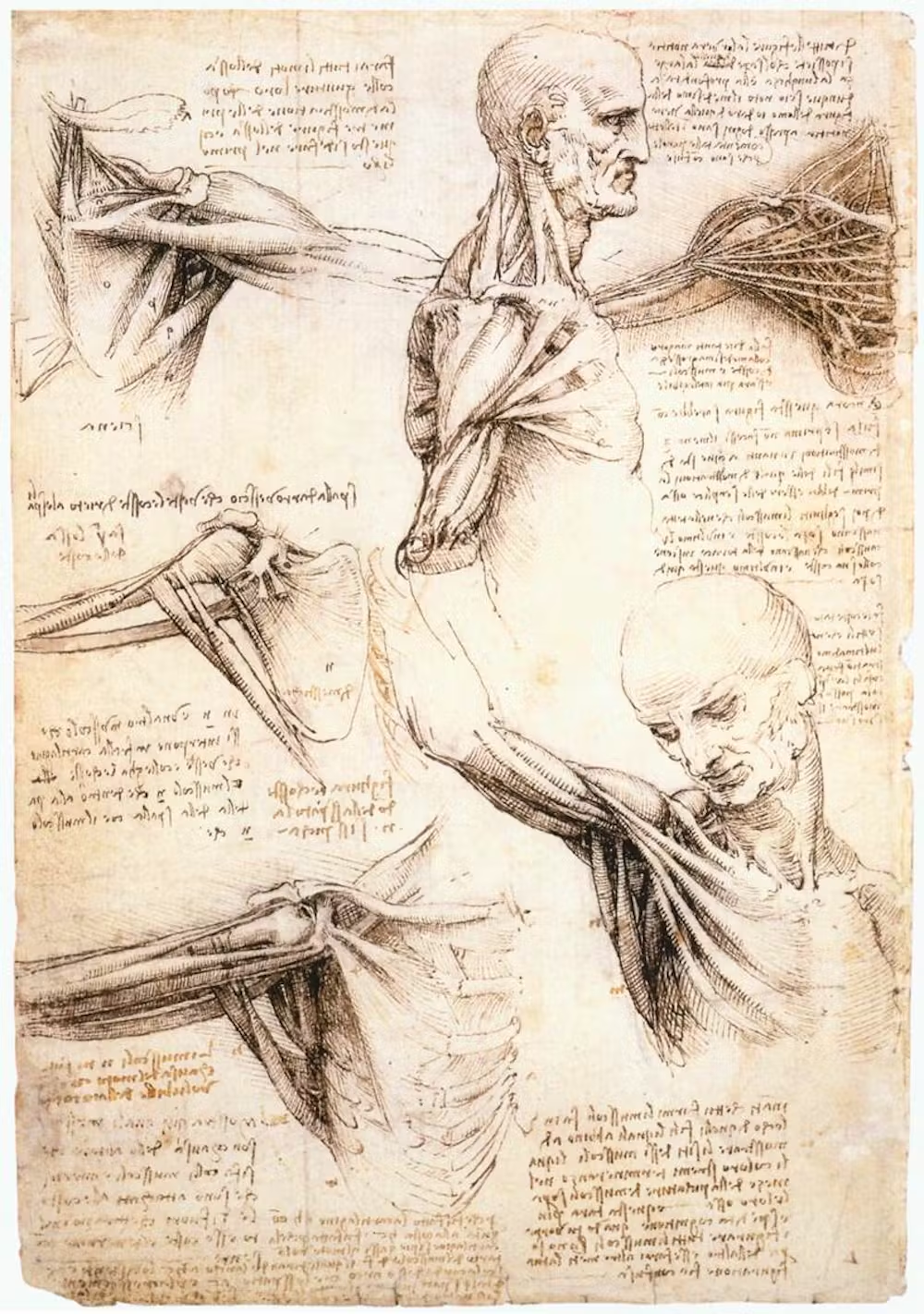
Artists like Leonardo da Vinci and Michelangelo studied human anatomy rigorously, often through dissection, to better understand how muscles, bones, and skin worked together. Leonardo’s anatomical sketches, including the famous Vitruvian Man, show his meticulous study of human proportions and his belief that the human body was a reflection of the harmony of the universe.

Michelangelo’s sculptures, particularly his iconic David (1501–1504), exemplify the Renaissance approach to the human form. The David is both anatomically precise and idealized, showcasing Michelangelo’s deep understanding of muscle structure and movement. The figure stands in a contrapposto pose, where the weight is shifted onto one leg, giving the sculpture a sense of naturalism and dynamism. This technique, borrowed from classical Greek and Roman sculpture, became a hallmark of Renaissance art and influenced generations of artists.

In painting, Raphael was renowned for his idealized and harmonious depictions of the human body. His fresco The School of Athens (1509–1511), located in the Vatican, features figures that are not only anatomically accurate but also imbued with grace and poise. Raphael’s mastery of anatomy, perspective, and composition allowed him to create works that encapsulated the Renaissance ideals of beauty, balance, and intellectual achievement.

Sfumato and Atmospheric Perspective

While chiaroscuro focused on the modeling of light and shadow, sfumato and atmospheric perspective were techniques that helped Renaissance artists depict depth and realism in their landscapes and backgrounds. Sfumato is a technique of softening transitions between colors and tones, creating a smoky, blurred effect that enhances the sense of depth.

Leonardo da Vinci’s Mona Lisa is one of the best-known examples of sfumato, where the soft transitions between light and shadow lend a subtle, lifelike quality to the face and hands. This technique not only makes the figure more realistic but also creates a mood of calmness and serenity.

Atmospheric perspective, also known as aerial perspective, was another tool used by Renaissance artists to create the illusion of depth. This technique involves changing the color and clarity of objects as they recede into the distance, mimicking the way the atmosphere affects how we perceive distant objects. Leonardo da Vinci was a pioneer of atmospheric perspective, as seen in the landscape background of the Mona Lisa, where the mountains fade into a blue-gray haze, enhancing the sense of vast space.

Foreshortening: Enhancing the Sense of Space

Another important Renaissance technique was foreshortening, a method used to depict objects or figures at an angle to the viewer to create the illusion of depth and three-dimensionality. By shortening the length of an object or figure in a way that matches the viewer’s perspective, artists could give their works a dynamic sense of realism.

One of the most famous examples of foreshortening is Andrea Mantegna’s The Lamentation over the Dead Christ (c. 1480), where the body of Christ is depicted in a strikingly realistic, recumbent pose. Mantegna’s use of foreshortening enhances the emotional impact of the scene, drawing the viewer into the depth of the composition and emphasizing the physicality of Christ’s body.

The Rediscovery of Classical Techniques

The Renaissance was, in many ways, a return to the ideals of classical antiquity. Inspired by the sculptures, architecture, and writings of ancient Greece and Rome, Renaissance artists sought to revive the classical principles of beauty, proportion, and harmony in their work.

Donatello, one of the most important sculptors of the early Renaissance, revived the classical tradition of free-standing nude sculptures with his bronze David (1440s), a work that reflected both classical ideals and the Renaissance focus on the human form. Similarly, architects like Brunelleschi and Alberti reintroduced classical proportions and symmetry in their buildings, influencing painters who applied these same principles to their compositions.

Conclusion

The Renaissance was a period of immense technical innovation in the arts. Through the mastery of techniques like linear perspective, chiaroscuro, and anatomical precision, Renaissance artists revolutionized the depiction of space, light, and form, bringing a new level of realism and emotional depth to their works. These innovations allowed artists to represent the human experience in a more lifelike and complex way, reflecting the broader intellectual currents of the time, including Humanism and the rediscovery of classical antiquity. The impact of these techniques continues to shape art today, as the principles of perspective, light, and form remain central to visual representation.

Renaissance Architecture: A Return to Classical Ideals

Renaissance Architecture: A Return to Classical Ideals

The Renaissance period, beginning in the early 15th century, marked a profound transformation in European art and culture, with architecture undergoing one of its most significant revolutions. Inspired by the rediscovery of ancient Roman and Greek texts and ruins, Renaissance architects sought to revive and reinterpret classical ideals, including symmetry, proportion, geometry, and the use of classical orders. The result was a movement that brought about some of the most iconic buildings and structures in Western history, shaping not only the aesthetics of the time but also influencing the course of architectural thought for centuries to come.

The Influence of Classical Antiquity

At the heart of Renaissance architecture was a deep admiration for the architecture of ancient Greece and Rome. Renaissance thinkers and architects, influenced by the Humanist ideals of the time, believed that the classical world had achieved a level of perfection in art and architecture that could serve as a model for their own society. This admiration for classical antiquity was fueled by the rediscovery of ancient texts, including the works of the Roman architect Vitruvius, whose treatise De Architectura (Ten Books on Architecture) became a foundational text for Renaissance architects.

Vitruvius emphasized the importance of three key principles in architecture: firmitas (strength), utilitas (functionality), and venustas (beauty). These principles, along with his detailed descriptions of classical proportions and the use of the classical orders (Doric, Ionic, and Corinthian), provided Renaissance architects with a blueprint for reviving and reinterpreting ancient architectural forms.

Key Elements of Renaissance Architecture

Renaissance architecture is defined by its emphasis on symmetry, proportion, geometry, and harmony. Architects of the time sought to create structures that were not only functional but also aesthetically pleasing, reflecting the Humanist belief in the balance between human intellect and the natural world. Several key elements characterize Renaissance architecture:

  • Symmetry and Proportion: Renaissance architects believed that buildings should reflect the harmony and order found in nature. This led to a focus on symmetrical designs and the careful use of proportion, often based on mathematical ratios derived from classical sources like Vitruvius and Plato.
  • Classical Orders: The use of classical columns and capitals (Doric, Ionic, and Corinthian) became a hallmark of Renaissance architecture. These orders were not merely decorative; they served as a way to create rhythm and structure within a building.
  • Domes and Arches: Domes, a key feature of Roman architecture, were revived during the Renaissance, symbolizing both the grandeur of ancient Rome and the divine. The use of rounded arches and barrel vaults also became common, creating a sense of strength and stability in buildings.
  • Geometrical Clarity: Renaissance architects used geometric shapes, particularly circles and squares, as the basis for their designs. These shapes were believed to reflect the perfect forms found in nature and the cosmos.

Filippo Brunelleschi and the Florence Cathedral

One of the earliest and most influential figures in Renaissance architecture was Filippo Brunelleschi (1377–1446), whose design for the dome of the Florence Cathedral (Santa Maria del Fiore) is widely regarded as a masterpiece of engineering and architecture. Completed in 1436, Brunelleschi’s dome was the largest in the world at the time and remains an iconic symbol of the Renaissance.

Brunelleschi’s innovative use of a double-shell dome and his mastery of classical proportion allowed him to solve the problem of constructing a dome without the use of traditional wooden centering. His work marked a turning point in architectural history, blending classical forms with cutting-edge engineering techniques. Brunelleschi’s success with the dome inspired a new generation of architects to experiment with scale, proportion, and classical forms.

Beyond the dome, Brunelleschi’s work on structures like the Ospedale degli Innocenti (The Hospital of the Innocents) showcased his ability to apply classical principles to urban and civic architecture. The loggia’s use of round arches, Corinthian columns, and proportional spacing reflected the ideals of harmony and balance that would become central to Renaissance architecture.

Leon Battista Alberti: Theoretical Foundations

While Brunelleschi was a pioneer in practical architecture, Leon Battista Alberti (1404–1472) provided the theoretical foundation for Renaissance architectural thought. Alberti was a Humanist scholar, architect, and writer whose treatise De Re Aedificatoria (On the Art of Building), published in 1452, became one of the most important architectural texts of the Renaissance. In it, Alberti laid out the principles of classical architecture, drawing heavily on Vitruvius and emphasizing the importance of proportion, symmetry, and beauty.

Alberti’s architectural designs reflected his belief in the harmonious relationship between a building’s form and function. His work on churches such as San Sebastiano and Sant’Andrea in Mantua demonstrated his ability to blend classical elements with Christian religious structures. Alberti’s use of classical orders, triumphal arches, and pediments helped create a sense of grandeur and monumentality that would influence religious architecture throughout Italy.

Alberti also designed urban structures, including the famous façade of the Palazzo Rucellai in Florence. The Palazzo’s use of classical pilasters, horizontal entablatures, and proportional spacing reflected Alberti’s vision of the city as an extension of nature, where architecture could create harmony and order in the urban environment.

Donato Bramante and the High Renaissance

As the Renaissance progressed, architectural forms became more monumental and grandiose, particularly during the High Renaissance. One of the key figures of this period was Donato Bramante (1444–1514), whose work on St. Peter’s Basilica in Rome is considered one of the most important achievements of Renaissance architecture. Commissioned by Pope Julius II, Bramante’s design for St. Peter’s included a massive central dome, inspired by the Pantheon, and a Greek cross plan, reflecting the ideals of classical symmetry and proportion.

Bramante’s work marked a shift toward more expansive and monumental architecture, influencing later architects such as Michelangelo, who would eventually complete the dome of St. Peter’s. Bramante’s other works, including the Tempiettoat San Pietro in Montorio, are celebrated for their clarity of form and their perfect use of classical proportions. The Tempietto, a small circular temple, is often regarded as the embodiment of High Renaissance ideals, with its harmonious use of Doric columns and a central plan that reflects the principles of geometric order.

Andrea Palladio and the Legacy of Renaissance Architecture

One of the most influential architects of the later Renaissance was Andrea Palladio (1508–1580), whose work and writings had a profound impact on European architecture. Palladio is best known for his villas and palaces in the Veneto region, as well as his architectural treatise I Quattro Libri dell’Architettura (The Four Books of Architecture), published in 1570.

Palladio’s designs, such as Villa Rotonda and Villa Barbaro, are characterized by their use of classical symmetry, proportionality, and the integration of architecture with the natural landscape. His villas often featured porticos with classical columns, echoing the temples of ancient Rome, and his designs aimed to create a seamless relationship between the interior and exterior spaces.

Palladio’s influence extended well beyond Italy. His architectural principles, particularly his emphasis on classical forms and harmonic proportions, became the foundation for Palladianism, an architectural style that spread across Europe and the Americas in the 17th and 18th centuries. His work influenced architects as far away as England, where Palladianism became synonymous with elegance and classical refinement.

The Lasting Legacy of Renaissance Architecture

The impact of Renaissance architecture was far-reaching, shaping not only the buildings of the time but also influencing future generations of architects and urban planners. The emphasis on symmetry, proportion, and the revival of classical forms became the basis for many later architectural movements, including Neoclassicism in the 18th century and the Beaux-Arts style in the 19th century.

Renaissance architecture also helped transform cities. The urban landscape of places like Florence, Rome, and Venice was reimagined during the Renaissance, with public squares, churches, palaces, and civic buildings designed to reflect the ideals of harmony and balance. The Renaissance vision of the city as a reflection of nature’s order remains an enduring concept in urban design.

Conclusion

Renaissance architecture was a bold reimagining of the classical ideals of proportion, symmetry, and beauty. Inspired by the architectural achievements of ancient Greece and Rome, Renaissance architects like Brunelleschi, Alberti, Bramante, and Palladio created structures that embodied the harmony and balance that defined the Renaissance as a whole. Their works not only transformed the built environment of their time but also left a lasting legacy that continues to inspire architects and designers to this day.

The Printing Press and the Spread of Ideas

The Printing Press and the Spread of Ideas

The invention of the printing press by Johannes Gutenberg in the mid-15th century marked a turning point in the history of communication, knowledge dissemination, and culture. This revolutionary technology fundamentally transformed the Renaissance, enabling the rapid spread of ideas, the democratization of knowledge, and the growth of literacy across Europe. It is impossible to overstate the importance of the printing press: it accelerated the diffusion of Humanist ideas, fueled the Protestant Reformation, and laid the foundation for the Scientific Revolution. By making books and other printed materials widely available, the printing press helped shape modern Western thought and culture.

The Invention of the Printing Press

Before the advent of the printing press, books were painstakingly copied by hand, usually by scribes in monasteries. This process was time-consuming, costly, and limited the availability of texts to a small, wealthy elite. Books were rare, expensive commodities, and literacy was restricted to the clergy, nobility, and a few scholars. However, by the early 15th century, Europe was experiencing increased demand for written works due to the growing influence of Humanism, the rise of universities, and an expanding merchant class seeking education.

Johannes Gutenberg, a German blacksmith, goldsmith, and inventor, responded to this demand by developing a system of movable type printing in the 1440s. The key innovation of the Gutenberg press was the use of individual, reusable metal letters and characters, which could be arranged to form words and sentences, then inked and pressed onto paper. This method was far faster and more efficient than hand-copying or woodblock printing, allowing for the mass production of books and pamphlets at a fraction of the time and cost.

In 1455, Gutenberg produced his first major work, the Gutenberg Bible, which is regarded as one of the masterpieces of early printing. The Bible’s widespread distribution demonstrated the power of the press to reach a wide audience, and it quickly became evident that this invention would transform the way knowledge was shared.

The Democratization of Knowledge

The printing press had a profound impact on literacy and education. By making books more affordable and accessible, it allowed knowledge to spread beyond the confines of monasteries and universities. As printed books became more available, literacy rates in Europe began to rise, particularly among the emerging middle class. For the first time, a much broader segment of society had access to literature, philosophy, and science.

Humanist scholars, eager to spread the ideas of the Renaissance, took full advantage of the printing press. Classical works that had been rediscovered and translated into Latin, such as those by PlatoAristotleCicero, and Virgil, were now printed and widely distributed, promoting the revival of classical learning. Humanist thinkers like Erasmus used the press to publish new translations of the Bible and ancient texts, ensuring that these works could reach a far wider audience than ever before.

Erasmus, one of the leading Humanists of the time, became a prolific writer, using the printing press to distribute his ideas across Europe. His works, including the famous In Praise of Folly, reached thousands of readers and fueled intellectual debates about religion, education, and ethics. In a letter to a friend, Erasmus famously declared, “I will speak to the whole of Europe,” illustrating how the press allowed individuals to reach audiences on a continental scale.

Fueling the Protestant Reformation

One of the most significant impacts of the printing press was its role in the Protestant Reformation. The press enabled rapid and widespread dissemination of Martin Luther’s 95 Theses, which he posted in 1517, criticizing the Catholic Church’s practices, particularly the sale of indulgences. Luther’s ideas spread like wildfire across Europe, thanks to the printing press, which allowed for the rapid production of pamphlets and books advocating for reform.

The Reformation was, in many ways, a product of the printing revolution. Without the press, it is unlikely that Luther’s ideas would have spread so quickly or gained such traction among both the educated elite and the common people. For the first time, religious debates could be conducted on a mass scale, as pamphlets, books, and broadsheets reached far beyond the pulpit or university lecture hall.

Luther himself recognized the power of the printing press. In a letter, he noted, “Printing is the ultimate gift of God and the greatest one.” His translation of the Bible into German was one of the most significant uses of the press. It made the scriptures accessible to the common people in their own language, allowing individuals to read and interpret the Bible for themselves, undermining the Catholic Church’s monopoly on religious knowledge.

The Catholic Church also made use of the printing press, publishing counter-Reformation texts in an attempt to combat the spread of Protestantism. However, it became increasingly clear that the printed word had shifted the balance of power in religious and intellectual discourse.

The Spread of Scientific Knowledge

The printing press also played a critical role in the development of science during the Renaissance. Scientists and scholars could now share their discoveries, theories, and experiments with a wide audience. The press enabled the dissemination of scientific knowledge across Europe, fostering collaboration and debate among intellectuals.

One of the most significant examples of this is Nicolaus Copernicus’ De Revolutionibus Orbium Coelestium (On the Revolutions of the Heavenly Spheres), published in 1543. This book, which proposed a heliocentric model of the solar system, challenged the long-held geocentric view supported by the Church. Copernicus’ ideas were controversial, but the printing press ensured that they reached scholars and scientists across Europe, paving the way for the Scientific Revolution.

Similarly, the work of scientists like Galileo GalileiJohannes Kepler, and Andreas Vesalius benefited from the ability to publish their findings. Galileo’s use of the telescope to observe the heavens and Vesalius’ detailed anatomical studies were shared through printed books, accelerating the exchange of knowledge and ideas that led to groundbreaking discoveries in physics, astronomy, and medicine.

The Printing Press and the Arts

The arts were not immune to the transformative power of the printing press. The publication of printed music allowed for the wider dissemination of compositions, particularly in secular settings. Composers like Josquin des Prez and Claudio Monteverdi saw their works printed and distributed across Europe, contributing to the spread of Renaissance musical forms and ideas.

Additionally, the printing press helped spread the works of Renaissance artists, including Leonardo da Vinci and Michelangelo, who benefited from the widespread circulation of their drawings and ideas. While art itself could not be replicated by the press, engravings and reproductions of famous works allowed for a broader appreciation of Renaissance art beyond the original locations of the pieces.

Lasting Impact on Society

The invention of the printing press had far-reaching consequences for the development of modern society. It laid the foundation for the Enlightenment by promoting the exchange of ideas and the spread of knowledge. The press also contributed to the rise of national languages, as books were increasingly printed in vernacular languages rather than Latin, fostering a sense of national identity.

Moreover, the press was instrumental in the development of modern education. Schools and universities were able to produce and distribute textbooks more efficiently, making education more widely accessible. The press also allowed for the growth of public libraries, where people could access books and acquire knowledge outside of formal schooling.

Conclusion

The printing press was one of the most transformative inventions in history, changing the way knowledge was produced, shared, and consumed. It democratized information, gave rise to new intellectual movements, and reshaped religion, science, and education. From the spread of Humanism to the Protestant Reformation and the Scientific Revolution, the printing press was at the heart of the Renaissance’s greatest achievements. Its legacy continues to shape the modern world, as the dissemination of knowledge remains a cornerstone of progress and human advancement.

Florence: The Cradle of the Renaissance

Florence: The Cradle of the Renaissance

The city of Florence is often considered the birthplace of the Renaissance, a period of extraordinary artistic, intellectual, and cultural revival that swept across Europe between the 14th and 17th centuries. Florence’s unique political, economic, and social conditions made it a fertile ground for this flourishing of human achievement. With its powerful patrons, wealth from banking and trade, and a concentration of creative talent, Florence became the nucleus of Renaissance art, literature, philosophy, and science, shaping the trajectory of Western civilization.

Florence’s Political and Economic Power

In the late Middle Ages, Florence emerged as one of the wealthiest and most influential city-states in Italy. Its prosperity was largely due to its dominance in the textile industry and its powerful banking families, particularly the Medici. Florence was not a monarchy but a republic, governed by wealthy merchants and noble families. This unique political structure allowed for a relatively open society where individuals could ascend the social ladder through trade, commerce, and talent.

One of the key drivers of the Renaissance in Florence was its economic power. The city was home to some of the wealthiest and most powerful banking families in Europe, most notably the Medici family. Under the leadership of Cosimo de’ Medici and his grandson Lorenzo the Magnificent, the Medici used their vast wealth to sponsor artists, architects, and scholars, creating an environment where creativity and innovation could thrive.

Lorenzo de’ Medici, in particular, played a pivotal role as a patron of the arts. He supported some of the greatest Renaissance figures, including Leonardo da Vinci, Michelangelo, and Sandro Botticelli. His court became a hub of intellectual and artistic activity, attracting scholars, poets, and humanists who exchanged ideas and shaped the cultural landscape of Florence.

The Medici Family: Patrons of the Renaissance

The Medici family’s influence extended beyond economics and politics. As patrons of the arts, they provided the financial backing that allowed the Renaissance to flourish. Their support for artists, architects, and scholars not only helped create some of the most iconic works of the Renaissance but also solidified Florence’s position as the cultural capital of the movement.

Cosimo de’ Medici, known as Pater Patriae (“Father of the Nation”), was instrumental in commissioning public works, including the construction of churches, libraries, and palaces. One of his greatest legacies was funding the construction of the Florence Cathedral’s dome, designed by Filippo Brunelleschi. The dome was an architectural marvel of its time, and it symbolized the ingenuity and creativity that characterized the Renaissance.

Lorenzo de’ Medici, often referred to as Lorenzo the Magnificent, took his grandfather’s role as a patron to new heights. Under his guidance, Florence became a center of artistic innovation. Lorenzo’s patronage extended to many of the leading artists of the Renaissance, including Sandro Botticelli, who created some of his most famous works, such as The Birth of Venus and Primavera, under Lorenzo’s support.

Florence’s Artistic Revolution

Florence’s artistic revolution was fueled by a combination of patronagecompetition, and the rediscovery of classical ideals. The city’s artists, sculptors, and architects looked back to ancient Greece and Rome for inspiration, merging classical aesthetics with contemporary themes.

The Florence Cathedral, particularly its iconic dome designed by Filippo Brunelleschi, became a symbol of the city’s artistic and architectural prowess. Brunelleschi’s dome was the largest of its kind and a feat of engineering genius. Brunelleschi’s use of classical proportions and innovative construction techniques marked a turning point in Renaissance architecture, influencing future generations of architects, including Michelangelo.

In addition to Brunelleschi’s architectural contributions, Florence was home to some of the greatest painters and sculptors of the Renaissance. Donatello, one of the most important sculptors of the early Renaissance, revolutionized sculpture by creating the first free-standing nude statue since antiquity, his David. Donatello’s work captured the human form in a naturalistic and lifelike way, reflecting the Humanist ideals of the time.

Masaccio, another Florentine painter, was a pioneer in the use of perspective in painting. His frescoes in the Brancacci Chapel, particularly The Tribute Money, demonstrate his mastery of linear perspective, which gave depth and realism to his figures. This technique would become a hallmark of Renaissance painting, influencing artists such as Leonardo da Vinci and Michelangelo.

The Intellectual Climate of Florence

The Renaissance was not just an artistic movement; it was also an intellectual one, and Florence was at the center of this revival of classical learning and Humanist thought. Humanism, a movement that emphasized the study of classical texts, the dignity of the individual, and secular knowledge, flourished in Florence. Humanists sought to revive the ideas of ancient Greece and Rome, believing that studying the works of thinkers like Plato, Aristotle, and Cicero could lead to a deeper understanding of the human experience.

Petrarch, often considered the “Father of Humanism,” laid the intellectual foundation for the movement by reviving interest in classical texts and promoting the idea that individuals could achieve greatness through knowledge and self-improvement. While Petrarch was not a Florentine, his ideas deeply influenced the intellectual culture of Florence, where Humanism found fertile ground.

Florentine intellectuals like Marsilio Ficino and Pico della Mirandola were central to the development of Renaissance philosophy. Ficino, under the patronage of the Medici family, translated the works of Plato into Latin, making them accessible to a wider audience and integrating Platonic thought into Renaissance Humanism. Pico della Mirandola, in his Oration on the Dignity of Man, expressed the Humanist belief in the potential for human greatness and the power of free will. These thinkers contributed to the intellectual climate that encouraged inquiry, innovation, and the pursuit of knowledge in all fields.

Florence’s Lasting Influence on the Renaissance

The influence of Florence on the Renaissance cannot be overstated. The city not only produced some of the greatest artists, architects, and thinkers of the time but also fostered an environment where creativity and intellectual exploration could flourish. The Medici’s support of the arts and Humanism set a precedent for other Italian city-states, such as Venice and Milan, and even beyond Italy’s borders, as Renaissance ideals spread across Europe.

Florence’s role in the Renaissance extended far beyond its borders. Artists who trained or worked in Florence, such as Leonardo da VinciMichelangelo, and Raphael, went on to shape the High Renaissance, taking the artistic and intellectual innovations of Florence to new heights. Florence’s focus on the individual, its revival of classical ideals, and its embrace of Humanism had a profound and lasting impact on Western culture.

Conclusion

Florence’s unique combination of political power, economic wealth, artistic talent, and intellectual dynamism made it the cradle of the Renaissance. The city’s leaders, particularly the Medici family, played a pivotal role in fostering the arts and promoting Humanist ideals. Florence became a beacon of creativity, innovation, and intellectual pursuit, shaping the course of European history and leaving an enduring legacy that continues to inspire scholars, artists, and thinkers today.

The Rise of Humanism and Its Impact on Renaissance Thought

The Rise of Humanism and Its Impact on Renaissance Thought

The Renaissance, which spanned from the 14th to the 17th century, was marked by an intellectual and cultural rebirth that profoundly reshaped Europe. Central to this transformation was the rise of Humanism, a movement that placed human beings at the center of the intellectual world. Humanism emphasized the study of classical antiquity—Greek and Roman philosophy, literature, and art—and focused on human potential, individualism, and secular knowledge. This shift away from the strictly religious worldview of the Middle Ages had a lasting impact on Renaissance thought, education, and art.

Humanism’s Classical Roots

The seeds of Humanism were sown in the late Middle Ages as scholars in Italy began rediscovering ancient texts by classical authors like Plato, Aristotle, Cicero, and Virgil. For centuries, much of this knowledge had been lost or ignored in favor of religious and theological texts. However, by the 14th century, scholars such as Petrarch—often considered the “Father of Humanism”—sought to revive these ancient sources and promote their study as a path to intellectual and moral improvement.

Humanists believed that studying the classics would lead to a better understanding of human nature and the world. They rejected the scholasticism of the medieval period, which focused on religious dogma and rigidly structured debates. Instead, Humanism celebrated individual inquiry, critical thinking, and the exploration of secular subjects like history, ethics, and literature.

Key Figures of Humanism

Petrarch (1304–1374) was one of the earliest and most influential Humanists. He believed in the potential of the individual to achieve greatness through knowledge and self-reflection. His famous letters to ancient figures like Cicero symbolized his desire to communicate with the great thinkers of the past and bring their wisdom into the modern world. Petrarch’s belief that humans could shape their own destinies through education and reason became a hallmark of Humanist philosophy.

Following in Petrarch’s footsteps was Giovanni Boccaccio (1313–1375), whose work The Decameron is not only a cornerstone of Italian literature but also an important document of Humanist values. The Decameron presents a series of stories told by a group of people fleeing the plague, highlighting themes of love, fortune, and human behavior. Boccaccio’s vivid portrayal of the complexities of human life, with both its virtues and vices, embodied the Humanist fascination with human experience.

Another key figure was Lorenzo Valla (1407–1457), a scholar and priest who exemplified the Humanist desire to apply critical thinking to all areas of knowledge, including religious texts. His famous work, On the Donation of Constantine, used philological analysis to prove that a document granting political power to the Pope was a forgery. Valla’s critical approach to historical sources reflected the growing Renaissance belief in questioning authority and relying on evidence.

Humanism’s Impact on Education and Society

One of the most significant impacts of Humanism was its influence on education. The rise of Humanism led to the establishment of new curricula in universities that prioritized the studia humanitatis, or the study of the humanities. This curriculum included grammar, rhetoric, history, poetry, and moral philosophy—subjects drawn from classical antiquity that were designed to cultivate a well-rounded, virtuous individual.

This focus on the humanities marked a significant shift from the medieval educational system, which had been dominated by theology and logic. Humanists believed that education should not only prepare individuals for religious vocations but also equip them for active participation in civic life. This idea, known as civic humanism, encouraged individuals to apply their knowledge to improve society. Thinkers like Leon Battista Alberti (1404–1472) promoted the idea of the “Renaissance man”—a person who is skilled in multiple fields and can contribute to the common good.

Humanism’s emphasis on individual potential also encouraged people to challenge long-held beliefs and authorities. The notion that humans could rely on reason and experience to understand the world laid the groundwork for the scientific inquiry and innovation that characterized the later Renaissance. Humanism played a key role in the Scientific Revolution, inspiring thinkers like Galileo and Copernicus to question established knowledge and seek new explanations for natural phenomena.

Humanism and the Arts

In the realm of art, Humanism had a profound influence on how artists approached their work. Whereas medieval art had focused almost exclusively on religious themes and followed strict conventions, Renaissance artists, inspired by Humanist ideals, sought to portray the human experience in all its richness and variety. Artists like Leonardo da Vinci and Michelangelo studied human anatomy to create lifelike depictions of the human form, reflecting the Humanist belief in the beauty and potential of the individual.

Leon Battista Alberti, an architect and Humanist scholar, wrote treatises on painting and architecture that emphasized the importance of proportion, perspective, and harmony—principles drawn from classical antiquity. These ideas would shape the work of Renaissance artists and architects, who sought to combine beauty with balance, order, and realism.

Humanism also encouraged artists to explore secular themes. Mythology, history, and portraits became popular subjects alongside traditional religious works. Botticelli’s The Birth of Venus, for example, depicts the classical goddess of love in a celebration of both beauty and classical mythology, while Michelangelo’s David glorifies the human form and individual heroism.

Humanism’s Broader Impact

Beyond education and the arts, Humanism had a wide-ranging impact on European society. It fostered a spirit of intellectual inquiry and debate, which would shape the political and religious movements of the era, including the Protestant Reformation. Humanist scholars like Erasmus called for a return to simple Christian piety and criticized the corruption within the Catholic Church, helping to lay the intellectual groundwork for reform.

Humanism’s emphasis on secular knowledge and critical thinking also influenced political thought. Figures like Niccolò Machiavelli applied Humanist principles to politics, advocating for pragmatism and a focus on human behavior in his famous work The Prince. This approach marked a departure from the medieval view of politics, which had been closely tied to religious authority.

Conclusion

The rise of Humanism was a defining feature of the Renaissance, bringing a new focus on the potential, dignity, and beauty of the individual. Through the revival of classical learning, Humanism reshaped education, the arts, and intellectual life, setting the stage for the remarkable achievements of the Renaissance. Its influence can be seen in the works of artists, thinkers, and writers who sought to explore the richness of the human experience and challenge the boundaries of knowledge. In doing so, Humanism laid the foundation for modern thought, encouraging individuals to seek truth, question authority, and celebrate the power of human reason and creativity.

Sandro Botticelli

Sandro Botticelli: The Poet of Beauty and Mythology

Alessandro di Mariano di Vanni Filipepi, known as Sandro Botticelli (1445–1510), was a master of the Italian Renaissance who created some of the most iconic images of the era. Botticelli’s art is renowned for its poetic grace, delicate forms, and exploration of mythological and religious themes. His masterpieces, such as The Birth of Venus and Primavera, embody the Renaissance spirit, with their fusion of classical ideals and Christian symbolism, making him one of the most influential painters of the 15th century.

Early Life and Training

Botticelli was born in Florence, a city that was the cultural epicenter of the early Renaissance. His early training was under Fra Filippo Lippi, one of the most respected painters of his time, whose style deeply influenced Botticelli’s approach to form and composition. Lippi’s emphasis on soft contours, flowing lines, and emotional expressions became key elements in Botticelli’s work.

Botticelli’s early works, such as Adoration of the Magi, reflect his mastery of religious themes and portraiture, as well as his ability to create intricate compositions with a sense of harmony and balance. His association with the Medici family, particularly Lorenzo the Magnificent, gave him access to the greatest intellectual and artistic circles of Florence, which would significantly shape his career.

Mythology and Beauty: The Birth of Venus and Primavera

Botticelli’s most famous works are his mythological paintings, particularly The Birth of Venus and Primavera. These paintings are celebrated not only for their technical brilliance but also for their exploration of beauty, nature, and mythology.

The Birth of Venus is one of the most iconic images in Western art. It depicts the goddess Venus emerging from the sea, standing gracefully on a seashell as she is blown toward the shore by the wind gods Zephyr and Aura. Venus, nude and idealized, embodies the Renaissance celebration of classical beauty and the revival of Greco-Roman mythology. Botticelli’s use of soft lines, flowing hair, and ethereal color palette creates a sense of otherworldly beauty, emphasizing the divine nature of Venus as the goddess of love.

Equally famous is Primavera, a complex and allegorical painting that features a group of mythological figures in a lush garden. The central figure, Venus, stands in a grove surrounded by figures representing the three Graces, Mercury, Flora, and Zephyr. The painting is rich with symbolism, often interpreted as an allegory of love, fertility, and the rejuvenating power of nature. Botticelli’s graceful figures, painted with delicate lines and translucent drapery, move as if they are part of an elaborate dance, evoking a timeless sense of harmony.

Both The Birth of Venus and Primavera reflect Botticelli’s fascination with the human form and the natural world, as well as his ability to convey complex ideas through visual poetry. These works are masterpieces of Renaissance humanism, combining the ideals of classical antiquity with a subtle Christian morality, presenting beauty not just as an aesthetic experience, but as a gateway to the divine.

Religious Devotion: The Mystical Nativity and The Cestello Annunciation

While Botticelli is best known for his mythological works, his religious paintings also hold an important place in his oeuvre. Later in his career, Botticelli produced several works that reflect his deepening religious devotion and the influence of the reformist preacher Savonarola, whose calls for spiritual renewal resonated throughout Florence.

One of Botticelli’s most striking religious works is The Mystical Nativity, painted around 1500. This painting depicts the birth of Christ with a highly symbolic and visionary approach, reflecting Botticelli’s growing interest in apocalyptic themes. Angels, shepherds, and the Holy Family are presented in a dramatic, otherworldly scene, with the heavens opening above and angels descending in glory. The painting’s rich symbolism and spiritual intensity mark a departure from the more serene and classical compositions of Botticelli’s earlier works, indicating the artist’s shift toward a more personal, devotional style.

Another important religious painting is The Cestello Annunciation, which depicts the angel Gabriel announcing to the Virgin Mary that she will bear the Son of God. The scene is marked by Botticelli’s characteristic grace and elegance, with flowing drapery and delicate expressions. The painting’s subtle use of perspective and light adds to its spiritual atmosphere, while the poised gestures of the figures create a sense of reverence and calm.

Botticelli’s Style: A Marriage of Line and Emotion

What distinguishes Botticelli from other Renaissance masters is his exceptional use of line. Unlike Leonardo’s emphasis on chiaroscuro (light and shadow) and Michelangelo’s muscular figures, Botticelli’s art is defined by its linear quality. His figures are outlined with delicate, flowing lines that give them a sense of lightness and grace, as though they are suspended in a timeless space. This approach creates an emotional intensity, focusing the viewer’s attention on the expressions and gestures of the figures, which often convey a sense of longing, melancholy, or quiet contemplation.

Botticelli’s color palette is also distinctive, with soft pastel hues that enhance the dreamlike quality of his paintings. His use of gold, particularly in the hair and garments of his figures, adds a divine and otherworldly glow, reinforcing the spiritual themes present in much of his work.

Legacy and Influence of Sandro Botticelli

Botticelli’s legacy is inseparable from his ability to blend beauty with profound symbolism, making his works not only visual masterpieces but also rich tapestries of meaning. His unique style, characterized by flowing lines, ethereal beauty, and a dreamlike quality, has left an indelible mark on Western art, particularly through his depictions of mythology and religious subjects.

One of Botticelli’s most enduring contributions is his portrayal of mythological themes through a Renaissance lens. His masterpieces The Birth of Venus and Primavera exemplify this. In The Birth of Venus, Botticelli celebrates classical mythology and humanistic ideals, depicting the goddess of love and beauty emerging from the sea on a shell. Venus, with her flowing golden hair and poised expression, embodies the Renaissance ideal of beauty—graceful, harmonious, and otherworldly. The painting is not only an homage to the classical world but also a reflection of the humanist revival, symbolizing love and the divine in human form.

Similarly, Primavera is a complex allegory of love, beauty, and fertility, filled with mythological figures like Venus, Mercury, and the Three Graces. The painting is often interpreted as a celebration of spring and renewal, but it also reflects deeper philosophical and poetic ideas. Botticelli’s ability to combine beauty with intellectual depth made these works iconic, and they remain central to the study of Renaissance art.

While his mythological paintings are perhaps his most famous, Botticelli was also a master of religious art. His Adoration of the Magi and numerous Madonnas are imbued with a spiritual intimacy, where figures are treated with tenderness and a serene, contemplative mood. His use of composition, where the figures seem to move within a harmonious, rhythmic space, gives his religious paintings a grace that transcends their narrative content, inviting viewers into a meditative experience.

Botticelli’s ability to convey emotion and spirituality with such subtlety and elegance influenced generations of artists. His meticulous attention to detail and his mastery of the human form were studied by later artists during the High Renaissance and beyond. Although Botticelli’s work fell out of favor during the late 16th and 17th centuries—overshadowed by the grandeur of Michelangelo, Leonardo da Vinci, and Raphael—it experienced a significant revival in the 19th century, particularly with the rise of the Pre-Raphaelite Brotherhood in England. These artists admired Botticelli’s use of color, his graceful forms, and his ability to infuse narrative scenes with emotional depth. The Pre-Raphaelites sought to return to the purity and sincerity of early Renaissance art, and they found in Botticelli a model of artistic integrity and beauty.

Today, Botticelli’s influence can be seen in modern and contemporary art as well. His iconic images, especially The Birth of Venus, have become symbols of ideal beauty and creativity, inspiring countless reinterpretations and adaptations in various forms of media, from painting to fashion to film.

Botticelli’s Renaissance Humanism

Botticelli’s work is deeply rooted in Renaissance humanism, a movement that sought to revive the art, philosophy, and values of classical antiquity while emphasizing the dignity of the individual and the potential for human achievement. His paintings reflect the fusion of Christian themes with classical mythology, often expressing complex philosophical ideas through allegory. This blending of sacred and secular, ancient and contemporary, defines much of his most celebrated work.

In The Birth of Venus, for example, Venus can be seen as both a classical goddess and a symbol of divine love and spiritual beauty, representing the humanist idea that earthly beauty can lead to a contemplation of the divine. The serene, idealized faces in Botticelli’s paintings, along with their perfect proportions and harmonious compositions, mirror the humanist belief in balance, reason, and the pursuit of higher knowledge.

Conclusion: Botticelli’s Timeless Elegance

Sandro Botticelli remains one of the defining figures of the early Renaissance, his art characterized by its lyricism, elegance, and intellectual depth. His ability to combine the ethereal with the earthly, the mythological with the religious, set him apart as a true poet of beauty. Though his style was unique, he embodied the spirit of his time, merging Renaissance humanism with a deeply personal vision of art that continues to resonate across the centuries.

Botticelli’s legacy lies not only in his exquisite paintings but also in his ability to capture the spiritual and intellectual currents of his era. His works invite us to explore the rich intersection of beauty, philosophy, and devotion that defined the Renaissance, and to appreciate art as both an aesthetic and a moral force. Today, his images of Venus, the Virgin Mary, and other figures stand as timeless representations of human potential, divine grace, and the eternal pursuit of beauty.

Raffaello Sanzio da Urbino

Raphael: The Master of Grace and Harmony

Raffaello Sanzio da Urbino, known simply as Raphael (1483–1520), is one of the most admired artists of the Italian Renaissance, renowned for his ability to infuse grace, harmony, and beauty into everything he touched. Alongside Leonardo da Vinci and Michelangelo, Raphael forms the triad of the High Renaissance’s greatest masters. Though his life was tragically short, Raphael’s impact on Western art was profound, and his works remain some of the most celebrated and influential in art history.

Early Life and Artistic Training

Raphael was born in Urbino, a cultural center of the Renaissance, where his father, Giovanni Santi, was a court painter. Surrounded by art from an early age, Raphael quickly developed a talent for painting, studying the works of prominent artists in his father’s workshop. After his father’s death, Raphael was sent to Perugia to study under Pietro Perugino, one of the leading painters of the day. Under Perugino’s tutelage, Raphael mastered the techniques of composition, clarity, and a refined sense of perspective, all of which would define his later work.

By the time he reached his twenties, Raphael had become an accomplished artist, quickly gaining commissions for altarpieces, frescoes, and portraits. His early works, such as The Marriage of the Virgin, already demonstrate his remarkable skill in creating balanced, harmonious compositions with lifelike figures, imbued with an ethereal beauty.

Masterpieces of Painting: The School of Athens and the Sistine Madonna

Raphael’s most famous works are marked by an unparalleled ability to depict serene beauty and spiritual depth. His fresco The School of Athens, located in the Vatican’s Stanza della Segnatura, is considered one of the greatest masterpieces of the Renaissance. Commissioned by Pope Julius II, this grand fresco illustrates Raphael’s mastery of composition and his understanding of philosophy, science, and humanism.

The School of Athens depicts an imagined gathering of the greatest philosophers, scientists, and thinkers of classical antiquity. At the center of the fresco are Plato and Aristotle, symbolizing the union of idealism and realism, flanked by figures such as Socrates, Pythagoras, and Ptolemy. What makes this painting extraordinary is not only the sheer number of figures included, but also Raphael’s ability to give each one a distinct personality and role within the composition. The architecture, reminiscent of ancient Rome, lends an air of grandeur and balance, reflecting the intellectual harmony of the Renaissance itself.

Another iconic work, the Sistine Madonna, demonstrates Raphael’s unparalleled ability to depict religious themes with tenderness and grace. Painted for the church of San Sisto in Piacenza, the Sistine Madonna is a devotional image of the Virgin Mary holding the Christ Child, flanked by saints. The soft, flowing lines, the serene expressions, and the gentle, maternal love radiating from the Madonna capture Raphael’s gift for portraying divine beauty in human form. The two cherubs resting at the bottom of the painting have become some of the most famous figures in art, their wistful, innocent expressions symbolizing the wonder of the divine.

Portraiture: Capturing the Soul

While Raphael is best known for his religious and historical compositions, he was also a master of portraiture. His portraits stand out for their psychological depth and lifelike detail. Raphael’s ability to capture the inner life of his subjects, their dignity, and their emotional complexity was revolutionary for his time.

Among his most famous portraits is La Fornarina, thought to be a depiction of his lover, Margherita Luti. The painting conveys an intimacy and affection that is unusual in traditional portraiture, suggesting the personal bond between the artist and his subject. The soft modeling of her face, the delicate play of light on her skin, and the suggestive gaze of the woman all reflect Raphael’s mastery of human emotion.

His Portrait of Baldassare Castiglione is another masterpiece, reflecting the Renaissance ideals of the perfect gentleman. Castiglione, a courtier and humanist, is depicted with a calm, noble expression, his elegance and wisdom conveyed through subtle details such as the rich fabrics of his clothing and the contemplative look in his eyes. Raphael’s ability to convey the inner qualities of his sitters would influence generations of portrait artists to come, from Titian to Rembrandt.

Raphael as an Architect

In addition to his achievements as a painter, Raphael was also an accomplished architect. His architectural works reflect the same sense of balance, proportion, and harmony found in his paintings. In 1514, following the death of Donato Bramante, Raphael was appointed chief architect of St. Peter’s Basilica in Vatican City. Though he did not live to see the project completed, his designs helped shape one of the most important architectural achievements of the Renaissance.

Raphael’s architectural work extended beyond St. Peter’s. He also designed palaces and chapels in Rome, combining classical elements with the evolving Renaissance style. His understanding of space, symmetry, and light in architecture mirrors the clarity and precision he brought to his paintings.

Raphael’s Early Death and Lasting Legacy

Raphael’s life was tragically cut short at the age of 37, likely due to a sudden illness. Despite his brief career, his influence on art has been immense. Artists such as Titian, Ingres, and even 19th-century Neoclassical painters looked to Raphael as a paragon of classical beauty, grace, and technical excellence. His works embody the ideals of the High Renaissance: harmony, clarity, and humanism.

One of the reasons for Raphael’s enduring influence is the accessibility and universal appeal of his art. While Michelangelo’s work often conveys the sublime struggle of human existence and Leonardo’s art explores the mysteries of the natural world, Raphael’s works celebrate the beauty of life, love, and learning. His figures are serene, his compositions harmonious, and his treatment of religious and philosophical themes uplifting.

Raphael’s frescoes, altarpieces, and portraits remain treasures of art history, continuing to inspire both admiration and scholarly study. His ability to marry technical mastery with emotional resonance sets him apart as one of the greatest artists in history.

Conclusion: Raphael’s Enduring Harmony

Raphael’s art is a testament to the power of grace and beauty. His works reflect an innate understanding of balance—whether in the human form, in a group of figures, or in architectural space. His paintings are imbued with an air of tranquility, and his figures, while lifelike, possess an idealized quality that elevates them beyond the ordinary.

In a life that was all too brief, Raphael achieved a level of artistic mastery that few can claim. His harmonious compositions, tender depictions of the divine, and profound understanding of human emotion continue to resonate with audiences across the world, cementing his legacy as a master of grace and beauty in the annals of art history.

Michelangelo Buonarroti

Michelangelo: The Sculptor of the Divine

Michelangelo Buonarroti (1475–1564) was a giant of the Italian Renaissance, celebrated for his unparalleled mastery in sculpture, painting, architecture, and even poetry. Known as “Il Divino” (the Divine One) during his lifetime, Michelangelo is best remembered for works that seem to transcend human artistry, imbuing stone, canvas, and architecture with a spiritual quality that continues to inspire awe. His ability to depict the human form with both emotional intensity and anatomical precision makes him one of the most influential figures in Western art.

Early Life and Training

Michelangelo was born in Caprese, a small town in Tuscany, and raised in Florence, the heart of the Renaissance. His early artistic training was shaped by Florence’s rich artistic tradition and the influence of masters like Donatello and Ghirlandaio. At age 13, he was apprenticed to Domenico Ghirlandaio, one of the foremost fresco painters in the city, but Michelangelo quickly gravitated toward sculpture.

His genius was recognized early by Lorenzo de’ Medici, the ruler of Florence, who invited him to live at his court. There, Michelangelo was exposed to the greatest thinkers, poets, and artists of his time. His early sculptures, such as the Madonna of the Steps and Battle of the Centaurs, already reveal a mastery of form and a deep interest in the human body, themes that would dominate his later work.

Mastery in Sculpture: David and Pietà

Michelangelo’s greatest contributions to art came through his work in sculpture. His marble figures seem almost alive, their musculature, gestures, and expressions breathing with emotion and vitality. Two of his most famous sculptures, the David and the Pietà, are considered among the finest ever created.

The David, completed in 1504, stands over 14 feet tall and depicts the biblical hero moments before his battle with Goliath. The sculpture is not merely a representation of physical strength; it captures the tension and resolve of a young man poised for action. The details of David’s body—his rippling muscles, veins, and poised expression—are rendered with such precision that it feels as if Michelangelo’s David could step down from his pedestal at any moment. The statue was meant as a symbol of Florentine independence and civic pride, a representation of the human spirit’s capacity for courage and determination.

The Pietà, housed in St. Peter’s Basilica in the Vatican, is a tender and sorrowful depiction of the Virgin Mary cradling the dead body of Christ. Sculpted when Michelangelo was only in his early twenties, it showcases an extraordinary sensitivity to the human form and emotion. Mary’s expression is serene yet filled with grief, and the folds of her robe and Christ’s lifeless body are executed with astonishing realism. The Pietà demonstrates Michelangelo’s ability to evoke deep spiritual feeling through the material of marble, transforming it into something almost divine.

Painting the Sistine Chapel

Although Michelangelo considered himself primarily a sculptor, he was also an exceptional painter. This is best exemplified in his work on the ceiling of the Sistine Chapel in Vatican City, a project he reluctantly undertook at the request of Pope Julius II. The Sistine Chapel ceiling, completed between 1508 and 1512, remains one of the most significant artistic achievements in history.

The vast ceiling is covered with over 300 figures, illustrating scenes from the Book of Genesis, including the creation of Adam, the expulsion from the Garden of Eden, and the great flood. Perhaps the most iconic of these scenes is The Creation of Adam, where the hand of God reaches out to give life to Adam. The image has become one of the most recognized representations of the relationship between humanity and the divine. Michelangelo’s figures are muscular, monumental, and filled with dynamic energy, making the ceiling a celebration of the human body as a vessel of divine beauty and power.

What makes the Sistine Chapel so remarkable is not just the technical brilliance of Michelangelo’s painting, but the sheer emotional and philosophical depth. His depiction of the biblical stories reflects profound contemplation on the nature of humanity, God, and creation itself.

Architecture and the Last Judgment

In the later years of his life, Michelangelo turned more toward architecture and continued to produce major works in painting. One of his final masterpieces was the Last Judgment, painted on the altar wall of the Sistine Chapel between 1536 and 1541. This massive fresco, which covers the entire wall, depicts Christ’s second coming and the judgment of souls. Unlike the idealized beauty of his earlier works, the figures in the Last Judgment are muscular and twisted, their expressions reflecting the terror and uncertainty of the moment. It is a dramatic and complex composition, with figures ascending to heaven and descending into hell, creating a swirling, chaotic scene that reflects Michelangelo’s evolving view of humanity’s fate.

Michelangelo also made significant contributions to architecture, most notably in the design of the dome of St. Peter’s Basilica in Vatican City. As chief architect, Michelangelo transformed the original plans, creating the massive and iconic dome that remains a symbol of Renaissance architecture and one of the most recognizable landmarks in the world.

Michelangelo’s Poetic Spirit

Less well-known but equally significant was Michelangelo’s poetry. He wrote hundreds of sonnets and madrigals throughout his life, expressing his inner turmoil, religious devotion, and reflections on art. His poetry, like his art, reveals the intensity of his spiritual struggles and his desire for divine inspiration. One of his poems reflects his lifelong dedication to the divine in his work:

“The marble not yet carved can hold the form
Of every thought the greatest artist has,
And no conception ever comes to pass
Unless the hand obeys the intellect.”

These words capture Michelangelo’s understanding of the creative process as something guided not just by technical skill but by intellect and inspiration from a higher source.

Legacy of Michelangelo

Michelangelo’s influence on Western art is incalculable. His innovations in sculpture, painting, and architecture set the standard for generations of artists that followed, from the Baroque to modern times. Artists like Bernini, Caravaggio, and Rodin drew inspiration from Michelangelo’s dynamic forms and emotional intensity. His works embody the ideals of the Renaissance—humanism, the pursuit of beauty, and the search for meaning in the divine.

Even today, Michelangelo’s masterpieces remain enduring symbols of artistic genius and spiritual devotion. Whether gazing up at the Sistine Chapel ceiling or standing before the towering figure of David, viewers are reminded of the power of art to capture both the beauty and complexity of the human experience.

Conclusion: Michelangelo, the Divine Artist

Michelangelo’s life and work reflect an unrelenting pursuit of perfection. He viewed art as a spiritual endeavor, a way to reach toward the divine through the creation of physical beauty. His sculptures seem to breathe with life, his paintings to pulsate with divine energy. To study Michelangelo is to encounter not just an artist, but a mind that wrestled with the very essence of existence, and a soul that sought to understand the relationship between humanity and God.

In the end, Michelangelo’s art is a testament to the power of human creativity and its ability to reflect the divine. Through his works, he has immortalized not only the human form but also the human spirit, leaving behind a legacy that continues to inspire awe and reverence centuries after his passing.

Leonardo da Vinci

Leonardo da Vinci: The Quintessential Renaissance Man

Leonardo da Vinci (1452–1519) stands as a towering figure in history, celebrated not only for his breathtaking artistic achievements but also for his boundless curiosity and intellect, which spanned numerous fields of knowledge. Often hailed as the quintessential “Renaissance Man,” Leonardo embodies the spirit of the Renaissance, a period marked by a revival of classical knowledge and an insatiable thirst for learning that transcended traditional boundaries between art, science, and philosophy.

Early Life and Artistic Beginnings

Born in the small town of Vinci in Tuscany, Italy, Leonardo was the illegitimate son of a notary and a peasant woman. Despite his modest beginnings, his immense talents became apparent at an early age. He was apprenticed to the renowned Florentine artist Andrea del Verrocchio, where he honed his skills in painting, sculpting, and drafting. It was during this apprenticeship that young Leonardo began to distinguish himself, reportedly contributing to Verrocchio’s famous painting The Baptism of Christ. Legend has it that Leonardo’s angel in the painting was so beautifully rendered that Verrocchio, astonished, swore to never paint again.

Leonardo’s early works were marked by his acute attention to detail and his desire to infuse his figures with lifelike qualities. His studies of human anatomy—many of which were done in secret—allowed him to render the human body with a precision and realism that had rarely been seen before. One of his most famous early works, The Adoration of the Magi, left unfinished, already demonstrates his ambition to break from the artistic conventions of his time.

Masterpieces in Art: The Last Supper and Mona Lisa

Leonardo’s artistic legacy is perhaps most famously represented by two works: The Last Supper and the Mona Lisa. Each painting, in its way, showcases Leonardo’s innovative techniques and his mastery of the human form and expression.

The Last Supper, painted in the refectory of the Convent of Santa Maria delle Grazie in Milan, is a monumental work that captures the moment Jesus announces that one of his disciples will betray him. What makes this painting extraordinary is the way Leonardo arranges the figures, with each disciple reacting emotionally, revealing their inner turmoil through gestures and expressions. Leonardo’s innovative use of perspective draws the viewer’s eye toward the central figure of Christ, creating a scene both dynamic and harmonious.

The Mona Lisa, housed in the Louvre in Paris, is equally iconic but for different reasons. This small portrait, likely of Lisa Gherardini, a Florentine merchant’s wife, has captivated viewers for centuries with its subject’s enigmatic expression. The painting’s sfumato technique—Leonardo’s mastery of soft transitions between light and shadow—creates a lifelike, almost mysterious quality. The Mona Lisa has become a symbol of artistic perfection, its allure tied to the emotional depth and the subtle complexities of the sitter’s expression.

Leonardo’s Scientific and Engineering Inventions

Beyond his achievements in painting, Leonardo da Vinci was also an inventor and engineer whose ideas were ahead of his time. His notebooks, filled with intricate sketches and diagrams, reveal a mind that was constantly at work, imagining solutions to both practical and theoretical problems.

Some of his most famous inventions include:

  • Flying Machines: Inspired by his observations of birds, Leonardo designed several prototypes for flying devices, including a helicopter-like machine known as the “aerial screw.” While none of these designs were built in his lifetime, they showed his advanced understanding of aerodynamics.
  • Military Innovations: Leonardo devised a number of war machines, including armored tanks, multi-barreled cannons, and gigantic crossbows. These designs were often commissioned by rulers seeking to gain a military edge, though they were never realized in full.
  • Hydraulic Engineering: His fascination with water led to the design of systems to control and divert rivers, as well as inventions such as a double-hulled ship and an underwater breathing apparatus.
  • Mechanical Devices: Leonardo created designs for gears, pulleys, and mechanical automata, demonstrating his deep understanding of how mechanical forces could be harnessed. His drawings of intricate clock mechanisms and perpetual motion devices were pioneering in their complexity.

Leonardo’s scientific investigations into anatomy, mechanics, and engineering were inextricably linked to his art. His studies of the human body, including the famous Vitruvian Man, were not only artistic masterpieces but also advanced scientific research on human proportions and movement.

The Renaissance Ideal: A Mind Unbounded

Leonardo’s life and work exemplify the Renaissance ideal of the polymath—a person whose knowledge spans a wide variety of fields. Unlike many of his contemporaries who focused on mastering one discipline, Leonardo saw no boundaries between art, science, and engineering. For him, understanding how the world worked was as much an artistic endeavor as it was a scientific one.

Leonardo’s insatiable curiosity led him to view the world with a holistic mindset. He believed that art and science were deeply interconnected, that to paint the human form, one must understand its anatomy; to design a machine, one must understand the forces of nature. This ability to cross intellectual boundaries is what makes Leonardo’s legacy so enduring. In a way, he laid the foundation for modern interdisciplinary thinking.

Legacy and Influence

Although Leonardo left many projects unfinished—his boundless curiosity often leading him to start new ventures before completing the old—his influence on both art and science is immeasurable. His ability to merge observation with imagination has inspired countless artists, scientists, and thinkers throughout the centuries. Artists like Raphael and Michelangelo were deeply influenced by his approach to anatomy and perspective, while inventors and engineers have drawn inspiration from his technological designs.

Leonardo da Vinci’s brilliance lay not only in his exceptional talent but also in his approach to life itself. He was a man who embraced uncertainty, continually questioning and probing the mysteries of the world around him. In an age that often sought clear answers, Leonardo reveled in the complexity of nature, understanding that the pursuit of knowledge is an endless journey.

Conclusion: The Eternal Leonardo

Leonardo da Vinci remains a symbol of human potential. His work teaches us that creativity and curiosity are inseparable, that the pursuit of one’s passions—no matter how diverse or wide-ranging—can lead to extraordinary contributions to human knowledge and culture. As we continue to study his art, his notebooks, and his inventions, we are reminded of the power of the human mind when it dares to dream beyond the confines of the possible.

Leonardo’s life is a testament to the Renaissance ideal of striving for knowledge in all its forms, leaving behind a legacy that continues to inspire and challenge us to see the world not just as it is, but as it could be.

Humanist Philosophy

Humanist philosophy, or humanism, is a philosophical outlook that emphasizes the value, dignity, and agency of human beings. It prioritizes human experience, reason, and ethics over the divine or supernatural. This philosophy developed during the Renaissance in Europe, partly as a response to the dominance of religious authority and dogma in the Middle Ages.

Key tenets of humanist philosophy include:

  1. Emphasis on Reason and Empiricism: Humanists believe that human beings can understand the world through observation, experimentation, and rational thought, rather than relying solely on faith or divine revelation.
  2. Focus on Human Potential and Achievement: Humanism values human creativity, education, and the pursuit of knowledge. It often celebrates human accomplishments in the arts, sciences, and literature.
  3. Ethics Based on Human Welfare: Humanists tend to base morality and ethical decisions on what promotes the well-being of people, rather than on religious doctrines. They advocate for justice, equality, and the flourishing of individuals and societies.
  4. Individualism: Humanists emphasize the importance of the individual and personal freedom. Each person has the capacity to shape their own life, pursue personal fulfillment, and contribute to society.
  5. Secularism: Humanism is often associated with secularism, the separation of religious institutions from civic or public life. It promotes the idea that people should find meaning and moral guidance in human experience, not in supernatural beliefs.

During the Renaissance, humanist thinkers like Petrarch, Erasmus, and later philosophers such as Montaigne and Voltaire, sought to revive classical Greek and Roman ideas that valued human reason and inquiry. Renaissance humanism played a significant role in shaping modern Western thought and continues to influence contemporary education, ethics, and political philosophy.

This philosophy profoundly impacted Renaissance art by focusing on realistic depictions of human beings, individual expression, and the beauty of the natural world, which diverged from the previously dominant religious focus in art.

Satoshi Nakamoto and Jesus of Nazareth: Flipping the Tables on Financial Power

Satoshi Nakamoto and Jesus of Nazareth: Flipping the Tables on Financial Power

Throughout history, certain figures have emerged at pivotal moments to challenge the structures of power, especially those rooted in economic and social control. Among these figures, Jesus of Nazareth and Satoshi Nakamoto stand out as two individuals—separated by millennia and radically different in context—who have taken a stand against financial exploitation. Jesus’ dramatic act of overturning the tables of the money lenders in the temple and Satoshi’s creation of Bitcoin both symbolize revolts against centralized systems of control, economic exploitation, and the corruption of what should be sacred or just.

Jesus in the Temple: The Revolt Against Financial Corruption

In the Gospels, Jesus is depicted entering the temple in Jerusalem only to find it transformed into a bustling market. The temple, a sacred space meant for worship and spiritual reflection, had been taken over by money changers and traders profiting from pilgrims who had come to offer sacrifices. The commercialization of the temple was not only an affront to its sanctity but also an exploitation of the poor, who were compelled to pay for goods and services at inflated prices under the guise of religious duty.

In an act of righteous anger, Jesus overturned the tables of the money changers and drove them out of the temple, proclaiming, “My house will be called a house of prayer, but you are making it a den of robbers!” This was more than an outburst; it was a direct challenge to the authorities who had allowed the corruption to fester. It was a symbolic act of rebellion against a system that turned sacred spaces into places of profit, prioritizing wealth and power over spirituality and justice.

Jesus’ actions in the temple represented a radical critique of financial exploitation, the desecration of the sacred, and the misuse of power. His act was not just about cleaning the temple, but about upending a system that prioritized profit over people, power over faith.

Satoshi Nakamoto and Bitcoin: A Digital Revolution Against Centralized Finance

Fast forward two thousand years, and a new revolutionary figure emerged—Satoshi Nakamoto, the pseudonymous creator of Bitcoin. Although Satoshi’s identity remains unknown, his invention has had profound implications for the world of finance. Bitcoin, a decentralized digital currency, was created in response to the 2008 global financial crisis, when trust in banks and centralized financial institutions had been shattered. Traditional financial systems had become monopolies of power, controlling the flow of money, exploiting individuals through fees and inflation, and contributing to cycles of economic inequality.

Satoshi’s creation of Bitcoin can be seen as a 21st-century flipping of the tables. Much like Jesus in the temple, Satoshi sought to challenge the dominant financial institutions that many saw as corrupt, inefficient, and unjust. Bitcoin offered an alternative—a decentralized system that allowed people to transact directly with one another, without the need for banks or governments as intermediaries. This shift represented a radical rethinking of money itself, from a centralized commodity controlled by the few to a decentralized system accessible to anyone with internet access.

Satoshi’s vision was driven by a belief that power, especially financial power, should not rest in the hands of a few central authorities. In the same way that Jesus stood against the concentration of power in the hands of the money lenders and temple authorities, Satoshi stood against the monopoly of banks and governments. Bitcoin, with its decentralized ledger and peer-to-peer transactions, embodies the idea of financial autonomy, offering individuals the power to control their own wealth without intermediaries or exploitative fees.

Decentralization as a Moral and Ethical Stand

Both Jesus and Satoshi not only critiqued existing systems but also proposed alternatives that embodied deeper moral and ethical principles. Jesus’ act of driving out the money lenders was not just about opposing financial exploitation—it was also about restoring a higher moral order. He sought to reclaim the sacred from the forces of greed, to return the temple to its true purpose as a place of worship and connection with the divine.

Similarly, Satoshi’s creation of Bitcoin was not only about providing a new form of currency; it was about proposing a new vision for the economy itself. By decentralizing financial power, Bitcoin aimed to restore autonomy to individuals, freeing them from the control of centralized institutions that often prioritize profit over people’s well-being. In this sense, Satoshi’s vision was ethical and political—a call to rethink how money and power should function in society.

Just as Jesus’ actions in the temple can be seen as a rebellion against the corruption of sacred space, Satoshi’s creation of Bitcoin can be viewed as a rebellion against the corruption of financial systems. Both figures sought to empower individuals and disrupt systems they saw as unjust, offering alternatives that centered on fairness, autonomy, and integrity.

Anonymity and Myth: The Power of a Symbol

Both Jesus and Satoshi Nakamoto are figures wrapped in myth and mystery. Jesus, though a historical figure, has been transformed into a symbol of spiritual liberation, transcending his time and place to become a global figure of hope, resistance, and moral leadership. His teachings and actions have been interpreted and reinterpreted across cultures and epochs, making him not just a man but a symbol of moral courage and divine love.

Both Jesus and Satoshi Nakamoto are figures wrapped in myth and mystery. Jesus, though a historical figure, has been transformed into a symbol of spiritual liberation, transcending his time and place to become a global figure of hope, resistance, and moral leadership. His teachings and actions have been interpreted and reinterpreted across cultures and epochs, making him not just a man but a symbol of moral courage and divine love.

Satoshi Nakamoto, similarly, has become more than a person—he has become a symbol of decentralization, autonomy, and resistance against financial corruption. His anonymity only strengthens his legacy, allowing Bitcoin and its principles to transcend the identity of a single creator. Like Jesus, Satoshi represents an idea that is larger than himself—an idea of freedom from exploitation, the empowerment of individuals, and the possibility of a system that operates outside the control of powerful elites.

Disruptive Forces for a New World

In the end, both Jesus of Nazareth and Satoshi Nakamoto stand as disruptive forces in their respective domains, challenging corrupt systems and offering new paths forward. Jesus’ actions in the temple were a direct attack on the exploitation of faith and the commercialization of sacred spaces, while Satoshi’s creation of Bitcoin is a rebellion against centralized financial power and the exploitation of individuals through inflation, fees, and manipulation.

Both figures offer profound critiques of power structures—Jesus through his advocacy for spiritual purity and moral justice, and Satoshi through his vision for financial autonomy and decentralization. They flipped the tables, not just literally or metaphorically, but in a way that invited others to rethink their relationship to power, authority, and systems of control.

Whether in the temple of ancient Jerusalem or the global financial system of the 21st century, the call is the same: to challenge injustice, to empower the individual, and to resist systems that prioritize profit and power over people. Jesus and Satoshi Nakamoto, though separated by time, context, and mission, both stand as symbols of radical change, offering us a vision of a world where power is decentralized, and individuals can reclaim autonomy over their lives.

In an age where financial and technological systems are growing increasingly complex, the lessons from both figures remind us of the importance of standing up to exploitative powers, reclaiming our autonomy, and seeking systems that are more just and equitable. Just as Jesus’ actions sparked a movement that changed the world, Satoshi’s invention of Bitcoin has already begun to reshape our understanding of money, power, and the future of financial systems.

The tables have been flipped. Now, it is up to us to decide what comes next.

This essay draws a symbolic connection between the revolutionary actions of Jesus of Nazareth and Satoshi Nakamoto, emphasizing their shared goals of challenging systems of exploitation and empowering individuals. By exploring these figures in parallel, we see how both act as disruptors in their time, confronting centralized powers in their respective realms of spirituality and finance.

Satoshi Nakamoto and Jesus of Nazareth – flipping the tables of the money lenders

There’s an interesting parallel you could draw between Satoshi Nakamoto, the pseudonymous creator of Bitcoin, and Jesus of Nazareth flipping the tables of the money lenders. Both figures, in their own ways, confronted established systems of power and sought to disrupt perceived injustices.

1. Challenge to Centralized Power:

Jesus’ Act: When Jesus overturned the tables of the money lenders in the temple, he was attacking the corrupt practices of the religious and financial authorities of his time. The temple had become a place where commerce and profit, rather than spirituality, dominated. His actions symbolized a rejection of the exploitation of faith for monetary gain.

Satoshi’s Creation of Bitcoin: Satoshi Nakamoto, through the invention of Bitcoin, similarly challenged centralized financial institutions—banks and governments. Traditional financial systems control money, often benefitting those in power while subjecting individuals to inflation, fees, and economic manipulation. Bitcoin’s decentralized nature allows people to take control of their finances without relying on intermediaries, echoing a kind of modern-day revolt against those who profit from centralized control.

2. Decentralization as a Moral Stand:

Jesus’ Message: Jesus’ actions in the temple were not just about money; they were also about restoring a higher moral order. He was acting against the desecration of sacred space and the exploitation of the poor.

Satoshi’s Ideals: Satoshi’s vision for Bitcoin was also morally charged, aiming to offer an alternative to a financial system that, in his view, could be oppressive and unfair. The decentralization of currency can be seen as a way to give power back to the individual, just as Jesus’ actions were about empowering people spiritually and ethically, freeing them from oppressive structures.

3. Messianic Role and Disruption:

• Both figures can be viewed as messianic in a sense—they came to disrupt existing systems and offer a new way forward. Jesus did this with his teachings and actions, ultimately leading to a movement that transformed societies. Satoshi, while not a religious figure, has similarly sparked a revolution in finance, creating a movement that has already begun to reshape global economics.

4. Anonymity and Myth:

Jesus: Though historical, the figure of Jesus is also wrapped in myth and legend, representing something far greater than a single person—a symbol of spiritual liberation.

Satoshi: Nakamoto’s anonymity has led to a similar kind of myth-making. The fact that no one knows who he is adds to the power of his creation, as it becomes less about a single individual and more about the ideals of decentralization and self-sovereignty that Bitcoin represents.

Both Satoshi and Jesus confronted systems of power they saw as unjust. Jesus symbolically flipped the tables of the money lenders, disrupting the corrupt temple system. Satoshi, through Bitcoin, offers a financial “flipping of the tables” by disrupting traditional banking and monetary systems, opening up the possibility of a more decentralized and equitable economic world.

Passover

Old Testament

Passover traditionally begins on the 15th day of the Hebrew month of Nisan, which typically falls in March or April. In terms of historical context, the first Passover is associated with the biblical Exodus of the Israelites from Egypt, which many scholars place in the 13th century BCE, though the exact historical dating varies.

Passover commemorates the event when, according to the Hebrew Bible, God “passed over” the homes of the Israelites during the tenth plague, sparing them from the death of the firstborn in Egypt.

New Testament

In the New Testament, the Passover plays a significant role, particularly in relation to the events of Jesus’ crucifixion. According to the Gospels, the Last Supper, which Jesus shared with his disciples, is often understood as a Passover meal (although there is some debate among scholars about this). This meal took place the night before Jesus was arrested, and his crucifixion occurred shortly after.

In the Synoptic Gospels (Matthew, Mark, and Luke), the Last Supper is described as occurring on the evening of the first day of Passover, with Jesus being crucified the next day, which corresponds to the 15th of Nisan in the Jewish calendar.

The Gospel of John, however, presents a different timeline, suggesting that Jesus was crucified on the day of preparation for the Passover, which would be the 14th of Nisan, when the Passover lambs were being slaughtered, possibly aligning Jesus’ death symbolically with the sacrificial lambs.

In both timelines, the Passover season frames the events of Jesus’ final days, adding deep symbolic significance to the narrative of his sacrifice.

Scholar

The word “scholar” comes from the Old English scolere, which was borrowed from the Latin scholaris. The Latin word scholaris means “of a school” or “school-related,” and it derives from schola, meaning “school.” Schola, in turn, originally meant “leisure” or “free time” in Greek (scholē), as the ancient Greeks considered learning an activity for those who had the luxury of time. Over time, the meaning of “scholar” evolved to refer to someone who is dedicated to study or learning, particularly in an academic setting.

PROCREATE

The word procreate comes from the Latin verb procreare, which is a combination of two parts: pro-, meaning “forth” or “forward,” and creare, meaning “to create” or “to bring into existence.” Together, procreare means “to bring forth” or “to beget.” The term entered English in the late Middle Ages, around the 14th century, retaining its sense of bringing forth offspring or creating new life.

In this sense, procreate refers to the biological act of reproduction, with the root meaning emphasizing the act of creation or generating life.

My favorite photo book of all time

Larry Towell – The Mennonites

I remember seeing Larry Towell shooting in person during the DNC in 2016 when I was working as a photojournalist. He is probably my favorite photographer of all time. I will never forget discovering this work early on when I was getting started about a decade ago and the profound impact it had on my photography.

Scroll to Top