What’s popping people—it’s Dante, getting my morning started here in Fairmount Park, Philadelphia. Check it out—I got a sword! Sword or shield, which one?
Hopped off the bus, and as it rains, I’ve been reflecting on the external world and the things that are out of our control.
The External World
A lot of what happens in the external world is out of our control—events, moments, even conversations. The things that penetrate the air and enter your ear canal or the things you perceive with your eyeballs—none of it is truly in our hands.
What we can control is how we position ourselves in the world. You can stand in front of a tree. You can listen to the sound of birds. But if you walk through the city, you’ll hear the chaos—the screaming, the shouting.
For example, the other day, a friend texted me about a shooting at Dilworth Plaza during the Christmas Village. A 14-year-old shot someone. It’s crazy out here.
What We Can Control
While these events are out of our control, we are always responsible for how we respond.
I could live in fear.
I could cower down, stay inside, and avoid the rain because I don’t want to feel the cold.
I could avoid City Hall because something terrible happened there.
But I believe our mind is the ultimate guide.
“Our mind is the ultimate guide in life, responsible for how we feel and how we experience our everyday lives.”
The power of the mind is phenomenal. Thoughts come to us, but they don’t necessarily originate from us. They might arrive via someone texting you, talking to you, or even from the ether. Sometimes, they’re memories or worries about the future.
Living in the Eternal Now
When you shut down your mind and exist in the present, that’s where true empowerment lies.
“To feel bliss as an individual, recognize what’s in your control and how to respond to it.”
It’s a lesson: detach from the external and reclaim power over your mind.
When I practice street photography, I go out with no preconceived notions of what I’ll find. I let life flow toward me and respond with my intuition. I can’t control the people on the street, the light, or the moments.
I can only control being there—on the front lines of life.
“The ultimate feeling of bliss comes through movement, walking, and existing in the moment, allowing life to flow naturally.”
Alignment with Nature
To align with nature, there needs to be a connection between the mind, body, and spirit.
I remind myself daily:
I am responsible for my thoughts.
I am responsible for where I position my body.
External influences will always be there—people, circumstances, events. But the ball is in your court.
“Reclaiming the power over your mind and spirit is empowering. The ball is in your court.”
Changing Perception
Rain, bad weather—these things can get people down. But is there really such a thing as bad weather?
“There is no such thing as bad weather. There is only your perception of it.”
When you shift your perception, you reclaim your internal state. The external world may be out of your control, but your mind, body, and spirit are yours.
Final Thoughts
Brush off the pettiness, the drama, and the chaos of the external world. Reclaim your spirit.
Take a walk in the rain, as I’m about to do. Whether it’s sunny or stormy, nature’s beauty is all around.
Pro tip: Get a raincoat that goes down to your ankles—it’s a game-changer!
The simplest and most powerful workflow I’ve found combines video, audio, and writing seamlessly. It’s about capturing thoughts in the moment and turning them into meaningful content.
Step 1: Record Your Visual Diary
Just use a GoPro Mini, go for a walk in nature (or wherever), and speak out loud. Think of it as a visual diary, almost like you’re taking notes or writing, but instead, you’re speaking into the camera.
Treat it like Marcus Aurelius’ meditations—a personal journal of your thoughts.
“Treat video and audio like public meditations, and just speak your mind.”
This process is freeing. Just let your ideas flow naturally and document your thoughts in real time.
Step 2: Transfer and Export
Once you’ve recorded your video:
Connect your GoPro to your phone via Bluetooth.
Use the GoPro Quick app to transfer the file directly.
Export the file at 720p.
Why 720p?
It saves space.
It allows for fast upload times.
Step 3: Generate a Transcript
Here’s where it gets streamlined:
Upload your video to YouTube.
Open the video in the Safari browser and request the desktop site by clicking the button at the bottom-left of the URL.
Access the transcript under the video description.
Copy and paste the full transcript into ChatGPT with this prompt:
Take this transcript and turn it into a blog post in markdown. Stay as close as possible to my voice and the original flow. Use headings for structure, bold and italics for emphasis, and blockquote my strongest lines. Keep it raw.
or
Take this transcript and turn it into a blog post in my direct voice — make it read like a natural essay-style rant. Don’t add anything new, don’t censor anything, just clean up the grammar, organize the paragraphs for flow, and maybe add a few headings if they help. Keep it raw, real, and me.
maybe
Take this transcript and turn it into a blog post in my exact voice. Keep the raw, natural flow — like a personal essay-rant I’d speak out loud — but clean up the grammar, organize the paragraphs for clarity, and use light structure with headings. Feel free to add bold text for emphasis, blockquotes for key lines, and bullet points when helpful. It should feel 100% like me — real, grounded, and unfiltered — but easy to read and follow.
This is surprisingly effective. The blog post is almost entirely in your voice, saving time and effort.
Step 4: Post to Your Website
Once the blog post is ready, copy and paste it onto your website.
Buy a domain with your name on Bluehost.com.
Install the Astra theme using WordPress.org.
Treat your blog as a personal diary, constantly evolving like a stream of becoming.
For added functionality, use the iA Writer app to export your blog post as a PDF and upload it alongside the post.
Why This Workflow Works
This process combines video, audio, and written content, creating a powerful way to write—almost like you’re writing out loud.
“Video and audio are the most powerful tools we can wield as creators.”
Even as I’m writing this, I’m speaking into my iPhone microphone using iA Writer. It’s fast, intuitive, and natural.
Final Tips
If you want to start a YouTube channel, disable likes and comments to keep it simple. Focus on your personal website blog as your main hub for everything.
“Your blog is a personal diary—always changing, always evolving.”
Feel free to try this workflow out and see how it transforms your content creation process!
The word purpose comes from the Old French porpos, which itself is derived from the Latin root proponere, meaning “to put forward” or “to set forth.” This Latin root is composed of two parts:
1. Pro-: meaning “forth” or “forward.”
2. Ponere: meaning “to put” or “to place.”
In essence, purpose originally referred to the idea of setting something forward as a goal or intention. Over time, it evolved to signify a person’s reason for doing something, the aim or objective they are striving to achieve.
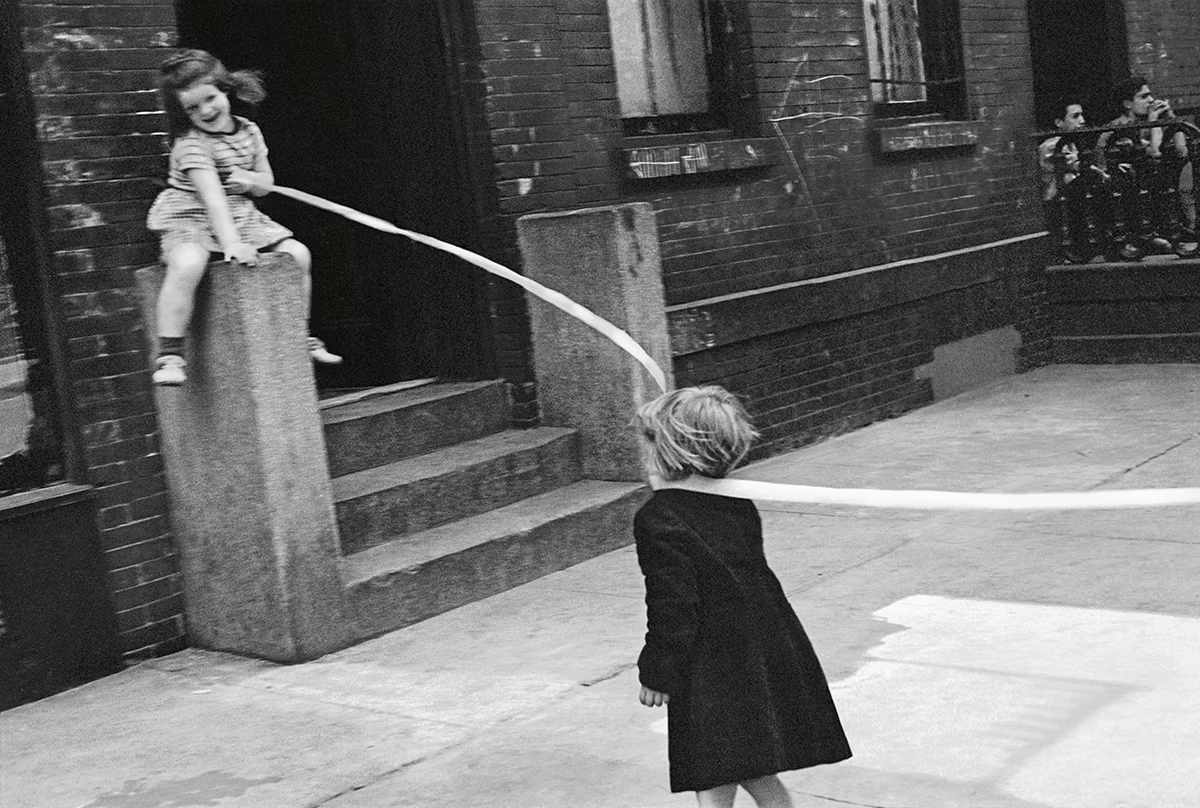
Helen Levitt’s One Two Three More is a poetic exploration of street life, revealing her mastery in capturing the spontaneous choreography of the everyday. Through her lens, Levitt documented the raw, unfiltered vibrancy of urban streets, elevating ordinary moments into extraordinary visual narratives.
A Quick Biography
Helen Levitt (1913–2009) was an American photographer born and raised in Brooklyn, New York. She began her career as a commercial portrait photographer but soon turned to the streets, finding inspiration in the everyday life of her city. In the late 1930s, she apprenticed briefly with Walker Evans and was deeply influenced by Henri Cartier-Bresson’s pioneering street photography. Helen Levitt is considered one of the first and most influential female street photographers.
Levitt’s first major break came in 1943 when her black-and-white images of New York’s streets were exhibited at the Museum of Modern Art (MoMA). Over her career, she transitioned from black-and-white to color photography, using the vibrancy of color to further enhance her depictions of urban life. Her work graced the pages of Life magazine and appeared in exhibitions worldwide, cementing her reputation as one of the most influential street photographers of the 20th century.
A Visionary of the Streets
Helen Levitt carved her place in photographic history by focusing on the overlooked details of life in New York City. Her unique approach to street photography captured fleeting interactions, moments of play, and the inherent beauty of chaos. One Two Three More is a culmination of her decades-long journey into the heart of urban existence, showcasing her signature style of visual storytelling.
Key Themes in One Two Three More
Playfulness Children dominate many of Levitt’s photographs, embodying the uninhibited spirit of creativity. From chalk drawings on sidewalks to spontaneous games, her images are a celebration of youthful imagination.
Urban Theatrics Levitt saw the streets as a stage, where strangers performed unknowingly. Her compositions often freeze interactions, gestures, and expressions that feel both candid and choreographed.
Everyday Elegance Levitt’s work transforms the mundane into the magnificent. A simple gesture, a fleeting glance, or an abstract shadow becomes art under her watchful eye.
The Power of Silence
Levitt rarely titled her images or provided context, leaving interpretation to the viewer. This deliberate ambiguity invites us to engage with her work emotionally, fostering a connection that transcends time and place. One Two Three More exemplifies this approach, creating a narrative that is universal yet deeply personal.
“The streets were her theater, and her photography was the script.” — Anonymous Critic on Helen Levitt’s Work
Levitt’s Mastery of Color and Black-and-White
While Levitt is best known for her black-and-white images, One Two Three More highlights her foray into color photography. Her color work adds a new dimension to her storytelling, capturing the textures and hues of the urban environment in ways that black-and-white could not. Yet, both styles share her impeccable timing and sense of composition.
Why One Two Three More Matters
This book is not merely a collection of images; it is a meditation on the beauty of fleeting moments. Levitt’s ability to find harmony in chaos resonates with photographers and viewers alike, reminding us of the poetry in our everyday surroundings.
Key Takeaways from One Two Three More
Be Present: Levitt’s work teaches us to observe our surroundings with an open mind and a curious eye.
Embrace Imperfection: Her photographs remind us that beauty often lies in the unpolished and unscripted.
Find Joy in the Ordinary: By elevating everyday moments, Levitt inspires us to seek wonder in our daily lives.
Conclusion
Helen Levitt’s One Two Three More is a masterpiece of street photography, blending humor, poignancy, and raw humanity. It challenges us to slow down, to look closer, and to appreciate the subtle stories unfolding around us. Levitt’s work is a timeless reminder that the streets are alive with drama, beauty, and meaning—if only we have the eyes to see it.
The phrase Inshallah (Arabic: إن شاء الله) means “if God wills” or “God willing” in English. It is derived from three Arabic words:
1. In (إن) – If
2. Sha’a (شاء) – Wills
3. Allah (الله) – God
It is commonly used by Muslims and Arabic speakers to express hope or intention for a future event while recognizing that it ultimately depends on God’s will. For example:
• “I will finish this project tomorrow, Inshallah.”
• “We will meet again, Inshallah.”
It conveys humility and submission to God’s plan, emphasizing that humans can make plans, but the outcome is in God’s hands.
Tod Papageorge’s Passing Through Eden is a profound photographic journey that captures the beauty and chaos of life in Central Park. Published in 2007, this collection of black-and-white images draws inspiration from the biblical narrative of Genesis, offering a visual meditation on humanity’s connection to nature and the enduring drama of existence.
Central Park as a Modern Eden
Central Park serves as Papageorge’s version of Eden—a place where human life unfolds in its raw and poetic form. Papageorge spent decades documenting the park, focusing on the interplay between people and the landscape. His images showcase moments of intimacy, solitude, and spontaneity, transforming the park into a microcosm of humanity.
The photographs invite viewers to reflect on the idea of paradise as both a physical space and a state of mind. Central Park, with its curated greenery and bustling life, mirrors the contradictions of Eden—manmade yet natural, serene yet chaotic.
The Influence of Genesis
The sequencing of Passing Through Eden is inspired by the structure of Genesis, the first book of the Bible. Papageorge juxtaposes his images to create a narrative flow that echoes themes of creation, fall, and redemption.
Key Themes Explored:
Creation: The park as a space where life begins and thrives, full of vitality and beauty.
Innocence and Loss: Scenes of joy and harmony are contrasted with moments of tension and separation, reflecting the duality of human experience.
Redemption: The enduring presence of nature as a source of solace and renewal amidst the challenges of urban life.
Papageorge’s biblical inspiration adds a layer of depth to the work, encouraging viewers to contemplate the spiritual dimensions of everyday life.
Photographic Style
Papageorge’s approach to photography is lyrical and deliberate. He utilizes natural light, strong compositions, and a keen eye for human behavior to craft images that feel timeless. His work often captures fleeting moments—an intimate embrace, a playful interaction, or a solitary figure lost in thought. These images transcend mere documentation, becoming visual poetry.
Characteristics of His Style:
Black-and-White Aesthetic: Enhances the timeless quality of the photographs.
Dynamic Framing: Balances the chaos of the city with the serenity of nature.
Human Presence: A focus on the human condition, blending humor, pathos, and beauty.
Legacy and Impact
Passing Through Eden stands as a testament to Tod Papageorge’s mastery of the photographic medium. The book not only celebrates Central Park but also explores universal themes of humanity’s connection to nature and the passage of time. It is a reminder of the enduring power of photography to reveal the extraordinary in the ordinary.
For photographers and art enthusiasts alike, Papageorge’s work serves as both inspiration and challenge—to see the world with clarity, patience, and wonder.
Final Thoughts
Tod Papageorge’s Passing Through Eden is more than a collection of photographs; it is a meditation on life itself. By grounding his work in the timeless themes of Genesis and setting it within the ever-changing landscape of Central Park, Papageorge creates a narrative that is both personal and universal. His images remind us that, even in the heart of a bustling city, traces of Eden can still be found.
“The park becomes a place where all the emotions of human life—love, solitude, joy, and melancholy—play out against the backdrop of nature, reminding us of both our fragility and our resilience.”
Explore Passing Through Eden and let Papageorge’s vision inspire you to find beauty and meaning in the world around you.
Dante Sisofo, a street and documentary photographer from Philadelphia, emphasizes the importance of immersing oneself in the “frontlines of life” to create meaningful art. He believes that impactful photography arises from active participation in life’s dynamic environments, driven by curiosity and a desire to authentically document the world.
Sisofo advocates for photographers to actively explore public spaces, suggesting that genuine engagement with one’s surroundings leads to authentic and compelling images. He asserts that photographers thrive by being present in the world, continuously pushing forward and embracing the unknown.
He also highlights the significance of a photographer’s mindset, encouraging a childlike curiosity and a fearless approach to capturing life’s moments. By immersing oneself in the “frontlines of life,” photographers can create work that reflects their lust for life and offers a unique perspective on the human experience.
In summary, Sisofo’s philosophy centers on the idea that impactful photography transcends technical aspects like camera type or location; instead, it hinges on the photographer’s courage and curiosity to engage deeply with the world.
The word amateur comes from the French term amateur, which itself originates from the Latin word amator, meaning “lover,” which is derived from amare, meaning “to love.”
At its core, an amateur is someone who engages in an activity out of love or passion rather than for professional reasons or financial gain. This original sense of the word emphasizes enthusiasm and devotion, contrasting with its modern usage, which sometimes carries a connotation of inexperience or lack of skill.
The etymological root reflects the idea that an amateur pursues their interests not for rewards but for the sheer joy and love of the activity itself.
What does it mean to wander? Why does it matter? As a street photographer, I love wandering. I love exploring. I love looking at homes, the architecture, the details, the trees. I love looking at life and all of its good complexities.
By wandering, I follow my intuition and my curiosity, and I simply listen to my gut. Some days I’ll walk the same mundane lane every single day, trying to hone in on repetition with my walking pattern. But then, there are periods where I like to wander, finding myself in new parts of town—new streets and alleys to explore. I twist, turn, weave around, and go aimlessly. As an artist, this is the ultimate joy in life.
Walking Without a Destination
Simply walking without any destination in mind allows me to discover new things, see new sights, and experience life in fresh ways. All of this novelty comes through the aimlessness of adventuring into the unknown. To find yourself in your hometown, or wherever you may be, with the mindset of a tourist is powerful. By remaining in this childlike state of curiosity, you can find yourself endlessly wandering.
Whether I’m here in Philadelphia or traveling abroad, I don’t like to set plans or destinations. I follow my gut. There’s an art to it—a matter of using your sensibility to guide you.
“Maybe you hear drumming around the corner, or you see a flock of birds and decide to go where they are. By following the beats and rhythms of the street, you embrace the art of wandering.”
Staying Playful and Open
Wandering is about staying playful and open, setting your body in motion without preconceived notions of what you’ll find. This is where I discover the most fruitful experiences and create the best photographs. It’s through this art of wandering, walking, and moving aimlessly that I find joy.
Benefits of Wandering
Exploration of new places
Discovery of unexpected beauty
Rekindling curiosity
Capturing unique photographs
To wander is to explore. To wander is to discover. To wander is to experience maximum joy.
The Joy of Wandering
Why do I feel more joyful while wandering? I think life is fun. Sometimes, life can feel like a bore if you’re stuck in a routine or indoors, treating life like a chore. But when you let go and let life flow toward you, you find yourself in an abundant mindset—a flow state of production, creativity, and flourishing.
Thriving in Chaos
Wandering can be dangerous at times. I’ve found myself in chaotic situations and on dangerous paths. But that’s where I thrive—in the unknown, in the chaos. As a photographer, putting order to the chaos and complexities of life is a superpower.
“Through wandering, I’ve realized life isn’t always what it seems. You might look at the mundane and think it’s all been done before, but that’s a defeatist mindset.”
Keep Moving
Keep moving.
Keep wandering.
Don’t worry about the outcome or destination.
Produce more, wander more, and experience more.
Step out your door and explore. It’s a beautiful world, a beautiful day. Whether you’re in Philly or anywhere else, there’s always something new to see. And even if you revisit the same location, the photograph you create will never be the same.
Henri Cartier-Bresson, often referred to as the “father of modern photojournalism,” revolutionized the art of photography with his innovative approach to capturing candid moments. The book Henri Cartier-Bresson: Photographer by Prestel offers a profound retrospective of his work, showcasing his genius and its enduring impact on street photography.
The Magnum Legacy of Cartier-Bresson
Henri Cartier-Bresson co-founded Magnum Photos in 1947, an agency that became a bastion for photojournalism and documentary photography. This book compiles some of his most iconic images, reflecting his philosophy of photography as both an art and a craft.
Key Contributions to Photography:
Pioneered the Decisive Moment: Cartier-Bresson’s concept of the decisive moment is the cornerstone of street photography. He believed in capturing a scene at its peak emotional or narrative impact.
Black-and-White Simplicity: His focus on monochromatic images emphasized light, shadow, and form, stripping away distractions.
Global Vision: From India and Mexico to China and the United States, Cartier-Bresson documented humanity with a universal lens.
Exploring Henri Cartier-Bresson: Photographer
This book is not just a photo collection; it’s a visual autobiography. Published by Prestel, it features images that span decades of his illustrious career.
Highlights from the Book
Timeless Portraits:
Cartier-Bresson’s portraits of luminaries like Albert Camus and Henri Matisse go beyond faces, capturing their essence.
Street Scenes:
Whether it’s the bustling streets of Paris or the serene countryside of India, his images feel both spontaneous and meticulously composed.
Historical Moments:
The book features pivotal moments like the liberation of Paris during World War II and the death of Gandhi.
The Philosophy of the Decisive Moment
Cartier-Bresson famously said:
“To me, photography is the simultaneous recognition, in a fraction of a second, of the significance of an event.”
This philosophy underscores the importance of timing, composition, and intuition in photography. He approached the camera as an extension of his vision, ready to capture fleeting moments of life.
The Impact on Street Photography
Cartier-Bresson’s influence on street photography is immeasurable. He established a framework for photographers to observe, anticipate, and react to the world around them.
Key Lessons from Cartier-Bresson’s Work:
Patience Pays Off:
Wait for the moment when composition, light, and action align perfectly.
Blend Into the Scene:
Cartier-Bresson often used small cameras like the Leica to remain inconspicuous.
Observe Without Judgment:
His images capture the truth of humanity without manipulation or staging.
Famous Quotes from Cartier-Bresson
Here are some of his most inspiring quotes:
“Your first 10,000 photographs are your worst.”
“It is an illusion that photos are made with the camera… they are made with the eye, heart, and head.”
“In photography, the smallest thing can be a great subject.”
Cartier-Bresson’s Enduring Legacy
Henri Cartier-Bresson’s work continues to inspire photographers worldwide. His emphasis on composition, geometry, and emotional resonance set the gold standard for street photography.
What Modern Photographers Can Learn:
Simplify Your Gear:
Use small, discreet cameras for greater mobility.
Study Composition:
Learn to see the world in terms of shapes, lines, and light.
Shoot With Purpose:
Every photograph should tell a story.
Final Thoughts
Henri Cartier-Bresson: Photographer by Prestel is more than a book—it’s an essential guide for anyone passionate about the art of photography. Through his images and philosophy, Cartier-Bresson teaches us to embrace spontaneity, trust our instincts, and seek beauty in the everyday.
Whether you’re a seasoned professional or an aspiring photographer, immersing yourself in Cartier-Bresson’s work is an experience that will forever change how you see the world.
Further Reading
The Decisive Moment by Henri Cartier-Bresson
Magnum Contact Sheets (a look into how Magnum photographers, including Cartier-Bresson, approached storytelling)
“The world is going to pieces and people like Adams and Weston are photographing rocks!” — Henri Cartier-Bresson
For the past two years, I’ve been reflecting on my work, transitioning from color to black and white. Looking at my photographs with some distance, I believe I’ve developed a style—a way of seeing the world. Even when I compare my old color work to my black-and-white frames, I still see my voice running through them.
This showed me that developing a voice in photography is possible, no matter the approach. But to get there, you need three things: consistency, discipline, and courage.
Focus on the Essentials
It’s easy to get caught up in gear. What camera should I use? What lens? Should I shoot film or digital? Black and white or color? All of that is noise. The real work begins when you simplify.
Here’s what worked for me:
Stick to one camera and one lens. Limiting your tools forces you to focus on seeing rather than tinkering.
Pick a direction—color or black and white—and commit. Constraints are essential for creativity.
Stay consistent and disciplined. Shoot regularly and stick with your setup long enough to develop a rhythm.
If you’re experimenting early on, that’s fine—everyone does it. But after a year of exploring, it’s time to take things seriously. Discipline will push you to grow.
The Role of Courage
When I think about what it takes to find your voice, courage is at the forefront.
“If you want to get close to life, you need the courage to stand on the front lines.”
For me, this meant getting physically close to my subjects. I’ve always been drawn to humanity’s rawness, and that closeness is reflected in my work. To do that, you have to be bold, audacious, and willing to face rejection or discomfort.
Learn from the Masters
Studying the work of great photographers shaped how I see. Here are some of the photographers who influenced me early on:
William Klein: His loose, raw compositions and visceral approach taught me to embrace imperfection.
Alex Webb: His mastery of light, shadow, and layered complexity showed me the heights street photography can reach.
Larry Towell: His closeness and integration within communities inspired me to embed myself in the scenes I photograph.
James Nachtwey: His boldness in documenting conflict motivated me to face the chaos of life head-on.
Sebastião Salgado: His adventurous spirit and ability to explore the world with a camera sparked my own curiosity to travel.
If you want to develop your style, immerse yourself in the work of those you admire. What draws you in? What resonates with you? Use these insights to inform your own work.
“You need to understand what has been done before you to know what can be done.”
Developing a style isn’t just about studying the masters—it’s about putting yourself out there. For me, that meant traveling, volunteering, and immersing myself in different cultures and environments.
Some pivotal experiences included:
Volunteering in Israel and Palestine: Living on a kibbutz, working with Palestinian families, and experiencing life up close influenced my approach to photographing humanity.
Traveling to Zambia: Spending time in rural communities gave me access to moments I wouldn’t have otherwise witnessed.
Shooting daily in Philadelphia: Practicing at home sharpened my skills and prepared me for bigger adventures.
“To create photographs that resonate, you have to be present in the world.”
These experiences taught me that photography isn’t just about light, shadow, and composition—it’s about where you choose to place yourself. Travel, explore, and let your surroundings influence your work.
The Power of Photo Books
One of the most inspiring tools in my journey has been photo books. For example, Alex Webb’s The Suffering of Light became my bible for street photography. It’s 30 years of his best work, and every time I revisit it, I find something new.
Photo books can transport you to new places and perspectives, sparking your creativity. I recommend studying the best work you can find. Ask yourself:
What makes this photograph great?
What emotions does it evoke?
What elements—light, color, composition—stand out?
Keep Moving Forward
If there’s one lesson I’ve learned, it’s this:
“Never stop moving, never stop making, never stop exploring.”
Curiosity drives creativity. It’s what pushes you to try new things, go to new places, and press the shutter again and again. I’ve been photographing for a decade now, and I’m still just getting started.
Your journey will be endless. Wherever you are in it, embrace the process.
Final Thoughts
If you’re struggling to find your style, remember:
Simplify. Limit your tools and make decisive choices.
Study the greats. Learn from their work and build on it.
Put yourself out there. Travel, explore, and stay curious.
Be disciplined. Consistency is the foundation of growth.
Be courageous. Push yourself to the front lines of life.
Finding your voice isn’t about rushing to create a masterpiece. It’s about showing up every day, pressing the shutter, and trusting that the process will lead you to something meaningful.
What’s popping people, it’s Dante! Walking around Philadelphia today, I’ve been reflecting on style in street photography. Finding your unique style is a journey, and I believe it’s more about your approach than post-processing or technical tweaks.
Style as a Way of Seeing
Many people think style is about:
High contrast black and white vs. color.
Editing choices in Lightroom or Photoshop.
But that’s not the essence of it. Style is your way of seeing the world. It’s about how you approach the streets, your subjects, and the way you interact with your environment.
Key Questions to Ask Yourself:
How do you approach your subjects?
Do you get close, or are you more standoffish?
Are you confrontational, or do you blend into the background?
What do you focus on?
People, objects, shadows, or maybe textures?
What stories do you want to tell?
Are you drawn to bustling cityscapes or quiet, introspective moments?
“Your style emerges naturally from your curiosity and how you choose to frame the world around you.”
The Process of Discovery
1. Shoot More
Take thousands of photos. As you shoot, patterns will begin to emerge in what you capture and choose to keep.
2. Curate Ruthlessly
Over time, the photos you decide to keep and cherish will define your style. Ditch what doesn’t resonate with you.
“Make 10,000 pictures and put in the 10,000 hours. Your style will reveal itself in the process.”
3. Embrace the Stream
View your photos as part of a timeline, a sequence of becoming. Don’t overthink which images go together. Let the flow of your work guide you.
My Personal Approach
For me, style is about speed, curiosity, and minimalism:
I shoot small JPEGs with high contrast black and white baked into the camera.
My workflow is streamlined, allowing me to focus on the moment rather than post-processing.
While I care about aesthetics, my style is a natural byproduct of my process. Every shot is part of my evolving photographic journey.
Final Thoughts
Style isn’t something you force; it’s something you discover. It emerges from your approach, your practice, and your perspective. So get out there, shoot relentlessly, and let your unique way of seeing the world shape your photographic voice.
“Style is not about mimicking others; it’s about finding your own rhythm in the chaos of the streets.”