February 28, 2025 – Philadelphia


Here is a link to a youtube playlist of my recent lectures on street photography and all of my work in progress blog posts. Many more to come!

What’s poppin’ people? It’s Dante. Today, we’re going to be discussing emotion versus abstraction in street photography.
I believe there’s this misconception in street photography that one must either be purely documentary-based, photographing life as it is, or a photographer who’s looking to abstract reality and create their own artistic expression.
But ultimately, one mustn’t follow one or the other to create strong photographs. I believe the best photographs synthesize the raw emotion of the subject within our frames with the abstraction of composition and form. This synthesis can elevate our photography to a whole new level.

We want to balance the best of both worlds—to create a photograph with strong form, strong geometry, but also raw and visceral human emotion that captures the essence of the street.
Where the power of black and white lies is in its ability to strip down to the basics, allowing you to focus on:
It removes the distractions of color and all the superfluous details when you crush the shadows and expose for the highlights. The aesthetics of high-contrast black and white create drama and intensity, making it the perfect medium to fuse both abstraction and emotion.

Photographing candidly is at the forefront of street photography. The best way to capture raw human emotion is to make sure moments are:
“Photograph life unposed. Photograph life in a way that doesn’t get in the way—let the emotional impact of the photograph speak for itself.”

When making photographs of expressions, ensure they remain authentic. Shoot quickly and stealthily, avoiding interference with the scene.
A small compact camera, like the Ricoh GR, makes this process easier. Since it’s so discreet, you can get closer to a scene without people noticing, allowing for raw, candid moments.

The abstraction of reality through light and shadow can add a visual impact that elevates even the most ordinary scenes. Some simple techniques to enhance this include:
“The simplest interplay between light and shadow can be enough to evoke emotional impact—without even using people within the frame.”
A photograph doesn’t need a person to convey emotion. Sometimes, light and shadow alone can be enough to create a sense of drama and mystery.

Finding the balance between abstraction and emotion is a fine line. You can achieve this balance by understanding:
A mistake I often see? Photographs that feel too cold, too distant. Sometimes, the subject is too far across the street or gets lost in the frame, making it difficult to connect with the moment.

“This is where closeness and proximity help you capture those raw human emotions.”
Get closer to the subject. Feel the beat of the street. Allow intuition to guide your framing, making your composition natural and effortless.
A master of this technique is Ray K. Metzker. His approach to deep shadows and exposing for highlights is the perfect example of blending abstraction with human presence.
Metzker mastered the art of abstraction in street photography and is a great reference for combining abstraction with human emotion.
Take a look at some of his photographs:


Metzker’s work is a foundation for studying how to integrate abstraction and emotion into our photography.
Here’s how I apply these ideas to my own work:
Even without a human subject, these techniques create mood and emotional impact, proving that abstraction can be just as powerful as raw human expression.


Yes! While I focus heavily on high-contrast black and white, it’s possible to blend abstraction and emotion in color photography as well.
For example:


The interplay between light and shadow still works in color—it just takes a more refined approach.
“Shooting high-contrast black and white is the simplest solution for abstraction, but color can work if handled carefully.”
If you want to experiment with abstraction and emotion in your own photography, try these techniques:


“Photography is not about depicting reality—it’s about showing what life could be. Create your own version of reality.”
Street photography is about playing, tinkering, and experimenting. There’s no need to strictly document the truth. Instead, find your own balance between abstraction and emotion.

Go out there. Explore the unknown. Make your own world through the camera.
If you want to see Ray K. Metzker’s work, I have a flip-through on my YouTube channel. Check it out in my photo book playlist—it’s a great foundation to build upon and understand the masters.
Thanks for reading. Now go out there and shoot! Peace.
How can we break the rules? And when should we break the rules?
I believe that in order to break the rules, one must have a free mind—a free spirit, someone who isn’t limited by dogmas, beliefs, or traditions. Ultimately, there is no 1-2-3, ABC formula on how to practice street photography. One must develop their own game to play when out there on the streets.

Consider the way in which you consume, produce, and publish your photography. Are you using Instagram? Are you limited to the four corners of a box?
You see me here in the mirror, reflected back within the four corners of that box. It reminds me of the mental blockage these platforms like Instagram create—trapping you in a grid.
“Delete your Instagram. Get off of these platforms that trap you in a box.”
Since I deleted my Instagram, I’ve been experimenting, playing, tinkering—not taking things too seriously, which is allowing me to break the rules intentionally.

Composition is important, right? It’s the foundation of a photograph. But in street photography, the raw emotion of the street should take priority.
“In order to break the rules, one must learn them first.”

I don’t want to promote lazy photography. I want you to:
Every photographer should be able to articulate the chaos within the frame and bring order to the moments within a composition. If you don’t know the rules, how can you break them?
Once you understand the rules, you can break them with purpose. Here are some of my photographs from over the past decade—from Philadelphia to Jericho, Naples, Zambia, and Mumbai—where I’ve broken the rules intentionally.
By experimenting with high contrast black and white, I focus on:
“Street photography—life itself—is imperfect. Perhaps embracing imperfection as perfection is the way forward.”
Sometimes the most chaotic scenes can be the most powerful. They may break traditional compositional rules—things might be cut off, moments may feel wonky—but the emotion is what matters.
“The best street photos aren’t perfect. They just feel right.”

I’ve been studying Japanese photographers like Daido Moriyama, who use imperfection as a strength—prioritizing feeling over clarity, challenging what “good photography” means.
By studying their work, we gain a better understanding of how to:
“To push the boundaries and break the rules, one must have the tools under their belt.”
Composition is intuition. The best photos aren’t planned—they happen in the moment. So:
“The blur, the grain, the overexposure—these things can actually add depth and intensity.”

Photographing nuns giving out pamphlets in a church, I intentionally used motion blur to capture the raw energy of the scene.

In Queens, New York, I shot an overexposed scene—focusing on the moment rather than perfect exposure. The grit and grain in the frame enhanced the emotion of the street.

In a Parisian café, I focused on a woman sitting alone. The composition wasn’t “perfect,” but the emotion was real. The scene became a mix of chaotic elements that formed something uniquely powerful.
I use the Ricoh GR III with high-contrast black-and-white JPEGs baked in. My technique:
This allows me to experiment with exposure quickly and achieve unique effects.
“By exposing for the shadows, I can create something visually interesting and impactful through experimentation.”

At the end of the day, there is no 1-2-3 method to this. Intuition is more important than any formula.
“Don’t be afraid to make mistakes, fail, and break through the process of breaking the rules.”
This is the beauty of street photography—there are endless ways to photograph. So go out there, break the rules, and evolve.

I’m constantly experimenting, evolving, and pushing myself beyond the basics. Breaking the rules is about freedom, intuition, and play.
“There are no rules, no guidelines in street photography. And that is what makes it the most liberating medium.”
Go out there, explore the unknown, and break the rules intentionally.
Peace.
Instead of differentiating ourselves through individualism based on our ethnicity, political beliefs, sex, religion, ideology, etc. why not recognize what makes us more similar than different?

For instance, we all have:
We are all flesh creatures, bound by gravity. We all cut, bleed, feel joy, rage, and sorrow.
Our bodies are ancient, with divine design, but we live in a modern society, with god-like technology, that separates us. It’s very easy to identify people by what makes them different. It’s very difficult to humble yourself and recognize the simple fact that we’re all the same.
What’s poppin, people? It’s Dante. Today, we’re going to be discussing the geometry of street photography.
I’ve been practicing street photography for the past decade, traveling the world, and I’ve mastered the art of composition. And I’m really eager to share some of my advice and tips with you, because I believe a lot of street photographers struggle with composition.
Composition often comes second when we’re on the streets—it’s chaotic, unpredictable. But in order to create stronger photographs, one must synthesize content with form. Life is out of our control, and it’s difficult to put order to the chaos within the frame. However, through practice, persistence, and repetition, we can improve our composition.

Ultimately, composition derives from intuition—that gut instinct when you press the shutter. It’s an intuitive practice. As much as we have two eyes that allow us to perceive the world with sharp visual acuity, the photograph is a result of our instincts.
“The moment you press the shutter derives from your gut. Let your gut instinct guide your compositional decisions in the moment.”
Take this scene in Jericho: climbing the Wadi Qelt mountain range with a group of Palestinian men, the car broke down, and I had to respond quickly. I saw the scene as a visual problem to solve—foreground, middle ground, background. I included the car in the foreground to fill one-third of the frame, breaking up the image while adding depth and visual interest. That small decision transformed a flat moment into an elevated photograph with shape and form.
Street photography is like solving a visual puzzle. You respond quickly, recognize patterns, and make compositional decisions in the moment. There are two approaches:

For example, at a bus stop in Philadelphia, I was intrigued by light and shadow play. But what anchored my composition was a circular sign on the left-hand side. That first compositional decision dictated how the middle ground and foreground aligned. I waited for a man to enter the frame, and at the instinctual moment, I pressed the shutter.
“Position and perspective determine the result of the photograph. The photographer is responsible for where they position their physical body in relationship to the moment and the background.”
By dropping to a low angle, you can dramatically alter composition, making the form and gestures clearer and more impactful.
I believe a great composition is easy to read. When composing a scene, I think about:

Take this moment in Zambia, where I woke up early to catch the sunrise with my host brothers. I was drawn to my host brother, Bob Boaglia, playing against the wall, casting a shadow. To make the composition more interesting, I included a hand in the foreground, adding depth and layers.
“When you see the world as shapes, you begin solving the visual puzzle intuitively.”
By using triangles and leading the viewer’s eye through the frame, you create a visual feast.

A good composition guides the viewer’s eye through the frame. Using triangles and vanishing points, you can create visual rhythm in an image.
In a scene outside a Palestinian mosque, I photographed two men sharing a moment. But instead of just focusing on them, I filled the background with a third element—a man smoking a cigarette. Now, the viewer’s eye moves left to right and back again, making the image more dynamic.
At a beach in Napoli, I used watermelon as a visual anchor while working back to front. By filling the frame with layers, I created a spiral composition, where the eye follows the watermelon, the men, and the sea.
“Leading lines and vanishing points add depth. They guide the viewer’s eye to something visually interesting.”

The rule of thirds is a fundamental tool, but it should be used intuitively. In Jericho, I framed two boys on opposite thirds, naturally following this rule. But I didn’t think about it—I felt it.
“The rule of thirds isn’t a law—it’s a guide. Composition should be intuitive.”

On the flip side, centering a subject can be just as powerful. In Bandra, Mumbai, I photographed a mother and daughter playing. By centering them, I emphasized the symmetry of the hands, flowing hair, and circular wheels in the background.
One of my favorite techniques is using natural frames—doorways, windows, mirrors—to contain the subject within the composition.


By framing your subject, you create visual impact and lead the viewer’s eye directly to the focal point.
“Composition derives from intuition. You must be present in the moment, not overanalyzing every decision.”
A playful attitude is essential. I don’t take myself too seriously when I’m out shooting—I respond intuitively. For example, in a refugee camp in East Jerusalem, I was initially drawn to the light and color of a watermelon stand. By waiting and being present, I captured the moment when a man lifted a watermelon onto his head—a perfect decisive moment.
Patience and fluidity are key. Sometimes the best moments occur when you let go of control and embrace the spontaneity of the street.
Street photography is about positioning yourself in relation to the world. It’s about synthesizing content with form and making split-second compositional decisions.
Take, for example, a golden hour scene at Bandra Fort, Mumbai. Observing the way birds flew through the geometric forms of the fort, I worked back to front, anchoring my composition with a man at the window. Then, I waited for the perfect moment—a bird flying through the frame—to complete the visual puzzle.

“When you recognize the world as shapes, you start making these relationships intuitively.”
So, go out there, train your eye, trust your intuition, and practice daily. Street photography is a game of patience, persistence, and presence.
What’s poppin, people? It’s Dante. Today, I want to break down some ideas about composition in street photography, specifically discussing content versus form.
In street photography, life is out of our control. There are so many spontaneous elements out in the world that we want to combine to make a picture—someone jumping over a puddle like Bresson, a boy and his mother sharing an endearing gesture, or the classic image of a man smoking a cigarette. These are the tried-and-true decisive moments we chase on the streets.
“What makes or breaks a great street photograph is whether or not the content, the moment, is synthesized efficiently with the formality of composition.”
We can debate whether form is more important than content, or vice versa. Ultimately, in street photography, content tends to take precedence. However, to become the best street photographer possible, you must synthesize both content and form.

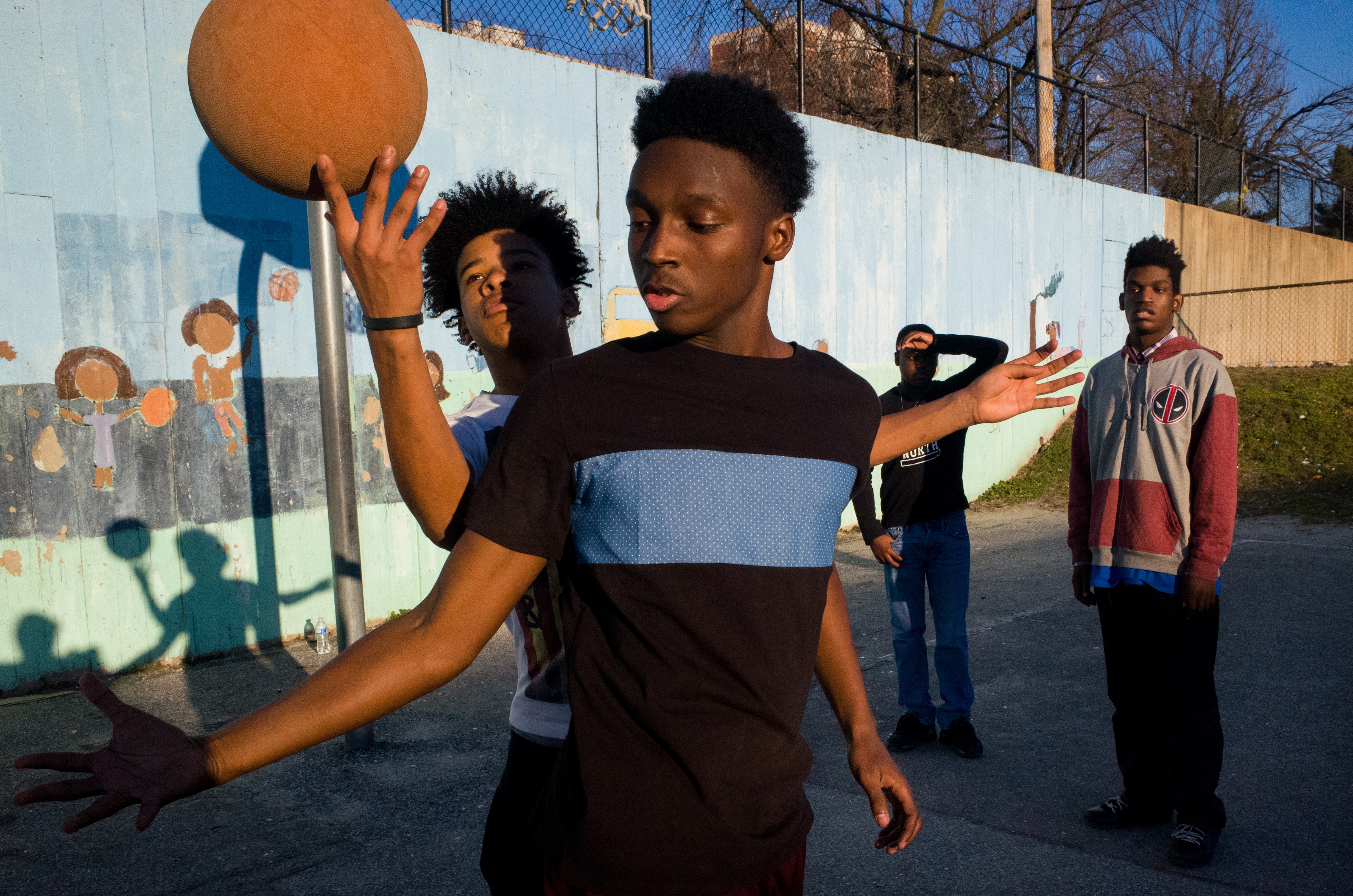
Street photography is about putting order to chaos, which is difficult to achieve. Take, for example, a scene of basketball in Baltimore:
I relate the moment of the boy playing in the fountain to the decisive moment unfolding, while also being hyper-aware of the background. This awareness of positioning creates a cohesive and visually engaging image.

“A lot of street photos fall flat because they lack an awareness of form and shape.”

In Rome, I once captured a moment featuring a hand gesture that stood out. But I didn’t just capture the hand; I positioned it formally on the right side of the frame, allowing the left side to be filled with two nuns. This synthesis of content and form creates visual harmony.
When I’m on the street, I don’t just take a picture and move on. I sense the possibility of a photograph, observing how to relate the subject to the background.
Example: In Philadelphia, at a bus stop scene:

“Being aware of the formality of composition allows you to create visually engaging and emotionally impactful images.”

Finding strong content isn’t enough—you must also set your stage and be patient. In a busy market in Mexico City, I noticed too much chaos, so I narrowed my focus to a colorful mural. I used light and shadow to create a formal backdrop and waited for the right moment to walk into the frame.
Key takeaways:
“We are responsible not just for reacting with intuition but for sensing the potential of a photograph.”
Ultimately, the goal is to combine content and form seamlessly, responding quickly to the moment while ensuring a visually compelling composition.
Practical tips:
This is just a quick dive into my thoughts on content and form in street photography. We’ll dive deeper into dissecting more images in the future—until then, stay observant and keep shooting.
And do this every single day for the rest of your life? 
The word phototropism comes from the Greek roots:
• “photo-” (φῶς, φωτός) meaning “light”
• “tropism” (τροπή, tropē) meaning “a turn” or “a turning”
Thus, phototropism literally means “turning towards light.” It refers to the growth movement of plants in response to light direction, typically seen in stems bending toward a light source. The term was first recorded in scientific usage in the late 19th century.

Street photography is about more than just capturing a single decisive moment—it’s about developing a sharp instinct for recognizing patterns, anticipating movement, and positioning yourself at the right place at the right time. Repetition is what builds that instinct.

“The more you repeat the same pattern, the more opportunities you create for something extraordinary to happen.”
The streets are unpredictable, but by walking the same routes, revisiting locations, and shooting consistently, you start to see how the city breathes. This rhythm allows you to be in sync with the movement of people, the changes in light, and the hidden moments that would otherwise go unnoticed.

Street photography thrives on patterns and predictability. The more you frequent the same locations, the more attuned you become to the daily rituals and behaviors unfolding around you.
By embedding yourself in these environments, you start noticing the subtle shifts in daily life—the way people gather, the flow of traffic, or the interactions between strangers. These patterns provide you with a deeper understanding of your surroundings, helping you anticipate moments before they happen.
The unpredictable nature of the street means that you can’t control everything—but you can control how prepared you are.
“The street and life are out of our control. We are only responsible for where we position ourselves with the camera and when we press the shutter.”
This means:
For weeks, I photographed the pigeons interacting with the William Penn statue atop City Hall. I noticed how they moved at different times of the day and how light changed their appearance. One day, I saw a perfect alignment—the pigeons in flight, the beam of light, and the silhouette of Penn.
This moment didn’t happen by accident—it happened through repetition, patience, and observation.


Repetition doesn’t just help you recognize patterns—it strengthens your ability to trust your gut.
Your gut feeling—the instinct to press the shutter at the right time—is something that only gets sharper through repetition.
Think of photography like weight training:
“The more you walk, the more you see. The more you see, the more you photograph. The more you photograph, the more you learn. The cycle repeats.”
Even if you have just 30 minutes on your lunch break or while commuting, bring your camera and shoot. The key is to be consistent. Just like going to the gym, progress is made by showing up every day—even on the days when you don’t feel inspired.
Repetition isn’t monotony—it’s an invitation to dig deeper. By consistently showing up, you increase your chances of capturing something remarkable. Every street photographer knows: luck favors the persistent.
In Philadelphia, I made bus stops my training ground for layering techniques. I studied when people arrived, where they stood, and how they moved. Over time, I learned the perfect angles and compositions, using the waiting passengers as key subjects.
By going back again and again, I could anticipate moments before they happened, creating more dynamic and structured photographs.
Photography isn’t just about being in the right place at the right time—it’s about training your eye for composition. Through repetition, you start to instinctively:
There’s something powerful about speaking a photograph into existence.
When I set out to capture a rainbow in Logan Square, I affirmed my vision out loud. I told myself: “I’m going to photograph the rainbow, and I’m going to capture someone leaping in front of it.” I walked the scene for hours, observing how people interacted with the space.

And then—it happened. Someone jumped at the perfect moment, and I got the shot I envisioned.
Repetition is the foundation of great street photography. It:
The more you shoot, the better you become. The more time you spend walking, observing, and clicking the shutter, the more success you’ll have. Photography is a lifelong pursuit, and the path to mastery is paved with repetition.
So go out there. Walk the same streets. Press the shutter. Again. And again. And again.
Your best photograph is always the next one.
free downloads, feel free to take my photo, print it out, hang them on walls in your classrooms, do whatever you want with them! I’ll make sure to get my archive available with full res downloads soon

Your name, Dante Sisofo, in Italian pronunciation would be:
DAHN-teh SEE-so-fo
• Dante is pronounced “DAHN-teh” (with a short, crisp “teh” sound at the end, not “day” or “dee”).
• Sisofo is pronounced “SEE-so-fo” (each syllable is clear and distinct).If you want it to sound authentically Italian, make sure to keep the vowels pure and avoid anglicizing it.

If all the land in the world has been conquered, all the roads are paved, and there are no good reasons to go to battle, maybe we should just conquer ourselves.
Our thoughts shape our reality.
If we tell ourselves that we’ve seen it all, done it all, and learned it all, then what more is there to life after all? I feel like because we have the Internet, iPhones, and unlimited information, entertainment, and technology, we like to think that we’ve seen it all or just know it all. I can tell you that this is not how I think.
I seek to forever be a student of life, an adult with a childlike spirit and an open heart and mind. Honestly, my main goal in life is to just never miss another sunrise again.
Why?
I believe being eager for the sunrise goes hand in hand with curiosity. Each day, when the sun rises above the horizon, I remind myself how infinite the possibilities in life are. I think about all of the questions I have, how much there is left to do, to explore, and to understand. There’s not enough time in the day to figure it all out, but I know that when I’m awake in the morning with my eyes wide open, and the sun is coming up, I have another chance—another opportunity to try to figure some stuff out.
Everything I’m working on is simply a work in progress. I think a lot of artists seek to create the perfect masterpiece, to get things to the point where they no longer need to work on it or finish a project. The thing is, nothing is ever complete, nothing will ever be perfect or finished how you want it to be. I think recognizing this idea is very empowering and will help any artist out there who ever feels burnt out.
For instance, I’m currently going through years and years and years of photographs, and it’s very daunting. I could never finish this project if I didn’t allow myself the idea that it will never be finished. I could put the photos in a book, sequence it how I desire, and even then, I’ll always look back at it as imperfect or incomplete, as there will always be something I could tweak to make it better or improve it.
Because of this, perhaps embracing this notion that everything is a work in progress is empowering. This idea gives me the freedom to continue pushing, to continue doing and creating, because I know that I can always come back and refine things. Nothing will ever be complete. Nothing will ever be perfect. Everything in flux!
Freedom is the elimination of choice.
For instance, when I walk along the Schuylkill River Trail here in Philadelphia, there’s only one path: onward. All the decisions to make have been removed because, when you think about it, you can only go forward or backward. This is where I thrive—on a path like this, moving my body onward, endlessly. If I move to the left, I’ll freeze to death after I fall into the river. If I move to the right, I’ll get hit by a car and die in a tragic accident.
Eliminating the decision of whether or not I want to go left or right, I feel free to continue moving, upward, and onward toward the cliffside behind the Philadelphia Museum of Art, where I can stand on top of the city, look out toward the horizon with a panopticon view of my surroundings, feeling abundance and power. When I look out at the skyline and the river, I have this childlike spirit that just wants to come out and play, and embrace the day with curiosity.
When you wake up in the morning with this child spirit and you’re just eager to go out there and explore and create and do and think and tinker with life, it can become overwhelming as an artist, knowing the amount of possibilities and choices you can take each day. Because of this, I like to stick to a very disciplined lifestyle. For instance, waking up in the morning and deciding what you want to wear and what kind of coffee you want is a choice. This choice is something I completely eliminate the night before I go to sleep.
The night before I wake up, I already have my clothes laid out for the day, so that when I get out of the shower in the morning, I can slip right into what I need and go straight out my door. Actually, before I go to bed, I even pre-prepare four espresso shots and leave them in my fridge so that when I wake up, I can take four shots and just move on with my day. Even though making espresso is really fast, especially when you have a machine, it’s actually taking up way too much time in my morning. I just want to get that energy boost and move on.
For me, the goal is simple: to get myself outside, to get under the sunrise, and to start moving right away.
When I arrive at work, I go to a corner in the greenhouse where I do some yoga stretching and align my body for the day. This is one of the most important parts of my day, especially when it comes to stretching my legs, as I’m always on my feet and moving throughout the day. Because of this, I prioritize this immediately. While I’m working, I’ll listen to lectures from the Peterson Academy, which is absolutely fantastic, and I highly recommend. I’m currently taking the courses on biology.
On my break, and during my lunch, I always make sure that I go for a 30-minute walk around the trails in the woods to read a book. When I read, I prefer to read while walking outside, and I will sometimes even read out loud to myself.
Eliminating breakfast and lunch is another choice that simplifies my life. By fasting throughout the day, I’m not thinking about what I need to eat or what I desire to eat. The night before, I simply have my meat thawed, ready to go in my fridge for when I come home to cook on the stove, throw in the oven, or slow cook. The carnivore diet is an elimination diet, removing all carbs, sugars, vegetables, etc. It has simplified my life so that I know all I need before I go to sleep is a few pieces of meat and I’m good to go. I treat food like fuel, and it sure as hell does the job.
One huge and very big decision that I’m very proud of, and I encourage you to do as well if you’re interested, is to stop going to grocery stores. Just go to a local farmer and buy meat in bulk. I’ve been buying from an Amish farmer recently, and I store all of my meat in a deep freezer at home. The meat tastes 1,000 times better and it’s just a much better way to go about this thing. Just think—you only ever have to go out there and buy food maybe four times per year. Eliminating all of these very small decisions to make when it comes to the food I eat, I feel so much more free and light.
Another choice that I eliminated is car ownership. I don’t desire or want to own a car. Living in the city, there’s really no need to own one. I can walk, take the bus, or Uber if I really want to go somewhere. I just love having the option and the freedom of movement that comes with not owning a car. My goal is to actually own as little as possible. A car is just a headache and something that will suck up your money.
In terms of investments and money, it seems foolish to diversify. When you figure out that the best place in the universe to store your time and energy is Bitcoin, why would you even store your money in a bank account? Fiat currency will lose its purchasing power each year, and it’s probably most wise to store money in hard money, digital gold, digital capital—in Bitcoin—that outperforms every other asset. Once you figure out what Bitcoin is, there’s no going back. You just go all in, eliminating all decisions to make when it comes to investing and saving money.
As photographers, we often get caught up with the point of photography—why we photograph, or what we’re photographing, and what it all means. We think about what the project or theme and topic should be. But what if I were to say that you just need to go out there and make more photographs?
What if your ultimate aim and goal was to simply archive your town, and to have documents that show proof and existence of your town in the future? My goal is to make an archive, to continue pushing the boundaries, and to continue photographing in an artistic way that not only makes the photographs that showcase where I was and where I am, but also how I feel about where I was and how I perceived where I am. I believe that the archive is a much more open-ended and liberating goal to strive toward because it’s simply endless.
Think of Eugène Atget and his documents of Paris and how he photographed a number of different subjects. He didn’t just pigeonhole himself to one way of photographing, but he photographed the entirety of Paris and left these documents behind that, to me, evoke the essence of street photography. This is where I get my direct inspiration. Not to mention, Paris and Philadelphia have a very interesting connection and are practically the same city in terms of layout, architecture, etc.
I like to think of a photograph as a thought. A thought is something that comes to you very suddenly, spontaneously, and is also something that is forever fleeting. However, when a thought arises, you might seek to write it down, to remember that idea, to come back to it on a later date.
A photograph is similar in this way. As I’m walking and moving and recognizing life, a spontaneous moment might arise that I photograph. That photograph is like a thought, an idea, something that comes quickly, something that comes randomly, but I make sure to take a note of it and come back to it later.
I’m starting to really understand the power of mindset and how it can fuel you on your everyday journey of life.
Every morning, I’ve been starting the day off with a simple prayer, and a moment of gratitude for the day. By uplifting my spirit with these positive thoughts, and considering the things that I’m most grateful for in life, like the simple fact that I have another day to wake up and catch the sunrise, and move my two legs and stand upright, have clean water and a piece of meat before I go to sleep, listening to the sound of birds chirping, and observing the chaos of city life, I’m fueled with abundance and this mindset that sets me up for success each day.
There’s a famous quote from the Book of Matthew where Jesus is giving his sermon on the mount:
“Seek, and you shall find. Knock, and it shall be opened to you.”
When you approach the day with gratitude and prayer and this divine connection to God, you are on the path to seeking truth. When you are open to divine guidance, when you are open to God entering your life, when you knock at the door of prayer, you are seeking intentionally through the pursuit of growth, knowledge, and curiosity. By setting the day up this way with prayer, I lead the day with purpose, reminding myself that the answers I’m looking for will come through faith.
The notion of faith is much more interesting to me than hope, as hope is something that you can maybe just brush off or use as an excuse that you’re hoping or wishing for something more. But having faith is having conviction, and is a much more powerful mindset.
Nothing can break my spirit with a camera in hand.
The power of photography lies in the ability for the individual to give their life deeper meaning. When you make a photograph, you are affirming life. When you go out there, and you make more photographs, you’re conquering yourself through the act of creation.
Creating a flow state of walking and observing life’s patterns and complexities is an experience that becomes very meditative. When you slow down and you let life come toward you, and you just keep moving your body onward, endlessly, life will deliver you beautiful gifts. These beautiful gifts will be everlasting memories that you cherish in the photographs you make.
If you’re out there in the world, and you have no direction, turn to your camera as a compass. For the camera and curiosity will lead you, guide you in life, and find yourself in situations that you can only dream of. It’s like a key that unlocks the door, and all you need to do is pick it up and start knocking. Chip away each day, and photograph in the spirit of play. Recognize the power you possess as a creator, wielding light as your medium, creating upon the world—our canvas—and making more photographs in this open, honest, and joyful spirit.